1-Visitor
June 20, 2018
Question

bode plot transfer function? mathcad prime4
  • June 20, 2018
  • 3 replies
  • 6513 views

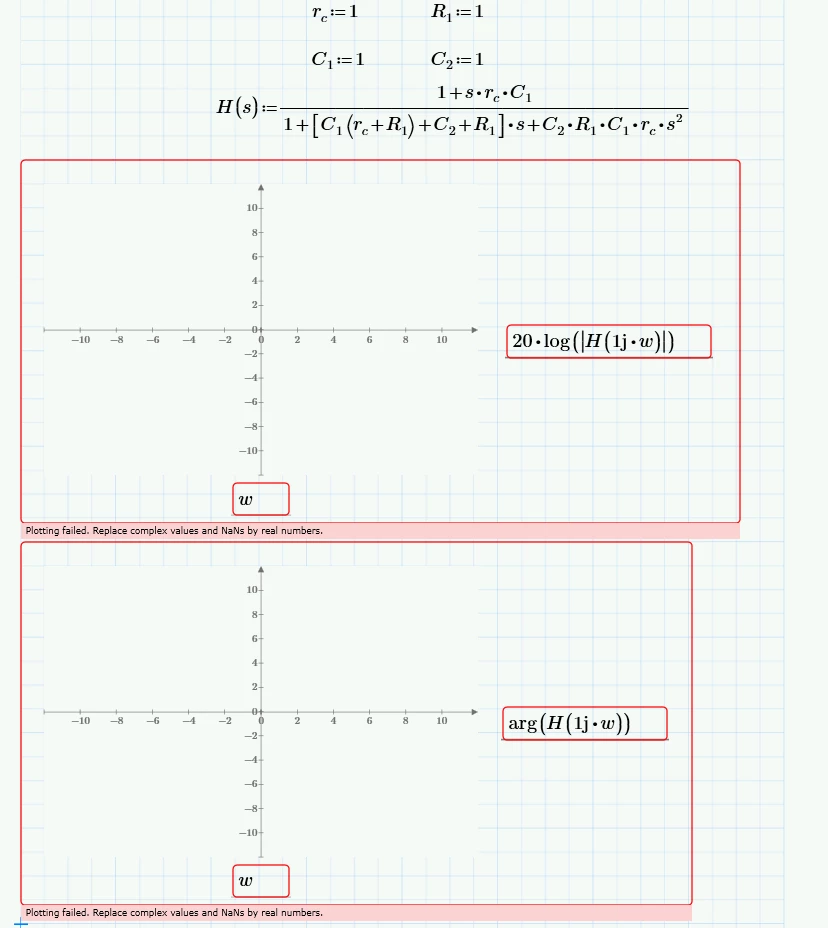
Skärmklipp.PNGI'm trying to make a bode plot, what am I doing wrong? and how should I do?

    3 replies

    23-Emerald I
    June 20, 2018

    Dunno!


    Attached is your sheet redone in Prime 3.0, with results  (should be readable using 4.0)

    25-Diamond I
    June 20, 2018

    @aingemarson wrote:
    I'm trying to make a bode plot, what am I doing wrong? and how should I do?

     Its hard to impossible to debug a picture. So you should provide your Prime sheet.

    Chances are that you had defined omega somewhere above the calculations you show.

    So you may decide to redefine omega as a range similar to what Fred had shown or use a differently named variable for plotting.

    23-Emerald IV
    June 20, 2018

    Please attach your worksheet, not just a picture!

    You've probably typed C1(rc+R1) instead of C1*(rc+R1). Now Prime tries to evaluate the function C1.

    Or did you define w somwhere upwards?

    LM_20180620_Bode.png


    Success!
    Luc

    23-Emerald IV
    June 20, 2018

    Ah, so you did type C1(... instead of C1*(...


    Luc

    25-Diamond I
    June 20, 2018

    Luc's guess was correct - you wrote a function call C1(rc+R1) instead of a multiplication C1*(rc+R1).

    But there is a second error, too, which will make your phase plot fail. You typed square brackets [] instead of parentheses (). Square brackets mean that you create a matrix/vector!

    Correcting these two errors, maybe adding a range variable  to select the frequency range for plotting and use a log scale should give you the plots you are looking for.

    BTW, you can create a true omega if you type a w and then Type Ctrl G.

    B.png

    21-Topaz II
    June 20, 2018

    rc * C1 is a time constant, i.e. it has the dimension of a time (second). The complex variable s can be defined as a complex angular frequency (pulsation) with dimension second ^ (- 1).

    So s * rc * C1 is dimensionless. This must also apply to the denominator. It does not have a physical meaning to add a resistance to a capacity ... so the denominator must be (C1 * (rc + R1) + C2 * R1) s + C1 * C2 * rc * R1 * (s ^ 2).

    aingemarson.jpg