ttokoro
21-Topaz I
21-Topaz I
April 27, 2025
Solved

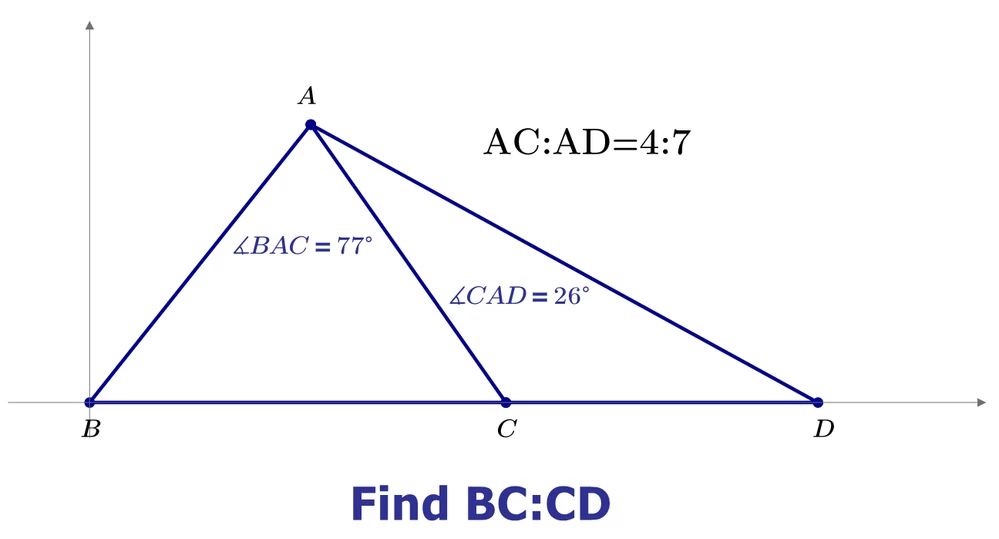
Find BC:CD

  • April 27, 2025
  • 4 replies
  • 2127 views

Find BC:CD

image.png

Best answer by AlfredFlaßhaar

A memory from school days :-):
Since only the aspect ratio is sought, the choice of the line lengths denoted by the ratio 4/7 is irrelevant – this is a problem of so-called similarity geometry. In all situations similar to the given geometric structure, the same ratio results in the solution. Therefore, with the help of a calculator, paper, and pen, choose AC and AD in the assumed ratio ---> BC/CD = 1.333...
Perhaps there is a clever solution using reflection/symmetry that doesn't require any calculations. I'll have to puzzle it out.
4 replies

15-Moonstone
April 27, 2025

A memory from school days :-):
Since only the aspect ratio is sought, the choice of the line lengths denoted by the ratio 4/7 is irrelevant – this is a problem of so-called similarity geometry. In all situations similar to the given geometric structure, the same ratio results in the solution. Therefore, with the help of a calculator, paper, and pen, choose AC and AD in the assumed ratio ---> BC/CD = 1.333...
Perhaps there is a clever solution using reflection/symmetry that doesn't require any calculations. I'll have to puzzle it out.
25-Diamond I
April 27, 2025

I can confirm your result, but unfortunately Mathcads symbolics is not able to simplify it to 4/3 which probably is the exact result.

And I am pretty sure that @ttokoro  will provide a very basic and clever geometric solution without much/any calculations 😉

Her my brute force attack in MC15

Werner_E_1-1745750111637.png


25-Diamond I
April 27, 2025

Werner_E_1-1745756167670.png


Let's consider the angle symmetry w of angle CAD.

Because 77° + 13° = 90°, it is at right angles to AB.


Now, if we reflect point C across w, we get point E on the line segment DA.

CE is therefore parallel to AB (both are perpendicular to w).


Now draw a parallel to BC through point E and intersect it with BA at point F.


If we choose AC=4 and AD=7, then AE=4 and ED=3.

The triangles CDE and FEA are similar triangles, so because FE=BC, we get the ratio

FE:CD = BC:CD=AE:ED=4:3

//.

25-Diamond I
April 27, 2025

Ooops, OK, a much easier and more straightforward way is using the intercept theorem.

Lets construct point E as described above which intersects the line AD at the ratio 4:3.

Because AB and CE are parallel it follows immediately that BC:CD = 4:3


Werner_E_0-1745763038414.png


14-Alexandrite
April 28, 2025

I think if you catch that angel BAC + half of angle CAD = 90°, like @WernerE did, an answer without brute force becomes apparent pretty quick.  I did not catch it myself—I tried the brute force with sine laws and got 1.33333.  I could not simplify my equation to something elegant.

SPaulis_0-1745852507326.png


25-Diamond I
April 28, 2025

Looks like old Mathcad 15 with muPad is a bit more capable here

Werner_E_0-1745855831997.png


Prime 10.0.1.0:

Werner_E_1-1745855890862.png


Maybe  applying the special relationship between the two angles can help ...

Werner_E_2-1745856424792.png

Disappointment!

So lets manually apply some double/half angle rules

Werner_E_3-1745856621278.png

Heureka! Now even Prime is able to finish the job!

It even works symbolically without assigning values for CAD and AC:AD

Werner_E_4-1745856713611.png

So it seems that Prime's Symbolic doesn't know all that much, but it obviously at least knows the relationship

Werner_E_5-1745856935913.png

and therefore can simplify

Werner_E_6-1745856956881.png

Nonetheless its much simpler and straightforward in real Mathcad

Werner_E_0-1745857582233.png


But one should not give up hope - perhaps one day Prime will also grow up and be more or less on a par with good old Mathcad. After all it's been less than 20 years since Prime 'replaced' Mathcad as the successor. 😉


14-Alexandrite
April 30, 2025

@Werner_E but there is no reason to simply to your last ratio, although elegant.  This solution is dependent on enough input geometry so that simple sine laws are sufficient.  The uniqueness of this problem is to catch what you did originally, that " angel BAC + half of angle CAD = 90° ", so that you didn't need to do any math.  If anyone changed the input parameter angle BAC (i.e. length BC), it would be a simple high school geometry problem to practice the sine law.  The issue I have is that this problem doesn't really promote the effectiveness of Mathcad because you came up with the 'elegant' answer in like... 10 seconds!  This is more like an IQ testing question where you'd fail if you 'had to' pull out your calculator. 

You had me at "Let's consider..." 😉

ttokoro
21-Topaz I
ttokoro21-Topaz IAuthor
21-Topaz I
April 30, 2025

Thanks all how to solve this puzzle by Mathcad.
image.png

t.t.
25-Diamond I
April 30, 2025

I see that D, A and E are collinear and that BC=BE. Basically ABC is mirrored at AB.

But I can't see the answer BC:CD=4:3 in your picture ....???

Of course, it's quite possible that I'm simply blind and can't see the wood for the trees.... 😞

ttokoro
21-Topaz I
ttokoro21-Topaz IAuthor
21-Topaz I
April 30, 2025

D, A and E are collinear so the area of Triangle BED is divided by S(B,D,A):S(B,A,E)=7:4.

ABC is mirrored at AB to ABE. So, S(A,B,C) is also 4. Therefore, S(A,C,D) is 7-4=3. 

B, C and D are collinear so the area of Triangle ABD is divided by S(A,B,C):S(A,C,D)=4:3. Therefore, BC:CD=4:3.

Using both area and line length rasio of triangle with same hight is the tips. 

Tokoro.

t.t.
