
11-Garnet
August 8, 2015
Question

How to retrive an eigenvector connected to its eigenvalue

  • August 8, 2015
  • 1 reply
  • 5119 views

I am still using MC v.11.x.

From a matrix I needed to extract the eigenvalues and eigenvectors, and re-order them (starting from the eigenvalues) in a decreasing manner. Accordingly I needed to change column order to the eigenvectors, so they correspond to the new order of the eigenvalues. I used the function eigenvec(M,z) for this. Yet without success.

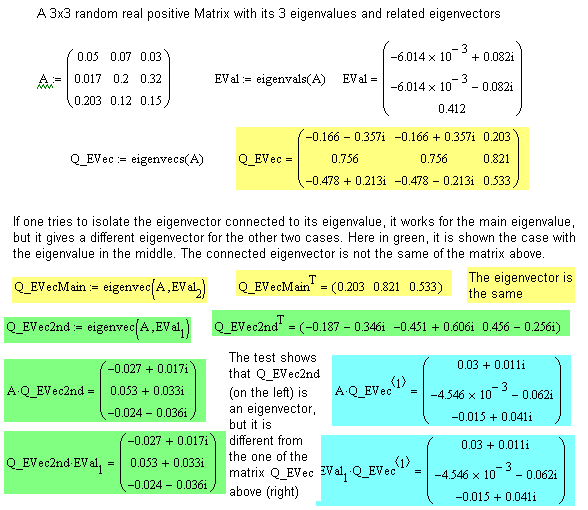
The Figure I hope explains the problem, in its essence (there is no re-ordering here). It shows that the connected eigenvector to its eigenvalue (captured with "eigenvec" function), is not the same of the one that appears in the function "eigenvecs(M)".

I understand (or  to say better, I realized, see the Figure) that the same eigenvalue may have multiple eigenvectors. But now:

     1. How can I extract the same eigenvector that appers in the "eigenvecs" function, by recalling its own eigenvalue?

     2. And more in general, is there a way to see the multiplicity of eigenvectors connected to a given eigenvalue?

Thanks.
multiple_eigenvectors.png

1 reply

19-Tanzanite
August 8, 2015

From the Mathcad 11 help: "eigenvecs(M) Returns a matrix containing the normalized eigenvectors corresponding to the eigenvalues of the matrix M. The nth column of the matrix returned is an eigenvector corresponding to the nth eigenvalue returned by eigenvals.".

So just use the eigenvals and eigenvecs functions, and you have what you want (or am I missing something?)

23-Emerald IV
August 8, 2015

1. You can't. There (probably) is a difference in implementation to determine the eigenvectors between 'eigenvecs' and 'eigenvec'. See this old post:

eigenvectors /gevnvecs

In your example the eigenvectors found with either function for the first two eigenvalues ar all normalized (|V|=1). Their ratio is a (complex!) number with a magnitude of 1.

2. What do you mean with multiplicity? One eigenvalue (v) of a matrix A is associated with an unlimited number of eigenvectors (V):

A*V=v*V.

You can multiply V with any number k to get A*(k*V)=v*(k*V).

19-Tanzanite
August 8, 2015

I assume you meant to reply to Anthony.

Anyway,

One eigenvalue (v) of a matrix A is associated with an unlimited number of eigenvectors (V):

A*V=v*V.

You can multiply V with any number k to get A*(k*V)=v*(k*V).

But then you do not have the same eigenvalue. You have a new eigenvalue, v*k, and a new eigenvector V*k. So there are an unlimited number of pairs of eigenvalues and eigenvectors that differ only by a scaling factor (which is why it makes sense to normalize the eigenvector), but that's not the same as having an unlimited number of eigenvectors for one eigenvalue.