15-Moonstone
February 14, 2025
Solved

limit sought

  • February 14, 2025
  • 3 replies
  • 1940 views

I recently received the following task from a competition:
Calculate lim(n-->oo) [n*integral(from 0; to 1) (x^n/(x^n+x+2024)].

Using derive, MC15 and Maple I got three different solutions. Can Mathcad solve this task?
(Solution: 0.0004937...)

Best answer by Werner_E

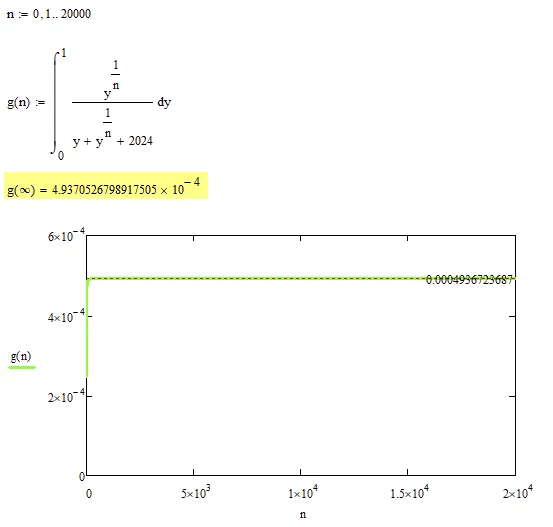
The equivalent function g(n), which is obtained by substituting y=x^n, is numerically much more stable!

Werner_E_0-1739552907851.png

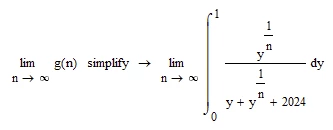
Nonetheless, Symbolics is still unable to find an exact symbolic solution when applying the limit

Werner_E_1-1739553391798.png

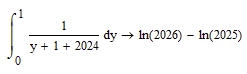
However, it is possible to do it this way

Werner_E_2-1739553425888.png

which of course is equivalent to

Werner_E_3-1739553447962.png

a basic integral for which we would not need any software 😉


3 replies

25-Diamond I
February 14, 2025

I don't think that Mathcad or Prime are able to arrive at a solution.

The symbolics of both is not able to come up with a solution and the numerics runs into severe round-off errors for higher values of n.

Here the "results" of Mathcad 15 and Prime 10:

Werner_E_0-1739541036617.png


Werner_E_2-1739541112428.png


25-Diamond I
February 14, 2025

Additional remark:


We can improve numerical accuracy significantly by decreasing the value of TOL.
But there will always be a value for n above which numerical inaccuracies will strike and falsely pull the result towards zero.

In case of TOL=10^-10 its the values above n=9449 which yield inaccurate/wrong results.

Werner_E_5-1739543173326.png


We can zoom in to see the results approaching the value you named and then the sudden death of the numerics starting with a specific n-value

Werner_E_4-1739543006205.png

If you force the symbolics into numeric float mode by using a decimal like 1.0 instead of just 1, we can get a pretty good approxumation

Werner_E_1-1739550227443.png

I had no luck with much larger arguments, though ('endless' calculation).


Also tried Wolfram Alpha, but uncle Wolfram wants us to insert coins to buy more computation time ...

Werner_E_0-1739553925702.png


Werner_E25-Diamond IAnswer
25-Diamond I
February 14, 2025

The equivalent function g(n), which is obtained by substituting y=x^n, is numerically much more stable!

Werner_E_0-1739552907851.png

Nonetheless, Symbolics is still unable to find an exact symbolic solution when applying the limit

Werner_E_1-1739553391798.png

However, it is possible to do it this way

Werner_E_2-1739553425888.png

which of course is equivalent to

Werner_E_3-1739553447962.png

a basic integral for which we would not need any software 😉


15-Moonstone
February 14, 2025

I was already familiar with the last solution for reasons based on theorems of analysis. However, since I have little experience in numerics, I wanted to experience the convergence behavior experimentally, live and in color, so to speak ;-). I have now become somewhat aware of the limitations. Thank you very much!

14-Alexandrite
February 17, 2025

This is what I got in Maple Fl;ow:

Untitled.png

25-Diamond I
February 17, 2025

Great!

Can Maple Flow also handle the original expression (in x) before doing the substitution x^n = y ?

14-Alexandrite
February 18, 2025

Looks like it can't

Untitled2.png