
13-Aquamarine
December 29, 2024
Solved

Mathcad solving the equation of dynamic thermal performance ( ISO 13786-2023) in general case

  • December 29, 2024
  • 4 replies
  • 3148 views

Hi there!

I'm trying to solve, in general, one equation that is important to me.

The idea is to find through my Mathcad Prime 9.0.0 the extremum value of a parameter in symbolic representation.


Here, I faced some "wall barrier" for solving due to the famous discouraging phrase as 

"The symbolic result returned is too large to display"...


What was previously done:

1. The simplification of each step of the calculation formula was performed, but the final point was to calculate the Zee matrix...


Mathcad didn't want to represent the particular calculus step, and I was deeply stuck, with no idea how to solve my issue.


My objective in this step is to solve the derivative equation when I set the k1 value (Internal area heat capacity) equal to zero by only two variables (width of the layers d1 and d2, respectively)  to find by such derivative equation to obtain a maximum of k1 value in the general case depending on two variables (width of the first layer d1 and d2 respectively).


The attachment has two files (MathCAD Prime 9.0.0)  that probably could shed light on the problem - the work solution for particular initial data and the symbolic unsolved.

I would appreciate any information regarding the math and help you can give.
Best answer by Ivan_Pat

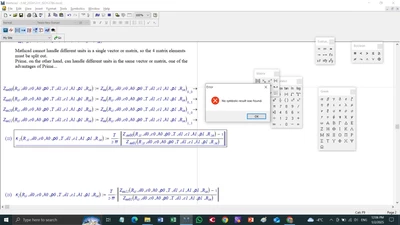
@LucMeekes  Thank you for the guidance, but even when used in Matchcad 15, the attached file, after being proceeded, also has no solution:

Ivan_Pat_0-1735812502849.png

So, as far as I got from the Maple benefit's description, the possible way to solve my equations is to get used to Maple

4 replies

25-Diamond I
December 29, 2024

It may help to omit the units when using symbolic calculations.

If you use units with symbolic calculations, it may help to turn on this option and let the sheet recalculate:

Werner_E_0-1735485957015.png

I also noticed that in your definition of matrix Z none of the units are labelled as being a unit (bold blue). This may make the symbolics think that  variable W and unit W are two different variables, which sure can blow up the result.


Ivan_Pat13-AquamarineAuthor
13-Aquamarine
December 29, 2024

@Werner_E, thanks. I'll try to use this tip to omit the unit issue.

By substituting units and switching off the units button as you suggested, nothing has changed...

25-Diamond I
December 30, 2024

Attached is what I had in mind when I wrote about omitting the units. Its also not necessary to introduce new variables A, B, C ... - just use th original names. Actually your 'variable' A is not a variable, but the unit Ampere! You can tell as its displayed bold and blue.

Additionally you don't need to evaluate each expression symbolically. Don't mind the red errors - they stem from the numeric engine complaining that variables are not numerically defined and this does not interfere with the symbolic calculations later.


In the attached sheet I used the symbolic evaluation only when I defined function k1(d1,d2). That's necessary as otherwise we would have to define all variables which depend on d1 and d2 as functions in these two variables.


At the end I try to solve the system we get when we set both partial derivatives of k1 to zero.

I could not wait for the calculation to finish, so I saved the file and cancelled the calculations. Maybe you have more patience and luck. But I fear that Prime will not be able to come up with a solution - not sure, though.

I must confess that I am not very confident that you will be able to come up with a genereic symbolic solution for the maximum of k1 but I'd be happy to be proven wrong...


18-Opal
December 30, 2024
Ivan_Pat13-AquamarineAuthor
13-Aquamarine
December 30, 2024

@ppal_255687 Thank you, but it also was tried ( I compound the Z matrix in such a manner)... 

I'll try to insert the simplified equations into the formulae.

23-Emerald IV
December 30, 2024

Apparently you have these Prime worksheets by conversion from (real) Mathcad (version 15 or less) worksheets.

Did they 'work', that is,  find the symbolic solution?


Success!
Luc

25-Diamond I
December 30, 2024

@LucMeekes wrote:

Apparently you have these Prime worksheets by conversion from (real) Mathcad (version 15 or less) worksheets.

Did they 'work', that is,  find the symbolic solution?


Success!
Luc


My guess is that the original sheet which was converted was the one with the numerical calculated values and the symbolic sheet is a new attempt to find a symbolic solution using that sheet as a template.

23-Emerald IV
December 30, 2024

Observing the references in ISO 13786: "[5] Carslaw and Jaeger. Conduction of Heat in Solids, Oxford University Press, section 3.7, 1959"

I would approach it symbolically this way:

LucMeekes_1-1735572798297.png

and further...


Success!
Luc


Ivan_Pat13-AquamarineAuthor
13-Aquamarine
December 30, 2024

@LucMeekes, thanks for your attempt to help with the issue.

if I understand your point, did you simplify each matrix component and represent delta and dzetta values as functions from variables?

Ivan_Pat_0-1735587725572.png

Whether the function has no extremum point(can't find the solution at first derivative =0),
or Machcad can't cope with the calculus of symbolic equations, as @Werner_E   noticed...


23-Emerald IV
December 30, 2024

I looked up the original expressions for the heat transfer in the referenced source document to find a more compact description of the matrix Z, because I did not want to type those large expressions.

The simplify,exp statements actually rewrite the simplified expressions out to those large expressions that appear in the ISO standard.

I did that to confirm that the Z matrix is correct.

Attached is my Mathcad worksheet. You're welcome to convert it to Prime and see how far you get. (I cannot do that, I'm limited to express.)


Success!
Luc