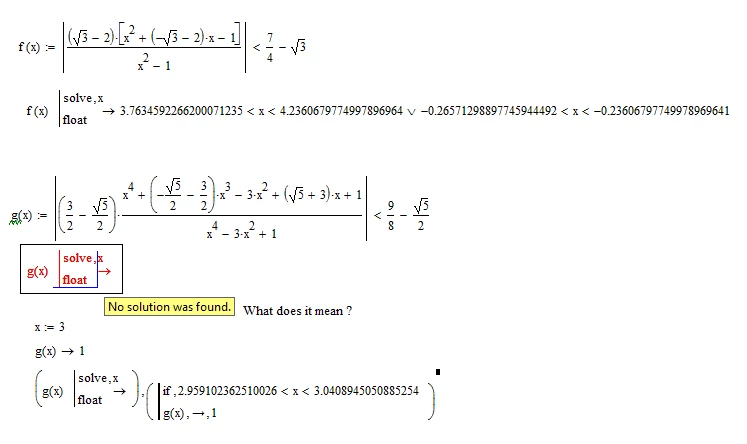
But the length of the five solution intervals are very small (in the range of 10^-8) so you may run into numerical problems when you try to plot.
Because five is an odd number, now B1 in the picture below consists of all the lower limits of the solution intervals and B2 holds all the upper limits.
The intervals you are interested in are the tiny areas between the points where the red curve crosses the dotted blue line (slightly above zero) up to the point where it crosses the green line (slightly below zero).
The picture shows a zoomed view for the first and the last solution interval.
The absolute value usually is quite beastly - either when it comes to solving equations and inequalities and also when it comes to derivatives. So its always a good idea to avoid the absolute value and either replace the calculations by separate calculations (like I did it above to get the limits of the intervals) or use squaring instead of the absolute value (see below). BTW thats also one reason why in regression analysis we use the squares of the errors instead of their absolute value - the latter would be far more difficult to handle.
Translate
Windchill Satisfaction Survey
Help shape the future of Windchill. Take our 5-minute survey and share your feedback.