You are right that the behaviour of evaluating combined Boolean expression unfortunately has changed in Prime.
Mathcad used "short-circuit evaluation". This means that when three Boolean expressions are combined with OR, the first one is checked and if the result is "true" the others are not evaluated anymore because its clear that the whole expression must be "true".
Prime evaluates every single boolean and decides afterward about the result.
As you already noticed, the error occurs when the limit is a string because its not allowed to compare a string with a numeric value.
So given that this is the expression which throws the error

on way to avoid the error is to split it
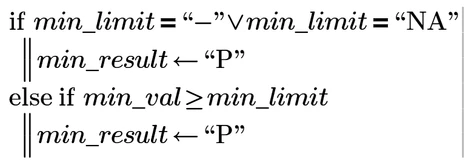
another is to wrap the last Boolean expression which could throw the error in a try and catch
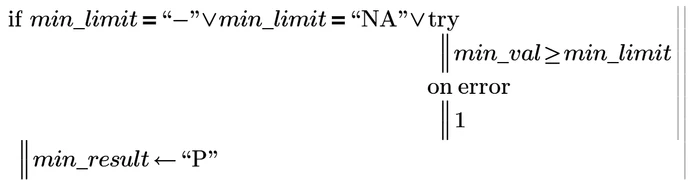
Guess the first way is better readable.
EDIT: It just came to my mind that there may be a problem with both suggestions if "min_limit" is a string but neither "-" nor "NA".
The first workaround would throw an error in this case which is the same behaviour as MC15 would show
The second suggestion would return "true" in this case. Change the "1" to "0" and it always will return "false" in this case.
Of course you would also have to apply similar changes for the other combined Booleans wherever this error could be thrown as well.
See here for a thorough explanation of short-circuit evaluation and also some pros and cons of using it. It does not help as there is no way to turn this feature on in Prime but the article may give a hint why PTC might have decided against using short-circuit eval (in case they really did this on purpose).
Short-circuit evaluation - Wikipedia