

Manufacturing a part with multiple operations on a 4-axis milling machine.
Hi
So for my masterthesis I currently am testing the possibilities and restrictions with a 4-axis milling machine (Roland MDX-50 with a rotational A-axis). I am now trying to mill a football (or soccerball, I'll just call it "Ball" from now on) as you can see in the image below. Normally we do this on a 5-axis machine, but the goal is to see if the MDX-50 can realise this piece and how precise it will be.
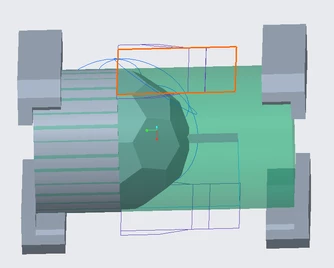 Image 1. Ball
I already made some volume roughs (with a 6mm End Mill) and profiling steps (with a 2mm Ball Mill) on the top- and the bottom side. So it will look like this:
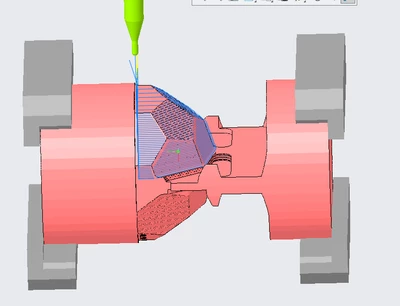
So I currently have 2 Coordinate Systems (further abbreviated as "CS"), 1 on the top and 1 on the bottom half. I used each CS to define an Operation. I can select both operations and ask to perform the Remove Material Simulation (as visible in Image 2). The simulation will do as I ask, but between the 2 operations, the tool will "teleport" from one place to another, because the second operation uses a different CS and an other clearance plane (of course).
However when I want to run it on my machine, the tool will not be able to perform this "teleportation". I previously tackled this problem by manually editing the G-code. (I used G54 for CS 1 and G55 for CS2. Then after post-processing I added the line "G90 G55 G21" where the second operation started and I made sure to manually add a "A180."-line to make sure the part was rotated 180degrees first because CS2 was on the bottom half of the part.)
So when it is just 2 operations this is doable, but when there are many more operations, with not so easy to calculate angles for the A-axis, this will become very hard.
So my question is: How can I combine my 2 operations on a 4-axis milling machine so that Creo calculates at what angle the A-axis should stand so I won't have to manually edit my G-code.
For anyone wondering, yes I changed my Work Center to a 4-axis machine that rotates around the A axis and my Operations have a Cylindrical Clearance (See 2 images below).
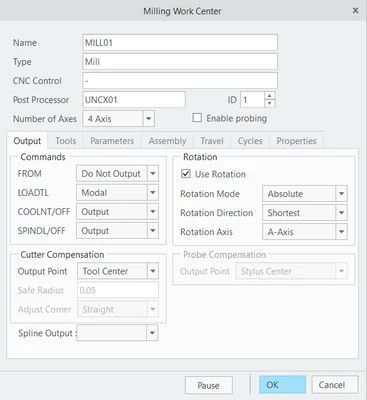
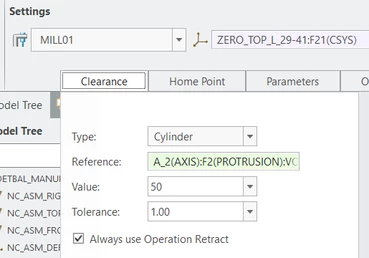
I hope someone can help me solve this problem.
If you need more information, just let me know and I'll try to let you know ASAP.
Excuse me for my not so great English and thank you in advance.