11-Garnet
April 2, 2018
Solved

Calculating heat dissipation by temperature difference

  • April 2, 2018
  • 1 reply
  • 9260 views

I was wondering why Creo thermal simulate can’t set a temperature as “heat load” and it only allows to set watt or power. The temperature differences calculations are commonly seen in lots of industrial applications.

Best answer by SweetPeasHub

Try these files.  There was a trick with a thin volume region so the model is not discontinuous.

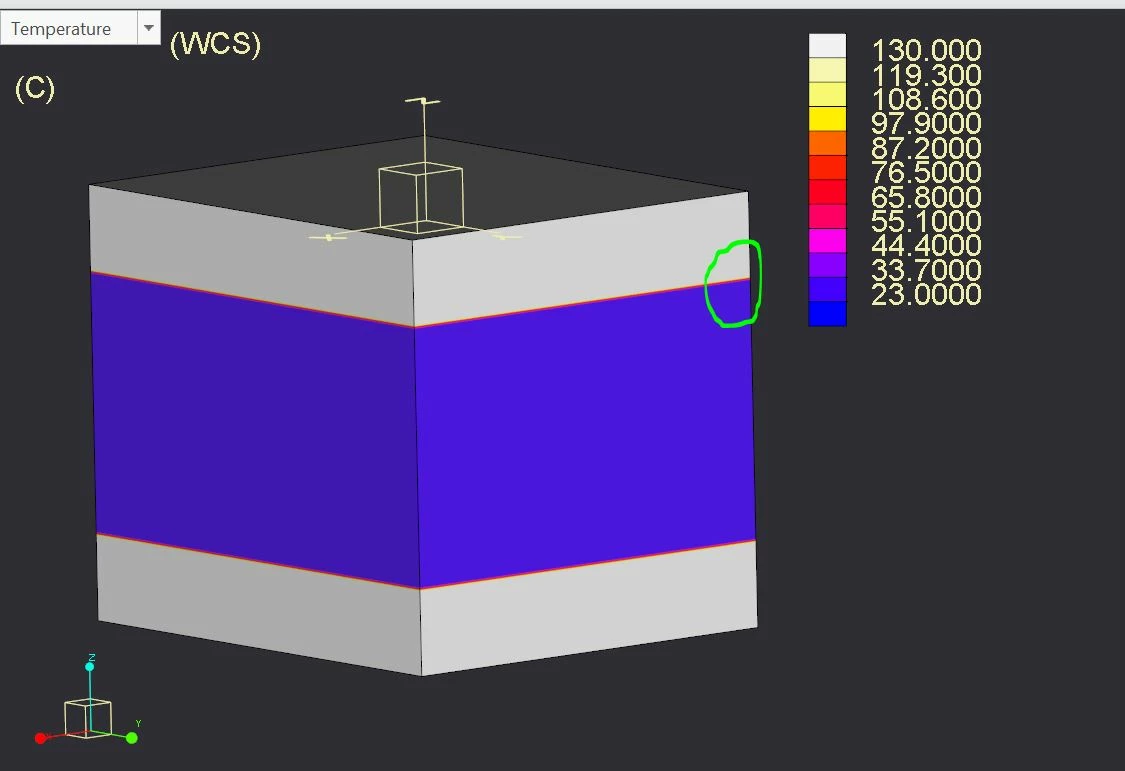
Top of this thin volume is prescribed 130C  bottom is prescribed 23C.  The bottom prescribed is not used for the transient study.

I had used this before but it slipped my memory.  I had trouble with the convection method and this came back to my mind.  CREO cannot do thermal resistance connection for transient analysis so in instead the thin volume is a 3D representation of thermal resistance.  You could change the material properties of that volume to adjust the resistance equivalent.


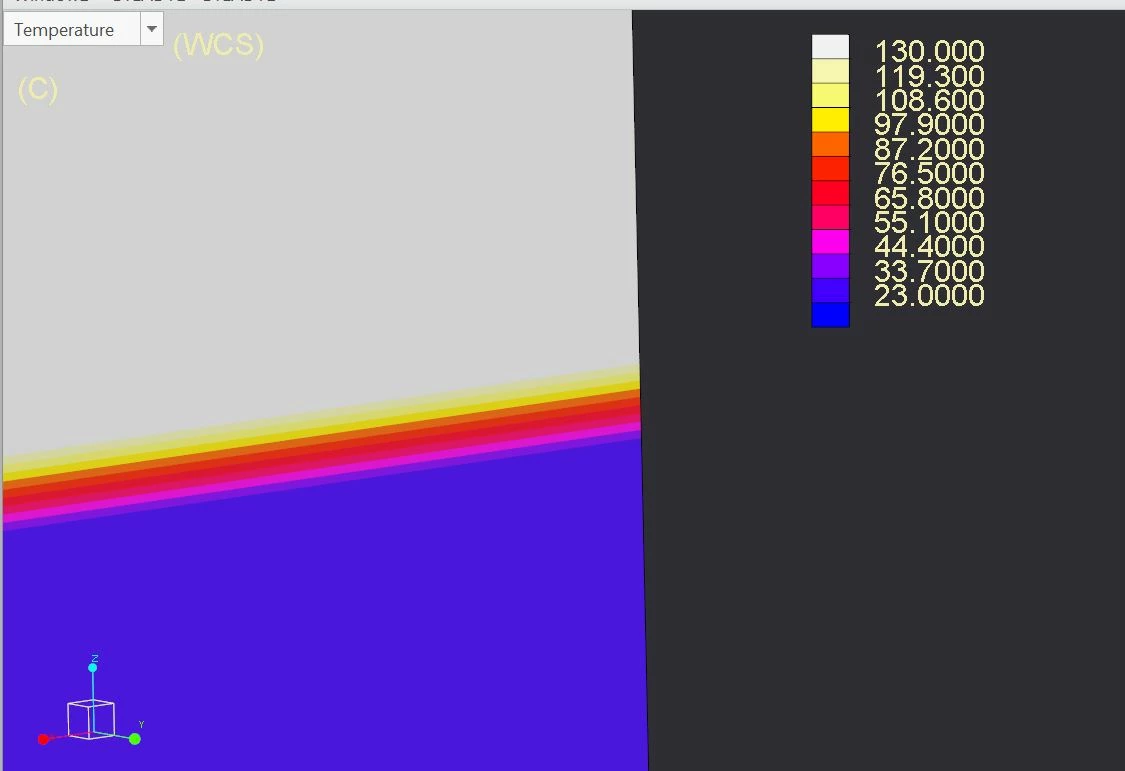
Here are the images of the initial condition from the steady state analysis.
 

Capture1.JPG


Capture2.JPG


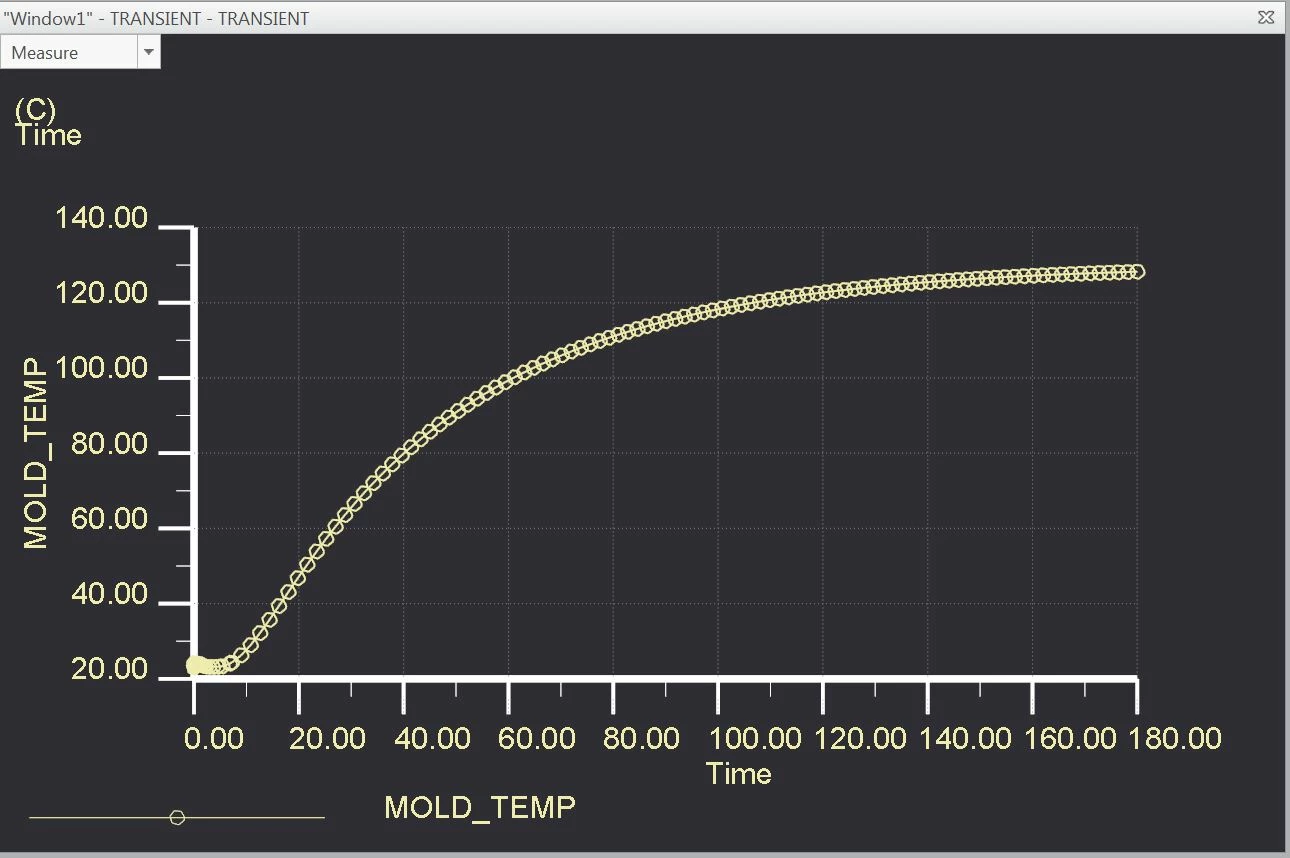
And here is a plot of the temperature vs. time at a point near the center of the mold.  It takes 7-8 seconds for heat flow to get to the center of my mold.
Capture3.JPG


Good luck and thanks for the challenge!  I use these kinds of questions as training to keep my abilites sharp.

I have 20 years of CREO simulate experience!

1 reply

Joey_Chen11-GarnetAuthor
11-Garnet
April 2, 2018

Maybe I should explain more clearly. The "Prescribed Temperature" must be set the same as "Initial Temperature" while doing a transient thermal analysis which stop users from using temperature as a heat load in a transient thermal study.

On another way, I suggest that the initial temperature of transient thermal analysis should be linked with the ambient temperature of radiation condition which makes more sense while setting up the boundary condition.

17-Peridot
April 2, 2018

It is hard to know exactly what you are looking for without some simplified description of your model.  My initial thought is that you want to run a steady state to generate a gradient in your model using only boundary conditions and no heat loads.  You could then use that gradient model as the input for initial temperature for the transient model.  Certainly CREO thermal analysis can handle the common condition of heat flow through a material with a cold side and hot side. 

1. Heat load is not required to successfully run a model.

2. Initial temperature does not have to be uniform.

3. prescribed temperature in my exerience is more rarely used in transient analysis because it is an infinite heat source/sink, maybe steady state is what you are looking for.

4. I also think radiation condition is more rarely used than convection, so maybe you need convection, not radiation.

5. The "bulk temperature" for convection or "ambient temperature" for radiation almost always would not match the temperature of the surface of your model. That is why it does not make sense to "link" that temperature onto your model as an initial condition.


Consider a house at 23C with an insulated wall to the exterior at 0C.

The interior has a bulk temperature of 23C convection condition.

The inside surface of the wall is some value lower than 23C. (it cannot match the interior temperature or there is no heat flow to the air.)

The outside surface of the wall is some value above 0C. for the same reason that it needs to be able to flow heat to the outside air.

The outside has a bulk temperature of 0C convection condition.


If you do not care about the convection conditions you could prescribe the inside and outside temperature of the wall at 23C and 0C respectively then use a steady state analysis to determine the heat flow through the wall only.


For a possible transient analysis of the same house...

Interior wall prescribed at 23C, Exterior wall prescribed at 0C, setup and/or run steady state to determine initial gradient in wall.

Use a second boundary condition set with the interior wall prescribed at 23C, but with a convection condition on the outer wall with the bulk temperature as a function of time going from 0C to -20C in some hours of time.  Then run transient analysis with the steady state analysis previously defined as the initial temperature distribution (MecT).  


Note none of these used a heat "load".  Just like in structural analysis you can run studies with boundary conditions only and do not need a "load" set.


Hopefully I was somewhat on the right track for you and helped clarify some things about thermal simulation.


Joey_Chen11-GarnetAuthor
11-Garnet
April 4, 2018

Thanks for your rapidly response.

Here is my situation, in factory, we have a sort of heating machine which use liquid (hot oil or pressured steam) to give thermal energy as shown in below illustration. The heating plates (in orange) are controlled temperature controllers. The heating plates can be opened and down, and the molds can be removed and reloaded.

I tried to do it your way but this method doesn’t seem to fit my example. If Creo simulate has thermal load with temperature then I can use it to the heating surfaces directly. Is there any good way to get temperature raising curves for certain points inside the molds while heating?


 2018-4-4 09-38-01.jpg