3-Newcomer
April 7, 2025
Question

How to analyze the vortex tube flow analysis? It is different from the reality.

  • April 7, 2025
  • 2 replies
  • 1309 views

I learned a little bit, but I haven't mastered it at all.
It should be cold at one end and hot at the other, but I didn't expect that one end is hot and the other end is even hotter.屏幕截图 2025-04-06 221255.jpg屏幕截图 2025-04-06 221416.jpg
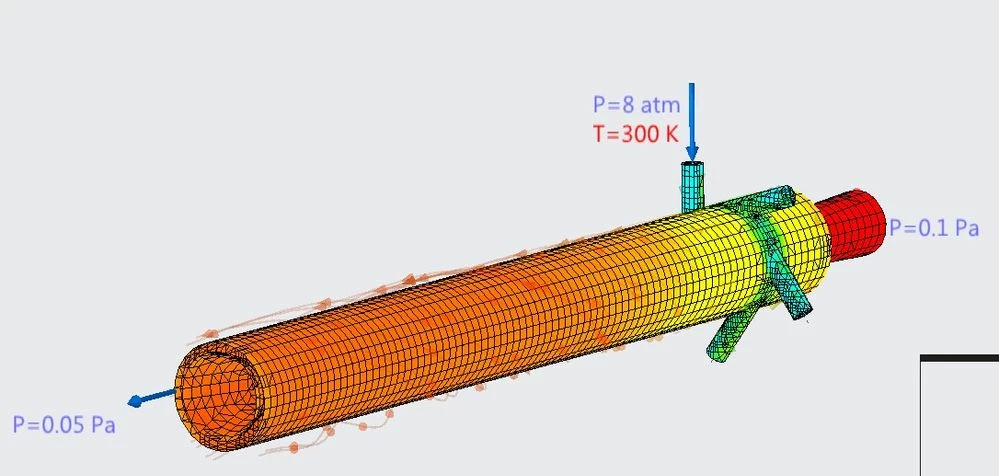
Is there expert tell me where I am wrong?

2 replies

12-Amethyst
April 7, 2025

You'll probably need to provide a little more information on your model.


Is the inlet condition applied to all of the small tubes, or only one of them?

What is the fluid in the model?

Is the model fluids only, or are there solids with conjugate heat transfer?

3-Newcomer
April 9, 2025

yes, the inlet conditions apply to all small tubes,  medium is air. the physical model includes turbulence and heat

21-Topaz II
April 9, 2025

Just looking at your image, I see you have exit boundary conditions of 0.1 Pa and 0.05 Pa. That's pretty much calling for a vacuum (10E-07 ATM) at both ends in comparison with the 8 ATM inlet. Why are they different? Why is the number so low? I would expect something like 1 atm (ambient)?

And again, what does the flow stream field look like? Are the flow lines in the tube as one would expect?

21-Topaz II
April 7, 2025

Hard to tell just from what you've got.

What do you see for the flow field? Do the flow streams look like what is seen in renderings by people who have researched these? Is your swirl chamber defined properly to get the flow you need? As I understand it, that's where the "magic" is in designing a vortex tube. As well as the configuration of the exit cone on the hot side.

Had a similar dilemma trying to model the flow of a cyclone in the past. Took a good bit of adjustment to get those luscious bits of solid debris to spin around and drop out of the device the way they were supposed to. Best part is when we built them they worked.