
1-Visitor
November 17, 2017
Solved

How to Control Rounding dimensions (roundig Up and Rounding Down)?

  • November 17, 2017
  • 1 reply
  • 7722 views

Hello,

Can anyone know how to control decimal rounding up/down value in Creo drawing?

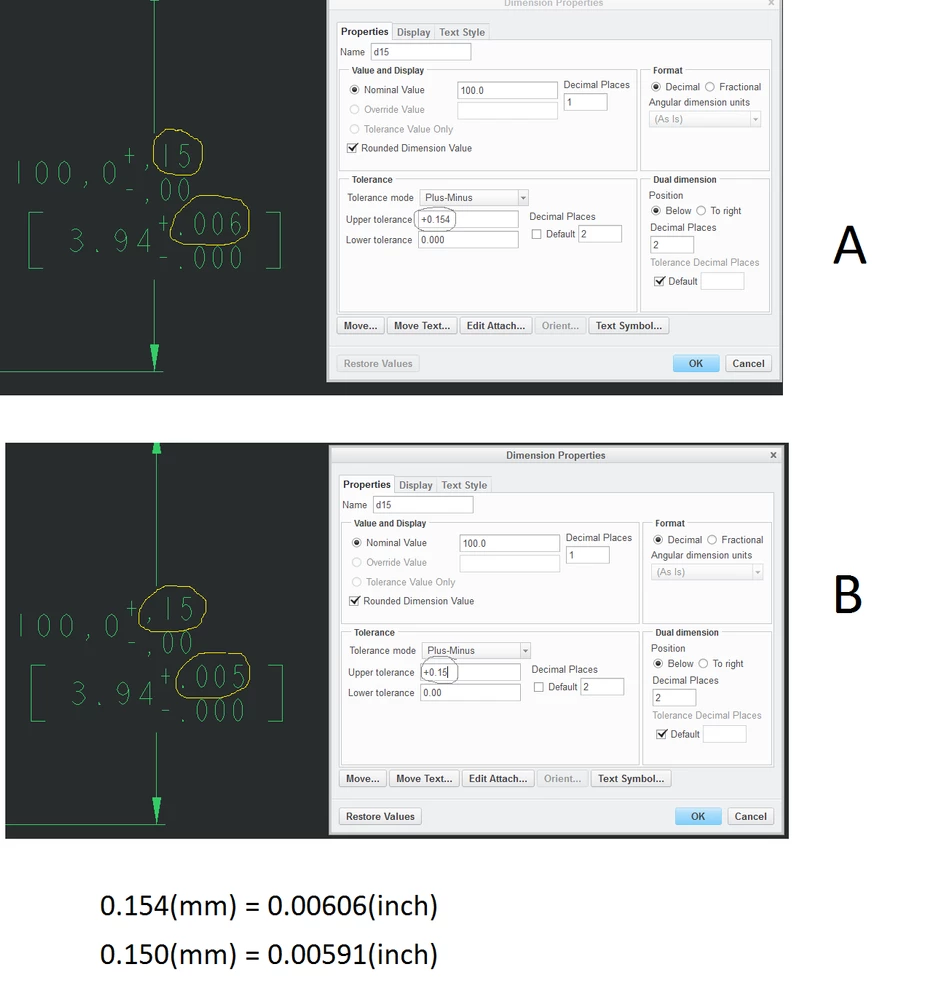
Please see the screenshot of it 
Untitled.png


I want to give a tolerance of 0.15, not 0.154.

but in inches, it should be 0.006.

here the tolerances are rounding down. I need them to round up.


Regards,

Sundar Dannana,

Engineer.

Best answer by TomD.inPDX

...and the bottom line being that the bracketed dimension must always lie within the tolerance band of the primary displayed dimension.  This is according to ASME ...whatever it was.  So yes, you can loose tolerance within the bracketed dimension.  In general, this is a good solution.


This standard enforces the importance of which is primary and which is secondary.  All too many times have I seen suppliers try to take advantage of this by doing their own translation of the numbers when dual dimensions are not present.  I do remind those suppliers that the numbers on the drawings is what I contracted, not a conversion of those numbers to a different system improperly implemented.  in this case, you should be able to trust what PTC has done in Creo.

1 reply

21-Topaz II
November 17, 2017

There was a lengthy discussion of this stuff previously here. A quick search of "creo dual dimension rounding" brought me to the following:

https://community.ptc.com/t5/Creo-Modeling-Questions/Dual-Dimensioning-Tolerance-Interpretation/td-p/385660

It starts with a question about standards and branches off to a lot of links about what I think you are trying to address.


17-Peridot
November 18, 2017

...and the bottom line being that the bracketed dimension must always lie within the tolerance band of the primary displayed dimension.  This is according to ASME ...whatever it was.  So yes, you can loose tolerance within the bracketed dimension.  In general, this is a good solution.


This standard enforces the importance of which is primary and which is secondary.  All too many times have I seen suppliers try to take advantage of this by doing their own translation of the numbers when dual dimensions are not present.  I do remind those suppliers that the numbers on the drawings is what I contracted, not a conversion of those numbers to a different system improperly implemented.  in this case, you should be able to trust what PTC has done in Creo.

17-Peridot
November 18, 2017

...and also know that I have no love for bean counters who cannot understand why you may want to use one for the primary value over the other.  A company that restricts engineers into one corporate dimensioning standard is only doing it t make their jobs easier.  There has to be allowances in certain cases.  In precision machining, those lost few microns or nanometers can cost real money.  I trust myself to know what I need to use and why.  And I've had to deal with plenty of the bean counters in my 40 year career.  Most of which are stiff-necked people that simply do not want to understand.