
The PTC Community will be on read only status starting March 23rd in preparation for moving our platform to a new provider. Read more here
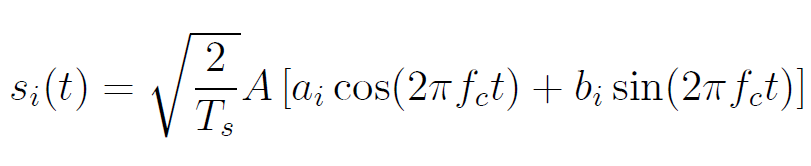
I'm having trouble reconstructing an OFDM QAM signal using its amplitude and phase spectra obtained by using the DFT. The QAM signal is given in the image below.
I have tried to do it so far using the below equation.
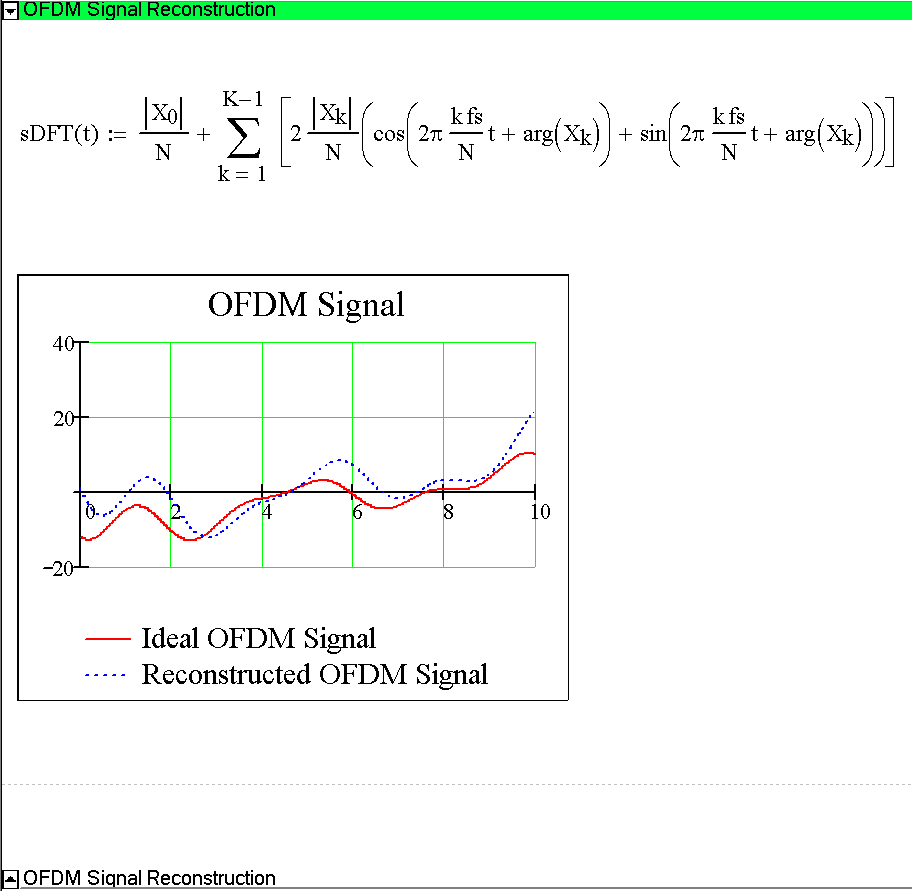
This is the closest I have reconstructed it to the original. What am I missing?
I am using Mathcad 13.
You sure would get a better respones if you attach a worksheet. From the pic alone probably nobody would be able to determine what the problem ould be.
Would the following link be of any help?
http://www.comlab.hut.fi/users/tko/geta07/GETA fall 07- OFDM with MathCAD.ppt
No sorry that doesn't help. I was browsing through that just last night actually. I have attached my worksheet.
Jonathan Mayers wrote:
No sorry that doesn't help. I was browsing through that just last night actually. I have attached my worksheet.
Was just a try.
So hopefully someone with better technical background could jump in.
BTW,
1. Yes. The DC value is part of the reconstruction.
2. No. The last definition of X is what I'm supposed to use.
Jonathan Mayers wrote:
1. Yes. The DC value is part of the reconstruction.
2. No. The last definition of X is what I'm supposed to use.
OK, so I'm not of much help. It was just that I thought that
1) the DC value could be (is) negative!?
and I noticed that
2) you are using just the first 10 values of the 200 element vector X in the definition of sDFT for reconstruction. Obviously thats supposed to be done.
Yes because after the first K components, all others are zero and do not affect the calculation. The DC value is positive for me so I'm not sure what you mean. However, I changed the equation up a bit and instead I put my DC value to be negative and the two signals overlay exactly. For anyone who may be in a similar situation, find attached the mathcad 13 worksheet.
Ah yes, that makes sense, especially if you think of the reconstruction in its complex form
BTW, I think your DC should be X0/N (without the absolute value) or even better Re(X0)/N so you are prepared if cause of numeric errors you get an imaginary part in X0.

