20-Turquoise
March 16, 2017
Solved

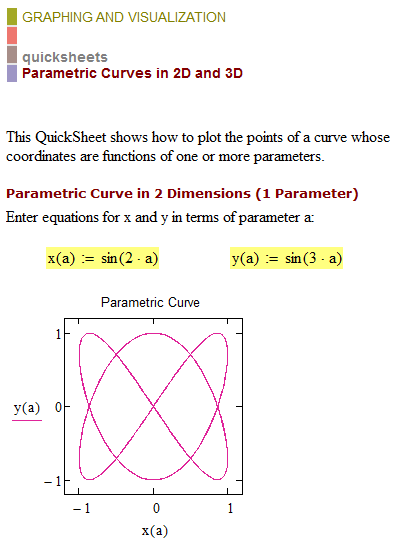
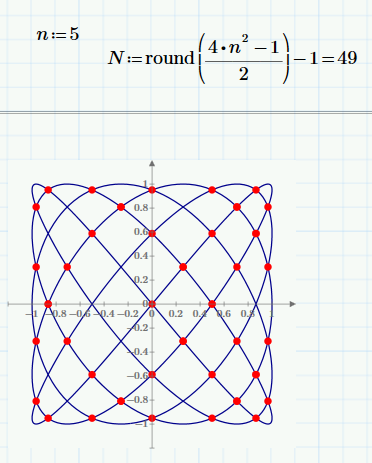
Plotting the points of intersection on the graph ?

  • March 16, 2017
  • 5 replies
  • 3771 views

  Hello Everyone.

  From :

(1).PNG

  To the question : Plotting the points of intersection on the graph ?

         Thanks in advance for your time and help.   

Best answer by Fred_Kohlhepp

Emperically:

5 replies

23-Emerald IV
March 16, 2017

The points where the curve intersects with itself are plotted on the graph.... along with a lot of other points.

If you want the coordinates of the intersection points plotted in readable text next to them, you need to define a few more curves to get them in.

Refer to the great work "Creating amazing images with mathcad" by Byrge Birkeland for ideas on how to do that.

Success!
Luc

25-Diamond I
March 16, 2017
lvl10720-TurquoiseAuthor
20-Turquoise
March 17, 2017

(2).PNG

   How many points of intersection on the graph ?

23-Emerald IV
March 17, 2017

Sorry, I misunderstood your original question.

To solve the problem at hand, I would mathematically create the lissajous-shape in 3D, then make a projection of it on a (2D) surface and find the intersecting points of it.

Why the detour? because now you only have two expressions, and a single running variable. I see no path where that brings you to more than 2 solutions.

Success!
Luc

lvl10720-TurquoiseAuthor
20-Turquoise
March 18, 2017

    I greatly appreciate all of your time and help. Werner, Luc, and Fred.       . I'm very, very happy. And I think I still need help with the two of question, the above, on cos(  ) function :

(3).PNG

              Thanks in advance.
                    Best Regards.

                           Loi

lvl10720-TurquoiseAuthor
20-Turquoise
March 18, 2017

  From :

(4).PNG

  So I have a query : How to rotate a graph (pi/2) clockwise and (pi/2) counter-clockwise ?

        Best Regards.

              Loi 

25-Diamond I
March 18, 2017

> How to rotate a graph (pi/2) clockwise and (pi/2) counter-clockwise ?

clockwise: replace the x(t) on the abscissa by y(t) and the y(t) on the ordinate by -x(t)

counter clockwise: replace the x(t) on the abscissa by -y(t) and the y(t) on the ordinate by x(t)