15-Moonstone
April 24, 2024
Solved

Reminder of an almost forgotten sentence ;-)

  • April 24, 2024
  • 1 reply
  • 1646 views

Given an ellipse E in the Cartesian coordinate system with the semi-axes a > b and the equation

x^2/a^2 + y^2/b^2 = 1. A chord AB of fixed length s < 2*b is considered. Let the point P be fixed on the chord so that the chord is divided into the segments AP = u and PB = v, i.e. u + v = s. The points A and B should now be moved on the periphery of the ellipse in a rotational direction while maintaining the chord length s and its pitch P in u and v. During this movement, point P describes a closed curve K.

The content of the annular area bounded by E and K is sought.
Best answer by Werner_E

I believe that Holditch was only specifically concerned with an ellipse and the case s=(a+b)/2 = u+v with u=v. I am not sure about that, though.

Its surprising that the area does not depend on the type or size of convex, closed curve used and is always  u*v*pi.


Good luck for dealing with the more general case using Mathcad!

I am not sure if the symbolics in MC14 or MC15 is capable enough to deliver a general proof.

EDIT: Actually I found (and still find) it hard to implement a way to find numerical solutions for the new curve created.

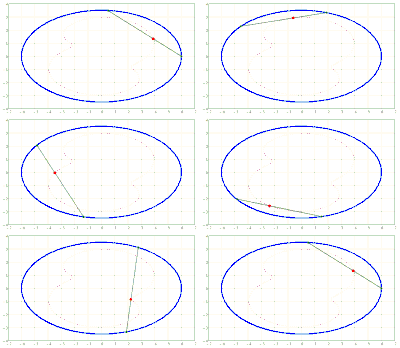
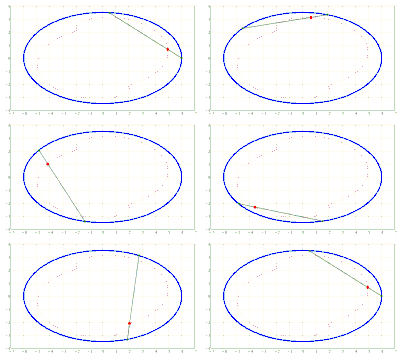
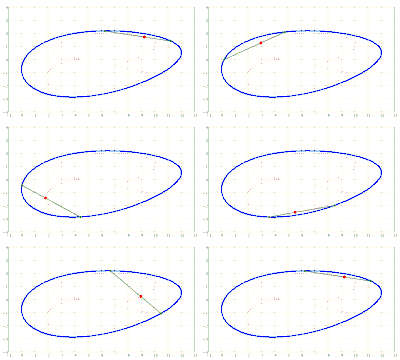
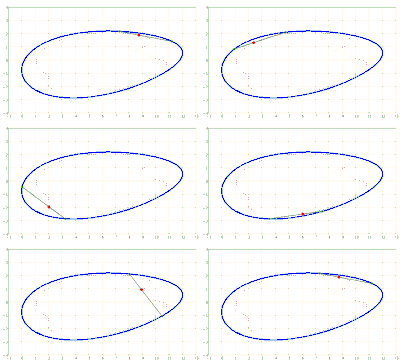
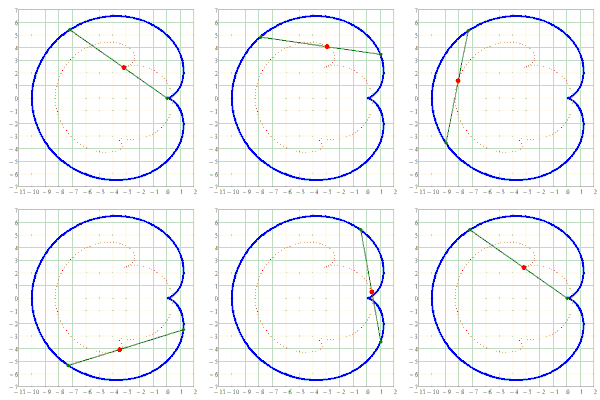
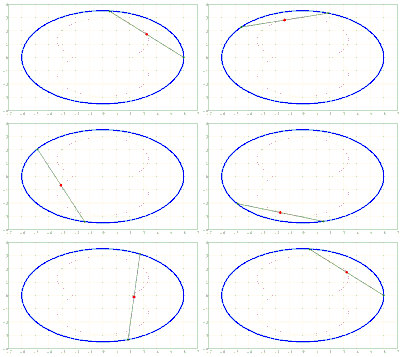
ani-ell1.gifani-ell2.gifani-ell3.gifani-gen1.gifani-gen2.gifAni-crd1.gif

Some nicer animations can be found here: Courbe de Holditch

1 reply

25-Diamond I
April 24, 2024

You are talking about Hamnet(t) Holditch's theorem from 1858!?

15-Moonstone
April 24, 2024

Yes, that is the “betrayed” result. The only thing missing is the symbolic solution. When I heard about this many years ago, I was impressed by the simplicity in the general case - a convex ring-like surface is easily calculated after sweeping through a tangent path.

Werner_E25-Diamond IAnswer
25-Diamond I
April 24, 2024

I believe that Holditch was only specifically concerned with an ellipse and the case s=(a+b)/2 = u+v with u=v. I am not sure about that, though.

Its surprising that the area does not depend on the type or size of convex, closed curve used and is always  u*v*pi.


Good luck for dealing with the more general case using Mathcad!

I am not sure if the symbolics in MC14 or MC15 is capable enough to deliver a general proof.

EDIT: Actually I found (and still find) it hard to implement a way to find numerical solutions for the new curve created.

ani-ell1.gifani-ell2.gifani-ell3.gifani-gen1.gifani-gen2.gifAni-crd1.gif

Some nicer animations can be found here: Courbe de Holditch