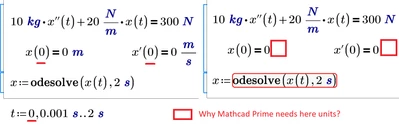
You are comparing (because that's what the '=' symbol is for) two items, If one has a unit, and the other hasn't, then either they're NEVER the same, or an error is flagged.
Prime makes a good choice here: flag the error, beause thë other option (they're never the same) is apparently not what the user meant.
Luc, I guess the explanation is not that simple as we are not dealing with a calculation like 3 + 5m= but rather 0 + 5m= (which Prime happily simplifies to 5m, BTW).
For Prime quite often 0 m equals exactly the dimensionless number 0 and ever so often its also the other way round. But because Prime does not use SUC it cannot always detect the correct unit which should be applied and this is the point were the special new unit Zero comes into play.
Its a bit inconsistent that Prime accepts the 0's without units which Valery had underlined in red on the LHS of the picture. We may be able to find out why those 0's are no problem for Prime while other 0's at other positions are. But I guess its better to get used to applying the correct units to every 0 which denotes a physical quantity.
The use of "Zero" as shown in the picture I posted is nothing I would propagate.
"For Prime quite often 0 m equals exactly the dimensionless number 0".
0 m does not equal 0, so wherever Prime allows that (and I think that Mathcad is no better),
it is making a mistake. It may be convenient for the user, and that might be the reason why it allows it every now and then, but I think it can lead to serious trouble.