1-Visitor
December 20, 2015
Solved

Implicit derivative?

  • December 20, 2015
  • 3 replies
  • 4815 views

How do I perform Implicit Derivative in MathCad?

I am trying to use MathCad Prime to solve an implicit derivative but I have no idea how I could do it. It seems to only solve a normal differentiation with only one variable.


Example:

x^2+y^2=25

dy/dx = -y/x


How do I get MathCad to work properly with implicit derivative?

Thanks!

Best answer by Werner_E

Mark Gase wrote:

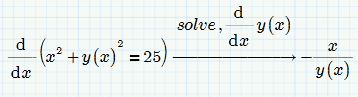
I didn't know Mathcad could solve this way.  To take it one step further, you can solve for dy/dx:

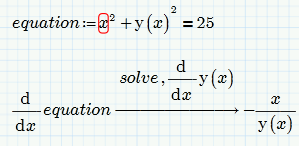
Yes and we don't even need to tamper with the original equation:

OR

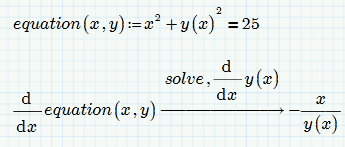
OR better

Werner

P.S.: If you encounter problems or get 0 as result, check the labels of your variable and function names. Prime automatic labeling really is erroneous and annoying.

3 replies

1-Visitor
December 21, 2015
rking-21-VisitorAuthor
1-Visitor
December 21, 2015

Thank you Mark.

But in Mathcad Prime I can't open .xmcd file and I can´t convert to .mcdx.

25-Diamond I
December 22, 2015

rking-2 wrote:

Thank you Mark.

But in Mathcad Prime I can't open .xmcd file and I can´t convert to .mcdx.

If you have a valid license for Prime, this license is also valid for Mathcad 15, so if you want to be able to convert files from MC15 and older to Prime format, you may download MC15  here -> Download PTC Mathcad 15.0 Free | PTC

It may be worth it and you need it to be able to do the conversions.

WE

25-Diamond I
December 21, 2015

Why don't you attach a worksheet and screenshots of your attempts so we can see better what you are trying to do.

1) Mathcad unfortunately can't handle implicit functions, so you have to create one term by subtraction 25 from the LHS

2) You have to tell Mathcad that y ist a function dependend on x by writing y(x)

Hope this is what you are looking for.

WE

1-Visitor
December 21, 2015

I didn't know Mathcad could solve this way.  To take it one step further, you can solve for dy/dx:

Werner_E25-Diamond IAnswer
25-Diamond I
December 21, 2015

Mark Gase wrote:

I didn't know Mathcad could solve this way.  To take it one step further, you can solve for dy/dx:

Yes and we don't even need to tamper with the original equation:

OR

OR better

Werner

P.S.: If you encounter problems or get 0 as result, check the labels of your variable and function names. Prime automatic labeling really is erroneous and annoying.

rking-21-VisitorAuthor
1-Visitor
December 21, 2015

Thank you all, I will be more careful to publish my questions.