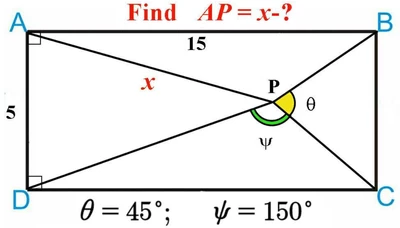
Best answer by Werner_E

No answer - that's a pity!
But no matter - anyway, to conclude for what ever it may be worth, here is a small animation made a few days ago, which shows the position of the possible solutions for P and the graphs of the distance functions at variable distance CD.

have fun!
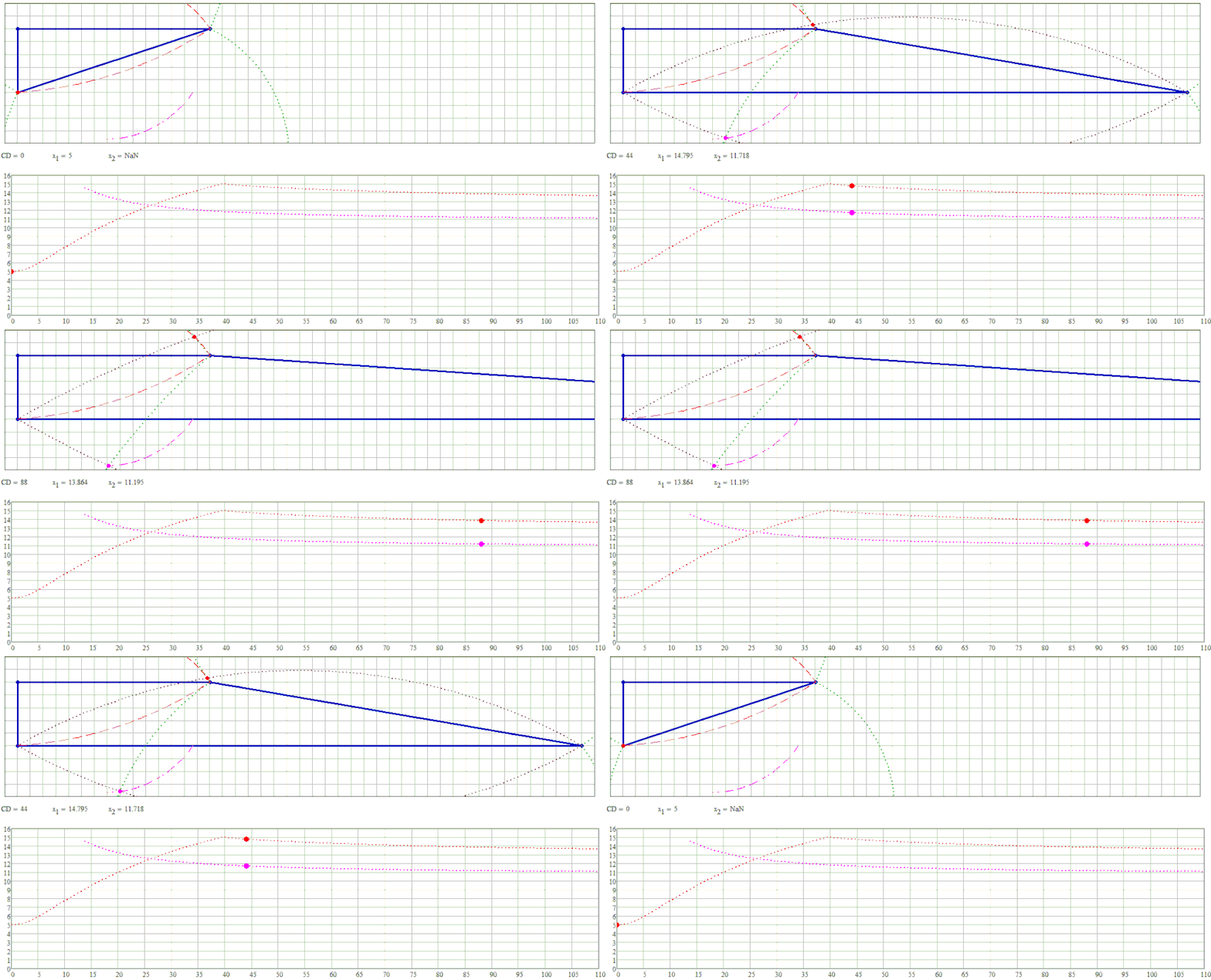
ani2.gif

12 replies

21-Topaz II
August 24, 2019

Hi Valery,

to me it is x=8.982

risposta a ValeryO.jpg

25-Diamond I
August 24, 2019

@-MFra- wrote:

Hi Valery,

to me it is x=8.982

risposta a ValeryO.jpg


There is a discrepancy to my solution.

But if my guess is correct Valery already has a solution in his hand and he can tell which one matches.


25-Diamond I
August 24, 2019

> Best solution in Mathcad needed!


What is "best" ?

"best" may be the simplest way to get the solution (simple is also hard to define), "best" can mean the the most visual solution or it can be the solution you already have in your drawer to post it later.

"best" can also mean the shortest solution and this would be to just type in the correct expression (if you are after an exact result) or the number like this:

B.png

Smiley Very Happy

25-Diamond I
August 24, 2019

????

Your reply is an empty post???

21-Topaz II
August 24, 2019

I wanted to delete it, but I can't, I can't find the right instruction.

As a test I used Carnot's theorem :

risposta a ValeryO 2.jpg

PC is necessarily the side of an equilateral triangle with base, BC.

25-Diamond I
August 24, 2019

@-MFra- wrote:

I wanted to delete it, but I can't, I can't find the right instruction.


Silly as it is but we are not allowed to delete our posts, but we are allowed to edit them even when somebody already answered to this post an may have referenced it. Thats not really clever.


As a test I used Cartesio's theorem :

Guess you are talking about the Law of cosine (cosine rule, Al-Kashi's theorem) for triangles in Euclidean geometry. https://it.wikipedia.org/wiki/Teorema_del_coseno

I used it, too. Another way would be to intersect two circle arcs.


PC is necessarily the side of an equilateral triangle with base, BC.

I don't see that symmetry. The distances from P to the four corners of the rectangle are all different.

As far as I see it the triangle BCP is neither equilateral nor isosceles.

Why do you think that PB=PC ?

B.png

21-Topaz II
August 24, 2019

According to my intuition, the theta angle is 45 degrees and it is so only if PB = PC otherwise it assumes different values.

risposta a ValeryO 3.jpg

25-Diamond I
August 24, 2019

@-MFra- wrote:

According to my intuition, the theta angle is 45 degrees and it is so only if PB = PC otherwise it assumes different values.


Your intuition is deceiving you 😉

There are a lot of different triangles with base BC and angle 45 degree at P. All possible locations of P are on a circle. I don't know what its called in English, in German its "Peripheriewinkelbogen". I doubt that Google translate does correct with "Peripheral angle arc" or "Peripheral angle circle".

See my picture which I added to the post above for the solution which clearly shows the different lengths.

21-Topaz II
August 24, 2019

You're right on the circle. What I'm not sure of is that both angles remain constant moving P on a fixed circumference. However, my solution is not wrong.

risposta a ValeryO 3.jpg

25-Diamond I
August 24, 2019

Sorry, but what you show at the bottom right as a "proof" is no proof because you again use the wrong assumption PB=PC here.

Calculate the coordinates of P with your "solution" and then calculate the lengths and angles one by one without assuming any symmetry (which simply isn't there).

21-Topaz II
August 24, 2019

you are right.