
1-Visitor
September 15, 2014
Solved

High local stress at inside corner

  • September 15, 2014
  • 3 replies
  • 3202 views

We are trying to simulate a toothed-ring with radial loads outwards due to a shrink fit and rotation. In the corners of the valleys between the teeth, the stress is incredibly high compared to the stress in the rest of the part (see screen shot below with a thin red line at the inside corner).

Is this stress real? Should we simulate differently?

Thanks in advance for any advice.
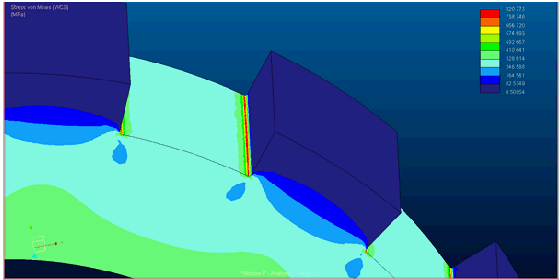
ToothWheelA.png


This thread is inactive and closed by the PTC Community Management Team. If you would like to provide a reply and re-open this thread, please notify the moderator and reference the thread. You may also use "Start a topic" button to ask a new question. Please be sure to include what version of the PTC product you are using so another community member knowledgeable about your version may be able to assist.
Best answer by dschenken

Yes and no.

If it is above the yield strength of the material the material will yield, lowering the stress in that area to the yield stress. Otherwise it is a significant stress concentrator/stress riser. If there is cyclic loading, this is where the part will fatigue and crack.

Anytime there is a rapid (dArea/dx or dSection Inertia/dx) change in section under a load the otherwise unsupported load has to go somewhere. Even a large-radius undercut will lower the stress.

Happily it also makes pop-top soda cans work.

3 replies

17-Peridot
September 16, 2014

You have a stress riser in that corner. Try a generous radius. It is probably trying to "peel" the tooth away.

dschenken1-VisitorAnswer
1-Visitor
September 16, 2014

Yes and no.

If it is above the yield strength of the material the material will yield, lowering the stress in that area to the yield stress. Otherwise it is a significant stress concentrator/stress riser. If there is cyclic loading, this is where the part will fatigue and crack.

Anytime there is a rapid (dArea/dx or dSection Inertia/dx) change in section under a load the otherwise unsupported load has to go somewhere. Even a large-radius undercut will lower the stress.

Happily it also makes pop-top soda cans work.

13-Aquamarine
September 16, 2014

The stress is real in linear world but not in elastic-plastic world.

Elasto-plastic analysis will drop the stress, strain will increase. Stay below ultimate tensile strain.

Don't use vm stress.

Do the teeth drive anything?

1-Visitor
September 16, 2014

Thank you for your response, that makes sense. Does Mechanica/Simulate do elasto-plastic analysis? We've never looked for it.

Thanks again!

2-Explorer
September 16, 2014

Jeff, is that the area of the highest stress? If so, to what % did the max_vm_stress measure converge to? What do your constraints and loads look like?

1-Visitor
September 16, 2014

I will look at the convergence, that's a good idea. But yes, that is the area of highest stress, according to Simulate. Things are looking better using the elastic/plastic analysis.

Thanks again!

Jeff