14-Alexandrite
March 11, 2026
Solved

SuAdapting 2D shortcuts to MBD? (o-ring, hydrauilc port)

  • March 11, 2026
  • 1 reply
  • 90 views

Some industry specs tool short cuts in the annotations which may not translate well to the 3D annotation rules.  I'm wondering if some teams have already addressed these?  

  1. O-ring Groove
  2. Hydraulic Ports

O-ring Groove

The standard o-ring groove dimensions often to to a virtual sharp condition.   Regular o-rings have virtual sharps at the bottom and dovetail have virtual sharps at the top.    Do you use virtual geometry, or special notes, or convert the tolerances to a more GDT based notation?
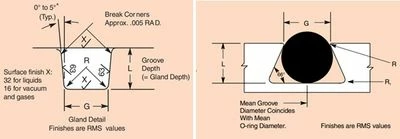
Parker_Oring.jpg

Example groove drawings (Source)


Hydraulic Ports

In some of the hydraulic port standards, the dimensions have angles to virtual surfaces.  Do you just redraw to a coinvent real surface, or add virtual surfaces.   (When a standard port is used, we could just specify the Standard Spec)
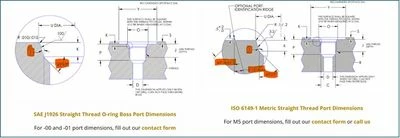
Port_Image.jpg

Example J1926 and ISO 6149-1 port images (Source

Best answer by tbraxton

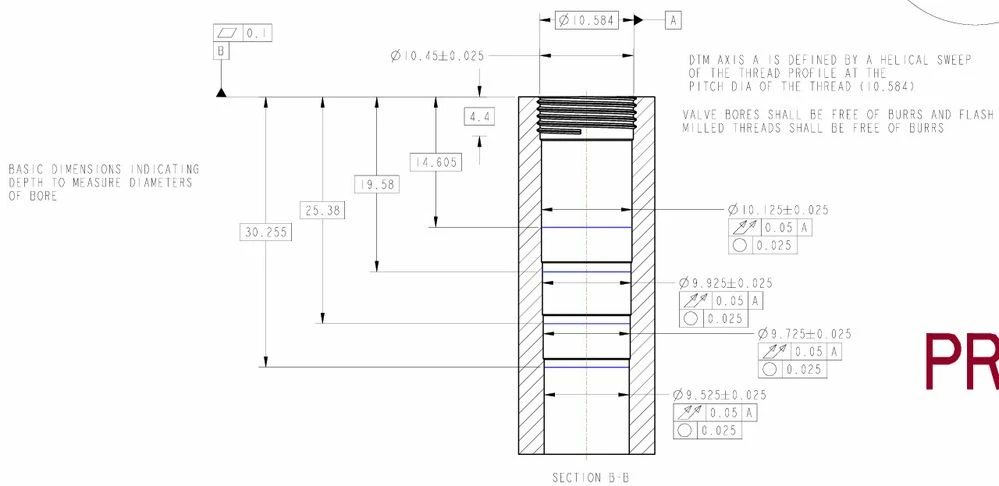
I have seen drawings that document measures to a theoretical sharp corner, typically these dimensions are noted to aid in design/programming of the desired geometry and not inspection (QA) dimensions. In your examples it appears that these virtual elements are added for the same reason (to facilitate the creation of the desired geometry). I would not expect to see tolerances associated with such elements; they would be treated as a basic dimension for GD&T purposes. In your examples the virtual elements are not critical to function of the physical parts, and I would not expect to ever ask that they be inspected during production. They may be used to verify/validate tooling but not to approve the parts themselves.


Here is a section from a similar application (3-way valve sealed with o-rings) where the dimensions and DRF are used to define how the parts are to be inspected to meet spec for reliable sealing. Note the use of basic dims to locate virtual planes in the bore where the seal is established with the valve in situ.

DRF and inspection dims for valve boreDRF and inspection dims for valve bore


1 reply

tbraxton22-Sapphire IIAnswer
22-Sapphire II
March 12, 2026

I have seen drawings that document measures to a theoretical sharp corner, typically these dimensions are noted to aid in design/programming of the desired geometry and not inspection (QA) dimensions. In your examples it appears that these virtual elements are added for the same reason (to facilitate the creation of the desired geometry). I would not expect to see tolerances associated with such elements; they would be treated as a basic dimension for GD&T purposes. In your examples the virtual elements are not critical to function of the physical parts, and I would not expect to ever ask that they be inspected during production. They may be used to verify/validate tooling but not to approve the parts themselves.


Here is a section from a similar application (3-way valve sealed with o-rings) where the dimensions and DRF are used to define how the parts are to be inspected to meet spec for reliable sealing. Note the use of basic dims to locate virtual planes in the bore where the seal is established with the valve in situ.

DRF and inspection dims for valve boreDRF and inspection dims for valve bore