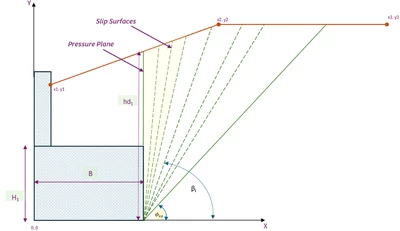
According to your explanations in the PM you sent to me
"To clarify, in addition to the soil self-weight, these loads represent surcharge (live) loads such as pedestrian or vehicular loads, etc.."
and
"If the surcharge region overlaps the critical wedge, only the overlapping length is considered."
I understand why only the second load can have any effect and so the others must result in zero.
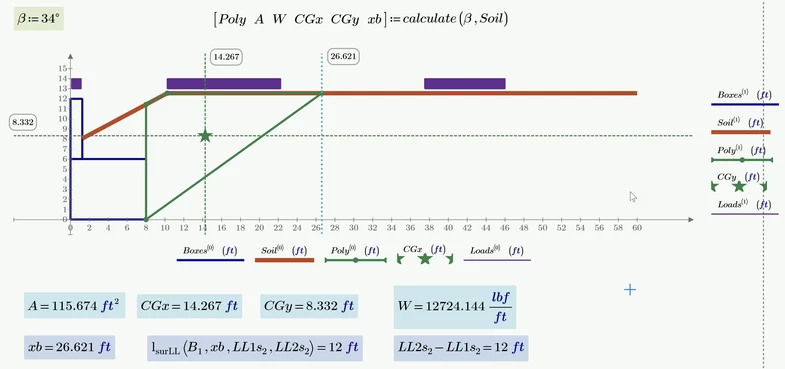
I added violet boxes to represent the position of those loads and it can clearly be seen that load1 is to far to the left to be able to affect the wedges and load3 it too far to the right as beta is not lower than 34°. We would need an angle ß of 23° or lower to have xb exceed the 37,5 ft and so make load3 to have an effect.
The pic shows the situation with ß being the lowest value of interest (34°) and your function lsurLL correctly returns that the wedge is overlapped by load2 for its full length of 12 ft.
EDIT: I removed the point-in-polygon test area because that function is not used at all.
Also removed the calculation of 'weight' in the 'calculate' function as it easily can be calculated outside.
The "Intersect" function was taken from an older sheet of mine where points were represented by complex numbers (real part = x-coordinate, imag. part = y-coordinate) and polygons by simple vectors of complex numbers.
The functions for calculating area and center of gravity of a polygon assume polygons to be presented as a nx2 matrix of real numbers.
replaced attached sheet