
10-Marble
November 3, 2024
Solved

Assistance with LTB Calculations in FEM

  • November 3, 2024
  • 1 reply
  • 4826 views

Hi everyone,


I’m implementing Lateral Torsional Buckling (LTB) calculations for beams using the Finite Element Method (FEM). My approach involves formulating the problem in matrix form, starting with the Elastic Stiffness Matrix and then the Geometric Stiffness Matrix. However, I’m encountering a singularity error when using the eigenvals function.


I’ve attached the Mathcad Prime 9.0 file for your reference. I would greatly appreciate any help or insights you can provide. Thank you!
Best answer by terryhendicott

Hi,

Had to do something else and am returning to finish off.


Use chatGPT with the following two questions to get an overall view of how to use both Ke and Kg

Formulate elastic stiffness matrix and geometric stiffness of 2D frame bending?

How to use the elastic stiffness matrix and geometric stiffness matrix in analysis of a 2D frame?


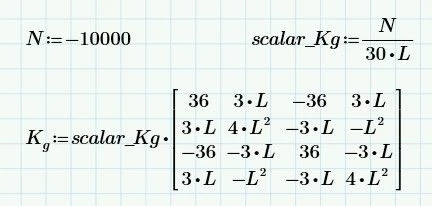
First how to examine the two element 6000 long simply supported beam under a compression of -10000

Capture.JPG

Note as has been pointed out this is singular and cannot be inverted.

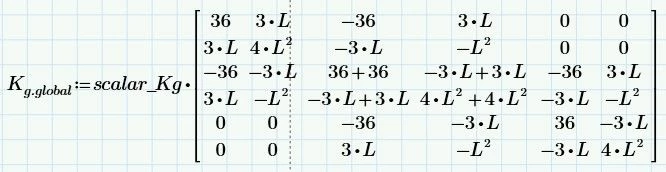
The geometric stiffness is assembled just like the elastic stiffness into a global geometric stiffness

Capture2.JPG

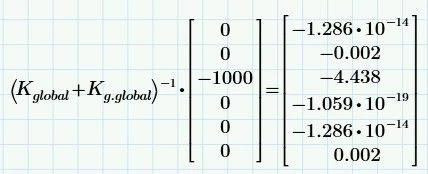
Now the combined action under the influence of the vertical point load downward and a compression inwards can be determined,

Due to the P-Delta effect of the compression applied over a sagging beam will decrease the stiffness of the structure and deflect a little more.

You can see the deflection has increased from 4.238 of previous post to a little more 4.438.

Capture3.JPG

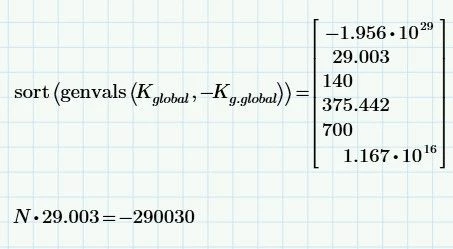
Now you can do a buckling analysis to determine how large the compression can be to buckle the beam (not lateral torsional buckling but member buckling)

Capture4.jpg

Hope this helps

Cheers

Terry


1 reply

25-Diamond I
November 3, 2024

I have no expertise whatsoever in your field of working, but when I look at your definition of K.g, I see that the rank of this matrix is not maximal as the matrix contains dependent rows.

The third row is the negative of the first row. So regardless of the value of L the determinant of this matrix is zero and so the inverse is not defined.

That's the reason Prime chokes on K.g^-1 and matrix A remains undefined!

Werner_E_0-1730637128158.png


Maybe "geninv" can be of help!?

Werner_E_2-1730637562512.png


You may want to look at these help pages

Inverting Matrices

Rank and Linear Systems Properties of Matrices


21-Topaz II
November 3, 2024

Hi,

The structural model in FEM consists of discrete element stiffness matrices usually more than one assembled into a global stiffness matrix with structural restraints applied.  Once assembled and adequately structurally restrained global stiffness matrix is invertible.

Capture.JPG

Of itself the stiffness of one element is singular (third row negative of first row).

Look at a structure of two elements 3000 long.  With restraints applied vertically at each end.  Then the global stiffness matrix can be inverted.


There are two ways to handle restraints.

One is to drop the row and column of the restraint from the global stiffness matrix and keep track of what was deleted

The other easier method is to apply a large stiffness relative to the values in the stiffness matrix values on the diagonal at the correct location for the deflection/rotation under consideration.


So two elements each 3000 long with a point load of -1000 applied at the center span is:

Capture2.JPG

Answer when solved is correct.

Capture3.JPG

Cheers

Terry


I have version 10 so cannot save back the files I have.


21-Topaz II
November 4, 2024

Hi,

Had to do something else and am returning to finish off.


Use chatGPT with the following two questions to get an overall view of how to use both Ke and Kg

Formulate elastic stiffness matrix and geometric stiffness of 2D frame bending?

How to use the elastic stiffness matrix and geometric stiffness matrix in analysis of a 2D frame?


First how to examine the two element 6000 long simply supported beam under a compression of -10000

Capture.JPG

Note as has been pointed out this is singular and cannot be inverted.

The geometric stiffness is assembled just like the elastic stiffness into a global geometric stiffness

Capture2.JPG

Now the combined action under the influence of the vertical point load downward and a compression inwards can be determined,

Due to the P-Delta effect of the compression applied over a sagging beam will decrease the stiffness of the structure and deflect a little more.

You can see the deflection has increased from 4.238 of previous post to a little more 4.438.

Capture3.JPG

Now you can do a buckling analysis to determine how large the compression can be to buckle the beam (not lateral torsional buckling but member buckling)

Capture4.jpg

Hope this helps

Cheers

Terry