1-Visitor
April 21, 2018
Solved

Better Fit

  • April 21, 2018
  • 3 replies
  • 2754 views

Hi to all,


In the attached (MCP3) file, can anyone give me some suggestions on how to get a better plot of f(x)? I have tried varying splines but the plot is quite erratic toward the end where as I would expect it to be quite uniform.


Thanks,


Andy

Best answer by Werner_E

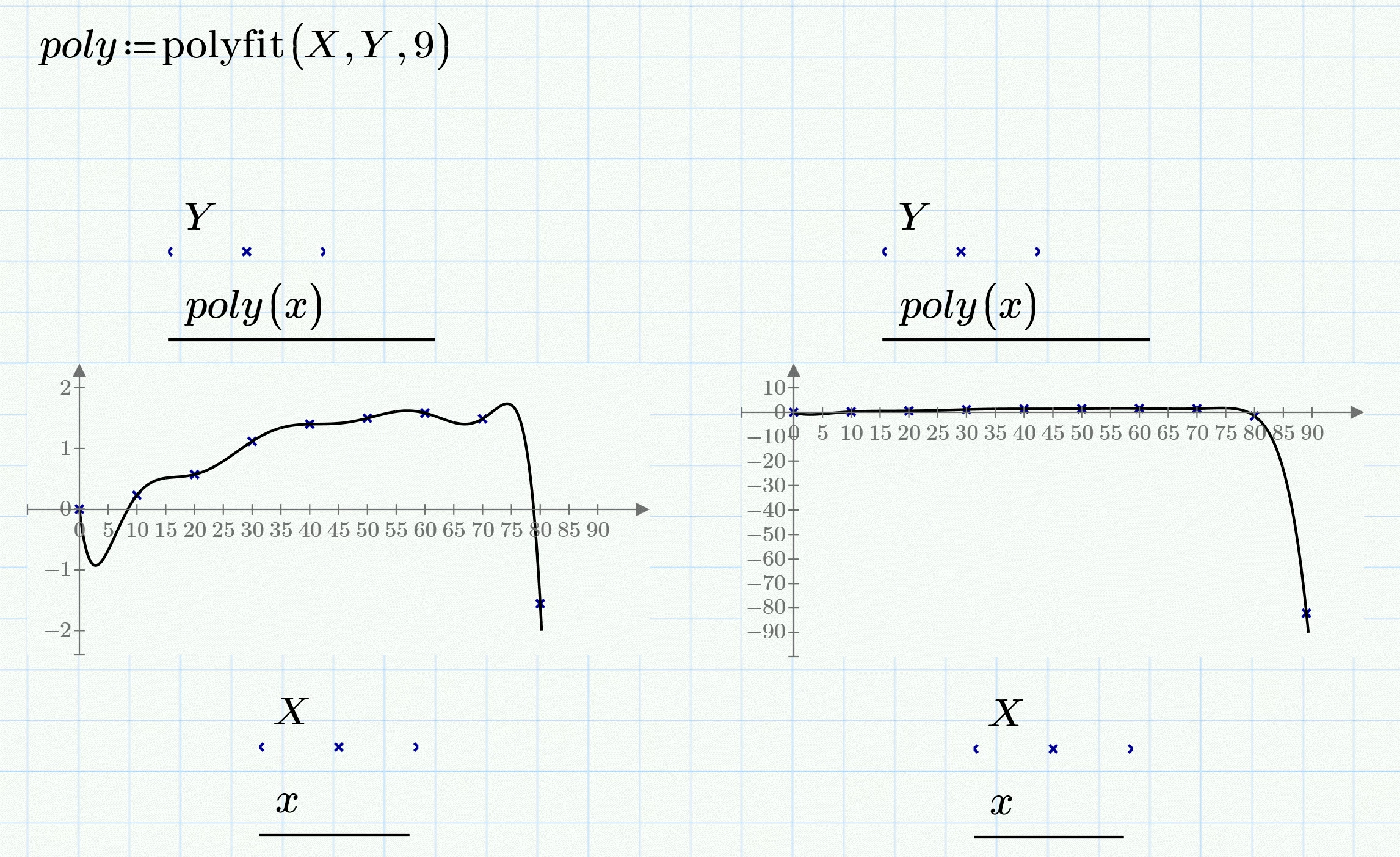
I guess a polynomial of 9th degree is too wavy, too?

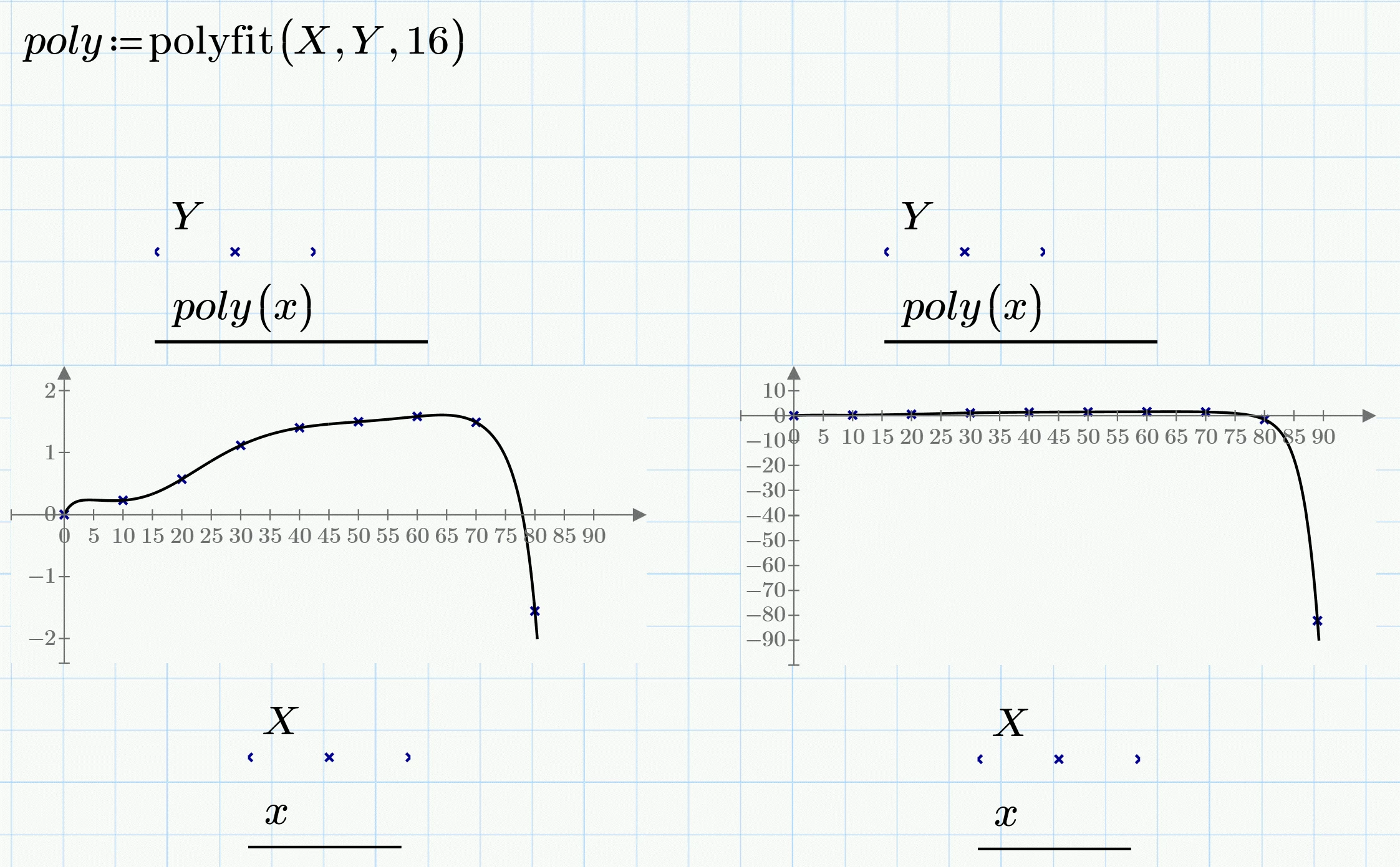
Its interesting that we can even demand for a higher order polynomial:

B1.png

B2.png

3 replies

16-Pearl
April 21, 2018

Here's a Schumaker quadratic spline.  Bit of a kink at 80, but it's closer than what you had.

2018-04-21_9-07-56.jpg  

2018-04-21_9-08-59.jpg


I fit the quadratic and then fit that with a b-spline so you can use it easily.

4.0 and pdf attached.


Also, linear interpolation might be good enough for your data, but there's not much fun in that.

Werner_E25-Diamond IAnswer
25-Diamond I
April 21, 2018

I guess a polynomial of 9th degree is too wavy, too?

Its interesting that we can even demand for a higher order polynomial:

B1.png

B2.png

23-Emerald IV
April 22, 2018

Is this the measured filter characteristic  (X in Hz, Y in dB) of an elliptic low-pass filter? https://en.wikipedia.org/wiki/Elliptic_filter

Or a Tshebyshev low-pass filter? https://en.wikipedia.org/wiki/Chebyshev_filter

Then you should be able to find a better fitting with the corresponding filter formulae.

It would also seem then, that you did not measure enough points to accurately catch the passband ripple: considering the very steep roll-off after about 80 Hz I'd expect many more ripples in the passband.

Like this:

LM_20180422_Chebyshev.png


Success!
Luc

awibroe1-VisitorAuthor
1-Visitor
April 24, 2018
Hi, no this is points on a stability curve that I’ve created in MC for a ship. I extracted the points to a fresh sheet to make this easier. Yes I guess I could have simulated more points...

Cheers

Andy