3 replies

16-Pearl
November 22, 2023

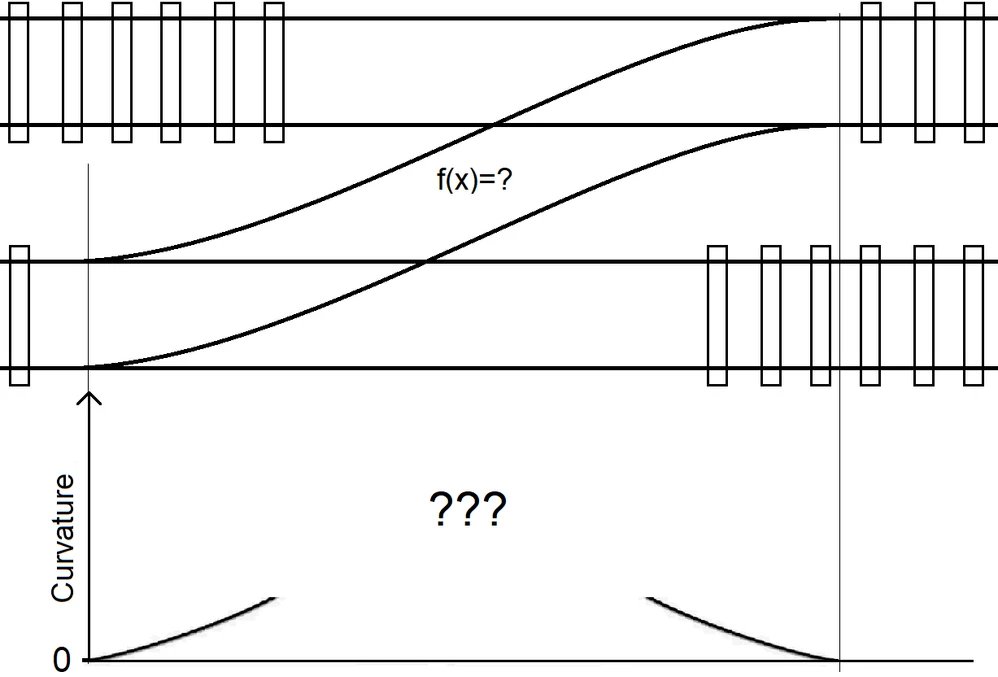
I would treat it like a cam, One key feature would be to avoid infinite jerk (rate of change of acceleration).  I've read that that makes for a more pleasant experience for the passengers (or cargo).  There are many cam profiles that can do that.  You'd want to balance jerk, acceleration and sideways velocity.  I'd start with 3-4-5 poly or cycloidal cam profiles, but I like to think the industry standardized on one.

16-Pearl
November 22, 2023

Your sketch of the track's transition (zero slope at each end) looks like a simple sine wave to me!

ChrisKaswer_0-1700663812795.png

Cheers!

24-Ruby IV
November 22, 2023

sin1.png

25-Diamond I
November 23, 2023

Paying attention not only to curvature but also to the third derivative of the displacement ("jerk") is certainly not unimportant, but let's not forget the fourth derivative ("snap" or "jounce"), the fifth derivative ("crackle") and the sixth ("pop"). 😄


The requirements for railroad tracks with lateral acceleration, wheel-rail friction, etc. are certainly completely different from those for road construction, where you could perhaps model with one (or two congruent) clothoid(s).


By the way, you're not just dealing with a single function here! If f(x) describes the fictitious center line, then the rails are so-called parallel curves and these are usually more complex different functions.


If you take this problem seriously, you can certainly have a lot of "fun" with it for a very long time ...


You may also be interested in this paper (in German),

https://dgk.badw.de/fileadmin/user_upload/Files/DGK/docs/b-314.pdf

in which the course of the rail is modeled by various different function types and also spatially because the rail inclination, which is intended to compensate for the lateral acceleration, is also taken into account.
However, I have only briefly skimmed the pamphlet...