
1-Visitor
January 12, 2011
Solved

Cylinder under external load

  • January 12, 2011
  • 2 replies
  • 23833 views

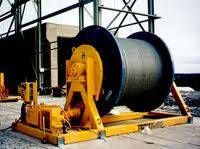
I am currently having trouble designing a reel winder in work, picture included below to help with the explanation.
Clipboard01.jpg

If you can imagine the wire coming off the bottom of the barrel and attached to a pipeline thus, putting the wire in tension. The tension in the wire creates a compressive stress in the barrel (hoop stress).

From here I have used to Hoop stress (also known as the circumferential stress) to find the external pressure using Lame’s equation, which is shown in the attached *.pdf.

From the solve block the external pressure seems acceptable, but the resultant tangential stress seems excessive.

Can anyone confirm if my Maths or logic is correct? I have been told that this could be calculated using the principle stress theory or a method out of Roarks, any ideas?

Mike

Best answer by wayne

Mike,
I made some corrections and some clarifications / comparisions.

Different references and mising thick walled and thin walled analysis was getting things messed up. This should be clearer

Designers sometimes use different loading assumptions to cover the possible loading conditons:

It looks like what was done in the past was:

1) Assume cyliner was continuoulsy wound with a uniform tenion in the cable, and not reaction or anchoring of the cable

Check stresses for this condition using von Mises.

Check stability of section, the collapse load.

2) Assume the cylinder anchored the cable (for it's rated load) by applying the cable force to the center of the cylinder, the cylinder then spans as a hoirzontal beam from end to end.

Check bending stresses

Check Shear stresses.

For case 2 however, I don't think the check is complete.

The cylinder cannot be loaded at the center, so there must be come torsion, which addes to the shear stress.

The worst case for shear is with the load applied towards on end or the othere.

This design assume no winds of the cable on the cylinder, whcih is probably not reasonable form what I understand. As a upper limit check, these stresses should be superimposed on the stresses from 1 and a von Mises check done.

Additionally, the collapse load is effected by case 2 as well, but much harder to analyize.

So the first thing is to determine what the actual design (loading) criteria is.

Wayne.

2 replies

12-Amethyst
January 12, 2011

Mike,

See attached.

The principal stresses are a check on the failure criterion, using von Meises, not a different method for obtaining the stresses.

Roarks formulas may look a little different and include calculations for the change in diameter due to pressure, but are the same for determining the stresses.

Both the Lame method and the Roark method (same) are based on continuously wound cylinders, in effect assuming, uniform conditions away from ends.

If you only have one wind, the condition is much better. You could estimate using the above, but use a larger effective width over which the cable force is assumed to act, therby lowering the stresses.

The end caps will go a long way to increasing the buckling, or collapse, load of the cylinder. Again, I believe the buckling equation is based on infinite lenght, or open ends.

A sketch would help, showing the how many windes and how the cable comes in and goes away from the cylinder, because I am still not sure.

Wayne

1-Visitor
January 13, 2011

The principal stresses are a check on the failure criterion, using von Meises, not a different method for obtaining the stresses.

Roarks formulas may look a little different and include calculations for the change in diameter due to pressure, but are the same for determining the stresses.

Right I get you, Wayne.

If you only have one wind, the condition is much better. You could estimate using the above, but use a larger effective width over which the cable force is assumed to act, therby lowering the stresses.

As a worst case, I think we would have to look at the barrel fully loaded with wire.

I will obtain a sketch from one of our Draftsman and post sometime today.

I have added a few notes to your sheet.

Cheers

Mike

wayne12-AmethystAnswer
12-Amethyst
January 13, 2011

Mike,
I made some corrections and some clarifications / comparisions.

Different references and mising thick walled and thin walled analysis was getting things messed up. This should be clearer

Designers sometimes use different loading assumptions to cover the possible loading conditons:

It looks like what was done in the past was:

1) Assume cyliner was continuoulsy wound with a uniform tenion in the cable, and not reaction or anchoring of the cable

Check stresses for this condition using von Mises.

Check stability of section, the collapse load.

2) Assume the cylinder anchored the cable (for it's rated load) by applying the cable force to the center of the cylinder, the cylinder then spans as a hoirzontal beam from end to end.

Check bending stresses

Check Shear stresses.

For case 2 however, I don't think the check is complete.

The cylinder cannot be loaded at the center, so there must be come torsion, which addes to the shear stress.

The worst case for shear is with the load applied towards on end or the othere.

This design assume no winds of the cable on the cylinder, whcih is probably not reasonable form what I understand. As a upper limit check, these stresses should be superimposed on the stresses from 1 and a von Mises check done.

Additionally, the collapse load is effected by case 2 as well, but much harder to analyize.

So the first thing is to determine what the actual design (loading) criteria is.

Wayne.

10-Marble
January 18, 2011

Mike,

I don't think you need to worry about overall elastic instability. A drum will not buckle under a wound-on rope any more than a concrete column would buckle under a prestressing cable. The tension in the rope and the compression in the cylinder shell are mutually bound, the one to the other, for buckling to occur the load must be independent of the structure so that it still has effect after a putative buckle has occurred. A few minutes playing with some string and a kitchen roll tube shows that even if you grossly distort a tightly wound tube there is no tendency to buckle; you can induce some localized creasing under the string where it first contacts the tube which, I think, is the main design problem with the shell. Especially if the item being wound in snags on something so that the cable force rises to the clutch-slip load, or whatever other cut-off device limits the system, (hopefully, before the rope breaks!).

Bill.

12-Amethyst
January 18, 2011

Lester,

Thoughtful respose.

I am not an expert in this area, this is more of a mechanical engineering field, but a few comments; (many of wich you allude to)

1) There is global buckling, local buckling and stability (which may be elastic or inealstic). An internally generated stress, like the prestressed column, will not buckle in a global sense from the internal prestress, as you point out, but it can buckle from local instability and it can be unstable.

2) In a perfect world, a column won't buckle either , just uniformily compress.

3) A beam- olumn, under transverse load, does not really buckle because it starts out displaced, but can become unstable and can have local instabilities.

4) The pretensioned column can be unsymetrically overstressed from the pretensioning and become unstable and fail, all by itslef

5) The barrel will not be perfectly round, will have significat internal stresses from the bending process (note that it already has plastic deformation) and will have at least one weld seam (which is why it may be inelastically unstable). Additionally the barrel must span from end to end to the bearing supports, so there are additional stresses. It is noted that the elastic stress check (nom Mises) is not really valid because of this, but it is still has merrit because it is a measure of the average stress levels, noting that stesses begin to even out as higher stressed areas become inelastic.

6) In the Richard Test (sorry Richard, but you invented the toilet roll test, so it's named after you), If you kink the role and then tension the string, It will have a load under which it will collapse. If the tension dissapeared as the tube begins to collapse, then I agree that it would not contnue to fail from the initial tension in the string, but if externally applied, as would need to be assumed in this case, it would. (I note that you also allude to this)

7) So what to do: Short of doing a bunch of tests, or a finite element analyisis, you could apply some general width /thickness criteria or local instability criteria as is done in the structural engineering field, and I assume is done in the mechanical engineering field as well. In this case, the engineer that did the calculations for which Mike is adapting, has a collapse equation, which on the face of it appears to have the necessary variables. I assume that this equation came from a handbook or text that addresses similar condiitons. It would be a good idea to find the origon if that equation, which is probabley in a mechanical engineering text, machine design, or something like that.

😎 You can also add stiffners, for example a donut shaped cylinder midway between the ends, which are already stiffened, along with some thickness criteria to prevent the local instability. (The end stiffners may already accomplish that, but I don't know).

Anyway, some more to think about. But in the end, there is some form of widht/thickness criteria that must be applied. (at least I definatly probably think that could possibily be the most likely possibility )

Wayne

10-Marble
January 18, 2011

Wayne,

Yes, I agree with nearly all of that.

In a perfect world, a column won't buckle either , just uniformly compress. I don't know about that, I thought the Euler load was the buckling load of a 'perfect' strut, not often, if ever, seen in the real world I grant you, but in a perfect world I would expect to see it. The whole point of the critical load is that it is the load at which a perfect column will buckle, even if there is an infinitely high material yield stress.

It was the 'collapse equation' which caught my eye, it is for the 'elastic critical stress in a short tube with ends held circular but not otherwise restrained'. It is in Roark, 4th ed. p 354. It was this which led me to respond and it is the point of principle that a wire wound round a cylinder might induce overall instability such as might arise in a cofferdam, for example; it will not.

I was reminded of a paper in the ICE Proceedings many years ago in which it was proposed that a prestressed turbo-alternator block could be 're-tuned' to avoid resonance with the machine by altering the prestress. Just like tuning a violin. Many professors of engineering replied to the discussion to say that this was rubbish, the wires might have been re-tuned but the block just got a mite shorter. I know this is vibration, not stability, but they are related effects.

regards, Bill