
24-Ruby III
July 23, 2013
Question

Experimental data best fit

  • July 23, 2013
  • 4 replies
  • 9062 views

Hi,

I have some data that have been obtained experimentally. I used the built-in function "genfit" for the selection of the approximating function. I took to be a form of this function like: f(x)=a*x^b. And in this case, I know that the function at the point x = 0 must be zero (f(x_0)=0). Are there any suggestions what other functions can describe the experimental data best way? Thanks.
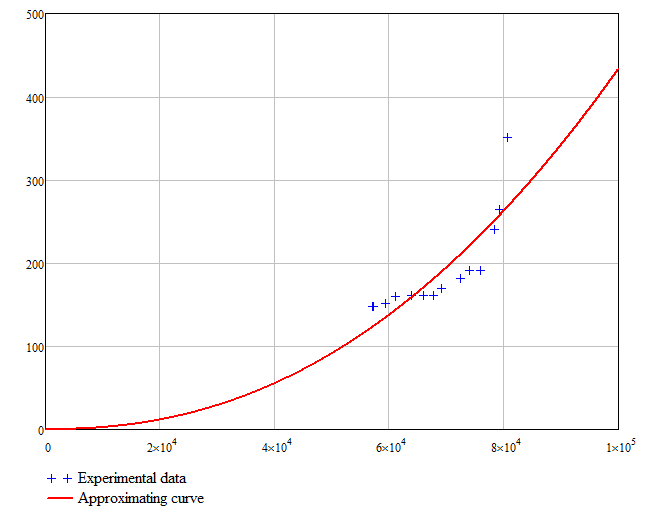
Pic_1.png

4 replies

25-Diamond I
July 23, 2013

It doesn't look from the rest of your data as if f(0)=0 but you should know better, of course.

See attached some other fit functions with two parameters.

Don't you know anything about the fit function you should expect?

I think the sorting at the beginning of your file needs some refinement.

bestfit.png

VladimirN24-Ruby IIIAuthor
24-Ruby III
July 25, 2013

Thank you, Werner. Theoretically the approximating function should look like the figure below. Sorting data at the beginning of the worksheet is not necessary. Experimental data is read from an external file in which the data are sorted in advance.

Pic_2.jpg

1-Visitor
July 23, 2013

One sugestion is to use an "S" shape function and fit it's constants - at least this is what I see (an S-curve shape) looking at the data.

One questions that may help - but I think you thought about this already: Can the process, from where the data come from, be modeled from first principles?

25-Diamond I
July 23, 2013

Did you give it a try?

Guess you would need more than two parameters to play with to achieve that.

bestfit4.png

1-Visitor
July 23, 2013

Yes, but without any success. I think we need a sigmoid function like this / similar one with more parameters.

Sigmoid_function.PNG

19-Tanzanite
July 24, 2013

An arbitrary order polynomial constrained to go through zero will fit it. But what's the purpose of the fit? If you want to get to the underlying physical parameters, then you need an equation that is derived from the underlying physics. If you just want an arbitrary smooth curve that is a reasonable fit then just fit a polynomial, and ignore the requirement that it goes through zero. An arbitrary function does not have to obey one physical constraint that is well outside the bounds of your data.

VladimirN24-Ruby IIIAuthor
24-Ruby III
July 25, 2013

I just need approximation function by with which I can get the intermediate points from the curve.

19-Tanzanite
July 25, 2013

Use regress to fit a polynomial. I would post a worksheet, but I have to head off for a very early flight.

25-Diamond I
July 26, 2013

Here is a slightly improved/speeded up verson of the first part alopng with a selection of different approximations

VladimirN24-Ruby IIIAuthor
24-Ruby III
September 3, 2013

Here are the results produced by the program CurveExpert Professional for "Nonlinear Model Fit":

Pic.png

Pic__.png

25-Diamond I
September 3, 2013

You get the same values using Mathcad with those two function types, but genfit is rather sensible with respect to the guess values. A solve block may find solutions which genfit doesn't.

In the file you sent you had used the inverse function, though. So you would have to plot X over Y to get the same.

See attached for more

bestfit1.png

bestfit2.png