
24-Ruby IV
February 5, 2023
Question

Formulas in Mathcad and textbooks

  • February 5, 2023
  • 2 replies
  • 4441 views

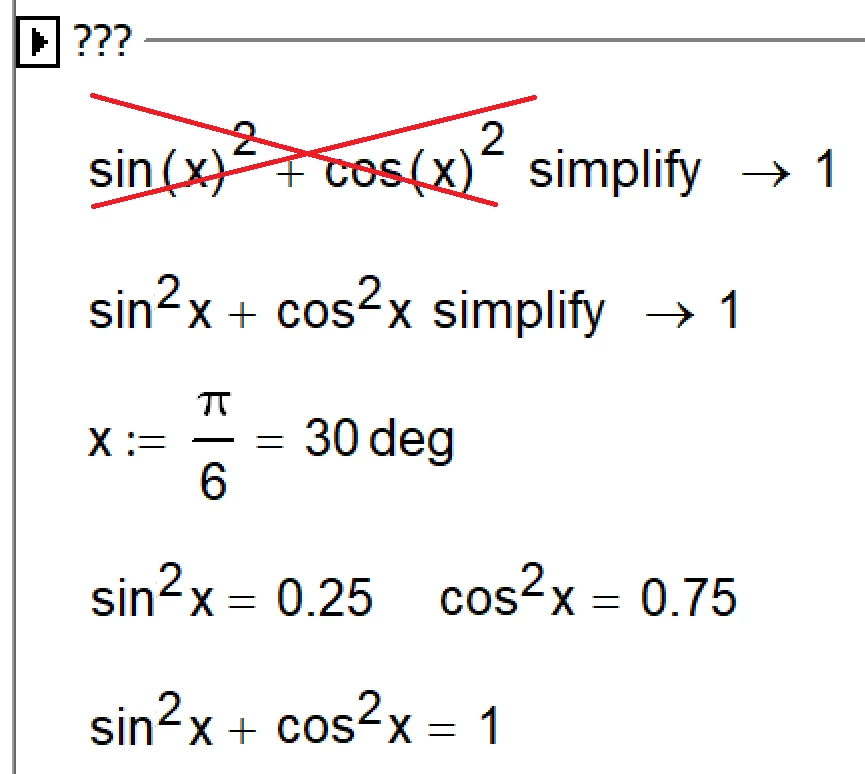
The writing of some formulas in Mathcad differs from the writing of these formulas in textbooks in mathematics.
My students have learned to partially correct this.
One example is in the picture.
Three questions.
1. Guess how my students do it! What is written in the hidden area.
2. Show other examples of such a mismatch of operators in Mathcad and textbooks.
3. What needs to be changed - Mathcad or textbooks?
sincos.png

2 replies

25-Diamond I
February 5, 2023

It goes without saying that its not the textbooks which should be changed, of course.


And Mathcads way of showing the square of the sine and cosine is perfectly compliant with the ISO80000-2. Omitting the parentheses and putting the exponent right after the functions name is allowed for named functions which also have a named inverse (and also preferred by me in that case) but its not mandatory.
The standards would also allow something like  Werner_E_0-1675627075788.png


BTW, try your workaround in Prime where we don't have the comfort of the Prefix Operator 😉

Werner_E_0-1675633695329.png

To conform with the standards we would of course have to change the standard Prime display to use an upright font without serifs.


And as you ask for other examples: The usage of "log" for the decadic logarithm "lg" is wrong! According to the standards "log" is neither the decadic nor the natural logarithm but should only be used to represent a generic logarithm, e.g. to demonstrate a log rule.
So instead of writing

Werner_E_0-1675629122672.png
you may simply write

Werner_E_1-1675629147734.png

but thats it. There is nothing like log(100)=2.

BTW, quite some lecture notes and even some textbooks use "log" for the natural logarithm "ln" which of course is incorrect, too.


24-Ruby IV
February 6, 2023

One of my students solved numerically the differential equations in Mathcad, and then checked it by solving the problem analytically on Wolframalppa website. The answer didn't match. The student struggled with the task until he realized that in Mathcad log is decimal, and in Mathematica it is natural.

25-Diamond I
February 6, 2023

@ValeryOchkov wrote:

One of my students solved numerically the differential equations in Mathcad, and then checked it by solving the problem analytically on Wolframalppa website. The answer didn't match. The student struggled with the task until he realized that in Mathcad log is decimal, and in Mathematica it is natural.


And both programs are doing wrong and do not respect the standards. This ignorance is not understandable.
Mathematica is famous for using non-standard own notations - just think of Sin[x] instead of sin(x) or the wrong Sin^-1[x] instead of arcsin(x).  asin(x)as used by Mathcad is often seen in publications, but its not compliant to the current standards. Using sin^-1(x) as is often used by school pupils is definitely wrong. If this would be a valid notation for the inverse of the sine function, we would not be allowed to write sin²(x) or sin² x  for the square of the sine function.
The inverse of a generic function named f(x) is to be named f^-1(x) but you are not allowed to write f²(x) for the square but must write f(x)² or (to be on the safe side as many people think that the argument is squared that way) (f(x))².

But the rule is that if the function and its inverse have special defined names (like sin and arcsin) these names must be used but for this we may use the convenient notation for the powers.

The rule is not really clever if you remember that f^-1(x) ist the inverse of the function f(x), but sin^-1(x) is the reciprocal of sin(x).  Its even worse in German, where the very easily confused expressions "Umkehrung" (for inverse) and "Kehrwert" (for reciprocal) are common.

Wish the standards would have chosen a different notation for the inverse of a generic function f(x).
I remember when  I was first confronted with inverse functions at school, the notation we used was f*(x) and not f^-1(x) but we soon had to switch over to the other notation.
OK, when first heard about the set of natural numbers, zero wasn't in that set. It was only somewhere in the 1970's when the standards were changed and since then zero is a natural number, too. Guess I am showing my age ...

ttokoro
21-Topaz I
21-Topaz I
February 6, 2023

image.pngimage.pngimage.png

t.t.
24-Ruby IV
February 6, 2023

sinx - without any space???

ttokoro
21-Topaz I
21-Topaz I
February 6, 2023

I can make bellow, but I can't find how to make sin x.

image.pngimage.png

t.t.