Number theory was definitely the domain of the old genius programme Derive. This was bought up by Texas Instruments and distribution was then later discontinued. Nevertheless, there are still sites from which you can download a 30-day demo version of the programme.
http://www.austromath.at/daten/derive/derivedemo.htm
However, I don't know if there is still a legal way to purchase a licence key for the permanent use of the programme.
There has been a magazine since 1991, the Derive User Group Newsletter, which I was recently surprised to discover is still published online and freely available. D-N-L #128 was published last December. All 128 booklets are available here for free
http://www.austromath.at/dug/
I have particularly fond memories of Johann Wiesenbauer's contributions in the D-N-L.
So if you are curious you may give it a try, and, I am not sure, but some contributions might be valuable even without having Derive at hand.
It sure might be possible to create the functions you are looking for in Mathcad or even in Prime, but they would be rather slow and limited to IEEE floating point with all its drawbacks (Derive used internally integers only and implemented their own calc routines to deal with really large integers - the limit was only the memory installed).
Just for demonstration I add a sheet which I posted here quite some time ago when someone has a question to prime twins and prime cousins, etc.
I now added a function to factorize numbers and then it was easy to also write the Euler phi function or a function for the number of divisors.
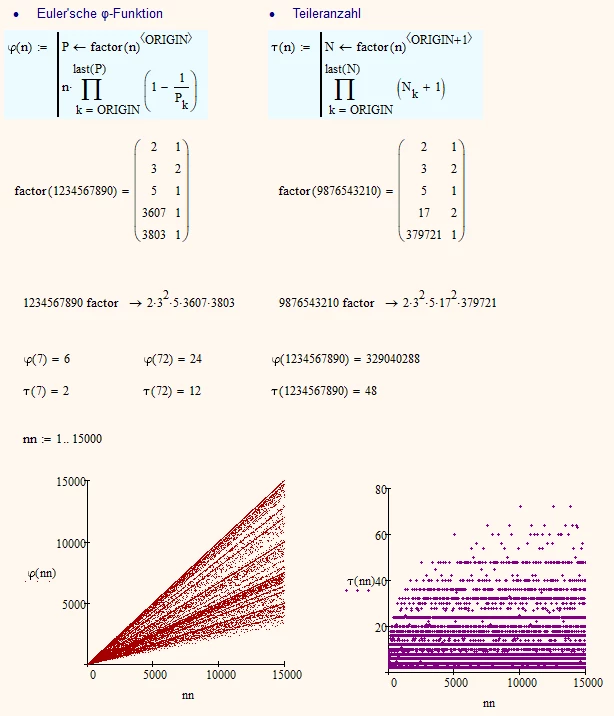
But be aware that things really get slow when it comes to numbers with very large prime factors!
And in no way I claim that my implementations are optimized for running speed and memory usage. They are certainly not, and there is still a lot of room for improvement.
EDIT: Added Function to return the set of all divisors (quite inefficient) and a divisor function (returns sum of powers of divisors).
EDIT2: Added a far more efficient "Teiler" function to return a vector with all divisors.
TODO: make the old prime number functions accessible for symbolic evaluation
speed up prime number functions (nextPrime, etc.)