Best answer by LucMeekes

Apparently your Vin is a square wave...

Have you tried what Prime finds for the invlaplace of just:

tanh(s)    ?

According to WolframAlpha it's:
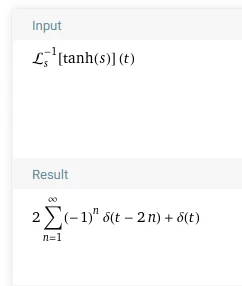
LucMeekes_0-1640161140641.png

I don't see how Prime got an infinit'th derivative in there, but that's what it tries to do apparently.

That said, I don't think you will be able to solve this problem in this generic way. Try to describe your input for just a few cycles of the square wave, instead of the general square wave. That gives you a better chance of performing the inverse laplace. I suggest you have alook here: https://community.ptc.com/t5/PTC-Mathcad/Square-Sine-and-PiceWise-Linear-Waves-Functions/m-p/718121#M194834

And, if you're only curious about the form of the resulting wave, use a circuit simulator (SPICE, LTspice, or the like).


Success!
Luc

6 replies

LucMeekes23-Emerald IVAnswer
23-Emerald IV
December 22, 2021

Apparently your Vin is a square wave...

Have you tried what Prime finds for the invlaplace of just:

tanh(s)    ?

According to WolframAlpha it's:

LucMeekes_0-1640161140641.png

I don't see how Prime got an infinit'th derivative in there, but that's what it tries to do apparently.

That said, I don't think you will be able to solve this problem in this generic way. Try to describe your input for just a few cycles of the square wave, instead of the general square wave. That gives you a better chance of performing the inverse laplace. I suggest you have alook here: https://community.ptc.com/t5/PTC-Mathcad/Square-Sine-and-PiceWise-Linear-Waves-Functions/m-p/718121#M194834

And, if you're only curious about the form of the resulting wave, use a circuit simulator (SPICE, LTspice, or the like).


Success!
Luc

ssato15-MoonstoneAuthor
15-Moonstone
December 22, 2021

Luc san,


 The input voltage is continuous rectangular wave.

We get the laplace  transofrm from a text book.


I agree the using circuit simulator.


Thanks


ttokoro
21-Topaz I
21-Topaz I
December 23, 2021

Using E(s) instead of 1/s*tanh(s*T/4), you can get the answer.  T and E must change the ones you use in your sheet.

image.pngimage.pngimage.pngimage.pngimage.pngimage.png

t.t.
21-Topaz II
December 22, 2021

Hi!
my solution with Mathcad 15:

answer to ssato.jpg

ssato15-MoonstoneAuthor
15-Moonstone
December 22, 2021

MFra san,


Your answer is too difficult for me.

I try to study your reply..


Thanks


21-Topaz II
December 23, 2021

Hello,

in the file you find at https://community.ptc.com/t5/PTC-Mathcad/3-LOW-PASS-I-order-DIGITAL-FILTERS-EQUIVALENT-TO-LINEAR-CLASSICS/mp/449024 # M176358, there is the study with the use of the Laplace transform, of the response of a linear and stationary system to different periodic signals.

23-Emerald IV
December 23, 2021

If I'm not mistaken, this your circuit:

LucMeekes_4-1640275834895.png

(L1 is quite a large inductor)

This is I1, the current in L2:

LucMeekes_3-1640275716557.png

Appears to increase to a steady amplitude, but look further:

LucMeekes_5-1640275926271.png

And in the long run, the first 20 ms:

LucMeekes_6-1640275982286.png

And up to 200 ms.

LucMeekes_7-1640276165563.png


Success!
Luc


ttokoro
21-Topaz I
21-Topaz I
December 23, 2021

Magnitude of i1(t) is different but the shape is almost same by Prime 7 for 25 cycles of applied voltage with +-both sign applied.

image.pngimage.png

t.t.
ssato15-MoonstoneAuthor
15-Moonstone
December 24, 2021

Hello Luc san, ttokoro san,


I attempt your method what is to describe my input wave form for just a few cycles of the square wave

I attached the work sheet. Almost is OK.

But I think the polarity of the only first cycle is reversed.


ssato_0-1640321315920.png

The polarity of waveform attached by ttokoro-san looks correct.


Is my wave form is correct , or do I have a mistake ?


Thanks


21-Topaz II
December 24, 2021

Hi!

Taking the cue from the circuit provided by LucMeekes and considering I1 as the current produced by the generator, I made this analysis of the circuit by inspection. The results are:

answer to ssato++.jpg

ttokoro
21-Topaz I
21-Topaz I
December 25, 2021

image.pnginstead of 9.02*10^-12.

t.t.
21-Topaz II
December 25, 2021

Improved solution:

answer to ssato W.jpg

ttokoro
21-Topaz I
21-Topaz I
December 25, 2021

Dear MFra,

Your last equation h(t) has no Unit step function, USF 


image.png

I think step voltage responce must have USF for every switchuing time as at first Luc shows us.

Because this transient responce is a convolution of Voltage signal and the inpulce response of the system. 

t.t.
21-Topaz II
December 25, 2021

thank you very much, I corrected the original.

5-Regular Member
January 2, 2022

You get symbolic evaluation result that contains a limit and cannot be evaluated to real numbers neither symbolically, not numerically, that is why it also cannot be plotted.

Behind the scene plot just takes the input function and calculates it's values in some set of points. The function that you pass to plot cannot be evaluated in any of the points, that is why you see this error message and no trace.

We did some improvements related to integral transforms in Mathcad Prime 8, but they do not help in this particular case.

Please report this problem to tech support (https://www.ptc.com/support/case-logger) and we will check if it is possible to improve handling of such cases.