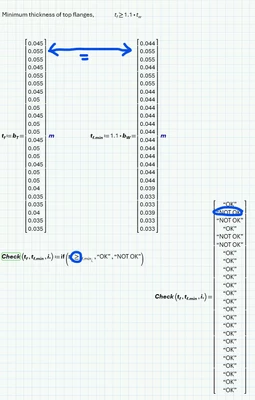
Prime possibly is correct. Let the two vectors display with more than 3 decimals and I guess you would see that second entry in the first vector is slightly smaller than the corresponding element in the second vector.
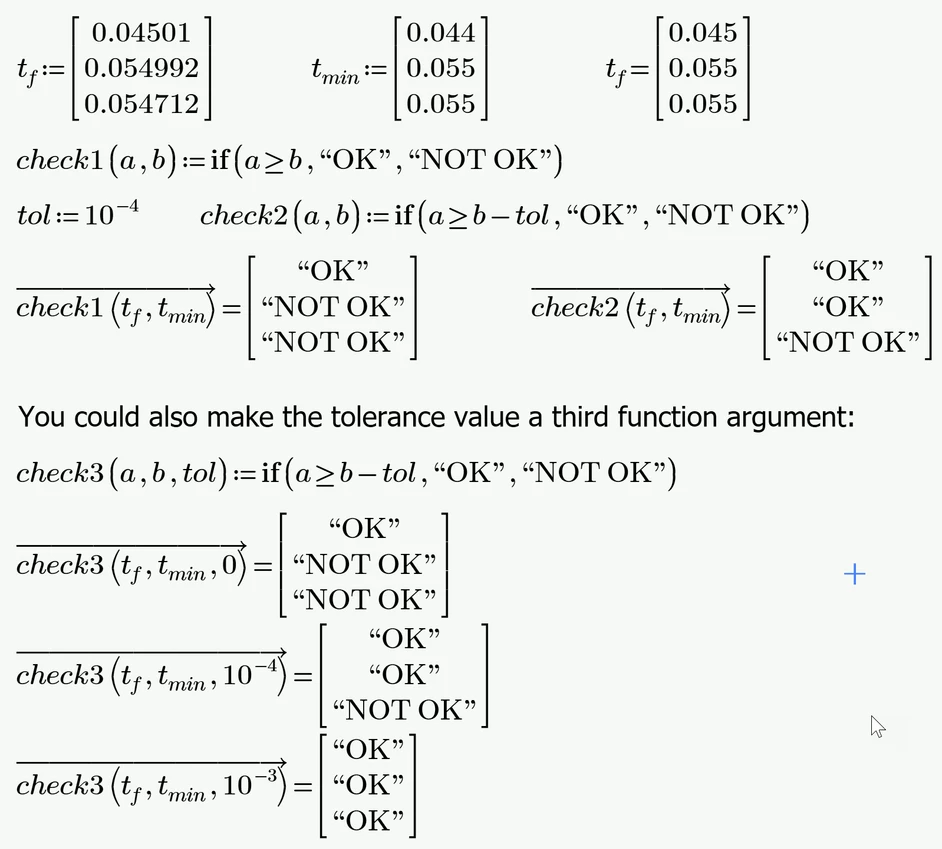
If this does not matter for you because the values still are within an acceptable tolerance, lets say 10^-4, you could use t.f>=t.min-10^-4 instead of t.f>=t.min.
BTW, I guess it would be better to get rid of the third range argument "i." and call the check function vectorized. That way the result would be a true vector and not an invalid object which only can be displayed but not assigned to a variable.
If you need to use that kind of check more often in a sheet and don't like to have to vectorize the call every time, you may also do it that way:
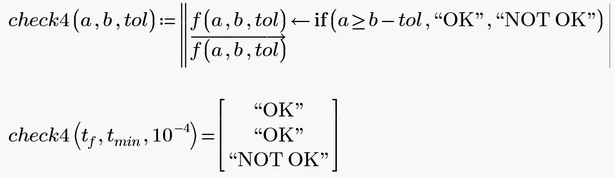
As we can't vectorize the if-function directly it was necessary to use a local function f.
An alternative approach (as opposed to the tolerance variable) is to actually round the values in both vectors to the desired precision:

Personally I would not prefer that approach, though.