
1-Visitor
July 5, 2017
Question

Point-Mass at it's Orbit: Newton's Equations searched

  • July 5, 2017
  • 3 replies
  • 4297 views

Hello!

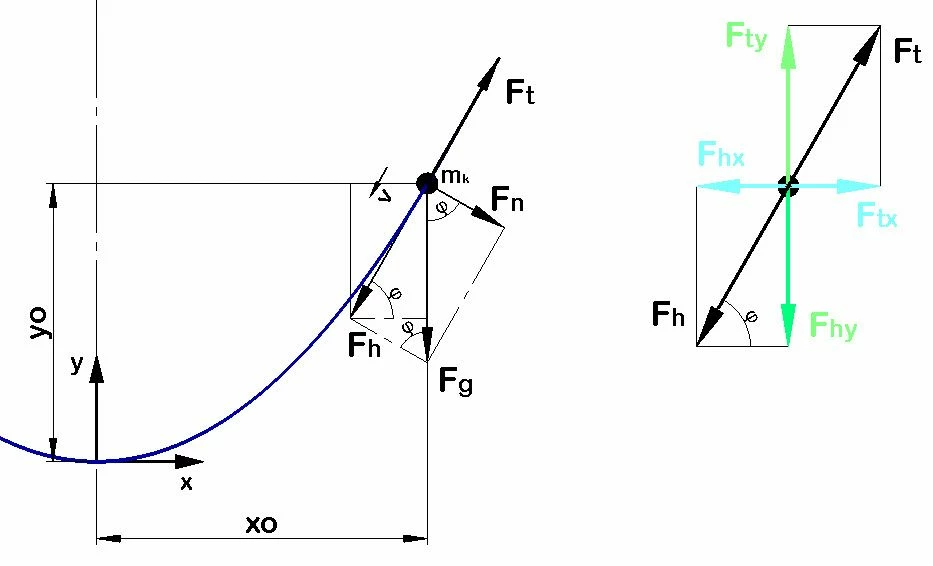
I have calculated the complete dynamics for a mass-point moving along a parabola curvation without any resistance like air-resistance, friction, etc.
 

05-07-2017 21-34-02.jpg


The solution is correctly solved with the Lagrangesche-methos, the movement happens in that way i suggested.

But sometimes it's very complex to create ODEs in that way and therefore it's better to use Newton's Laws.


I tryed to solve the problem with the dynamic balance of forces acting on the mass, but i couldn’t get the same solution in that way so i’m asking what’s wrong. (please see attachement including MP4 and Pdf-file)


Can somebody tell me what’s wrong there?


Thank you very much.

3 replies

23-Emerald I
July 6, 2017

The attached file may help

vlehner1-VisitorAuthor
1-Visitor
July 6, 2017

Hi Fred,

In principal i understand what you calculated.

But what i do not understand is: The sign of the force Fhx.


Initial situation:

The body is on the right side and we release it at xo, then it moves along downwards the curvature to the left.


I calculated Fhx as negative and added Ftx, this should be zero.(see sketch)

Fhx (yellow) is acting from right to the left side and will accelerate the body, the force Ftx acts from left to the right because the body has the intension to stay at the position he is (=Trägheitskraft).


If i built the sum, then i have: -Fhx+Ftx=0 what gives a wrong graph, but the dynamic statik says: the sum of all forces have to be zero. In many textbooks i saw this same procedure.


When changing the sign of Fhx to positive, i get a correct graph like you have.

Now i'm confused because i know that the sum of all acting forces have to be zero taking into account their direction they act.

I had the same problem in the thread: https://community.ptc.com/t5/PTC-Mathcad-Questions/Hello-World-See-my-1-st-Prime-Animation/td-p/196317/page/7


neither something in my interpretation is basically wrong, nor something other don't work correctly.

Please explain me.


Thanks for your help.

vlehner1-VisitorAuthor
1-Visitor
July 6, 2017

Another example for the sum of all forces:

We have an inclined plane without friction and any resistance, then it is (like in many textbooks):

 Scan.jpg

This princip is the same with the parabola.

vlehner1-VisitorAuthor
1-Visitor
July 7, 2017

Something else has occurred to me:

comparing the ODE from the Lagrangesche Method with the ODE from the Newtons method shows following:

Lagrangesche ODE:


07-07-2017 11-51-32.jpg


Newton's ODE:


07-07-2017 11-54-41.jpg


Note, that the sin and cos functions can be written here as:


07-07-2017 11-58-03.jpg

vlehner1-VisitorAuthor
1-Visitor
July 7, 2017

All this is from my textbook kinetics, technical mechanik 3:

The origin task see example 4.5 in this textbook.Scan1.jpg


Scan.jpg


21-Topaz II
July 7, 2017

Hi Volker,

Could you be interested in the following Lagrange multiplier technique? 

Material poin on a surface.jpg

Greetings

Francesco

vlehner1-VisitorAuthor
1-Visitor
July 7, 2017

Hi Francesco,


Absolutely!

It's impressive.

could you attach this file please- then i can study it much better.

Thank you.

21-Topaz II
July 8, 2017

Hi Volker,

I've attached the requested file.

I hope I've zipped the file correctly.

Greetings

Francesco