

1-Visitor
August 12, 2016
Question

Stumped Help Please

  • August 12, 2016
  • 2 replies
  • 5626 views

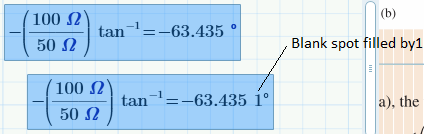
I have a problem in mathcad I do this problem -(100ohms/50ohms)tan^-1=  Now when I try to add a degree sign at the end it errors out.  I have done this problem and know it works however when trying to do it again this happens.  I noticed the only difference between the one that works (formula) and the one that doesn't there is a shaded out box before the degree sign (one that doesn't work) I have tried to delete it no go.  Any suggestions?PTC2.png
2 replies

25-Diamond I
August 15, 2016

> I have a problem in mathcad I do this problem -(100ohms/50ohms)tan^-1=

Thats no correct mathematical expression (unless tan is a scalar an not the trig function).

If tan^-1 should be the inverse function of tan, you should  never call it tan^-1 (even though Mathematica does it and you probably see tan^-1 on your calculator) as it has a standardized name:- arctan. In Mathcad and Prime this function is called atan.

Prime for some unknown reason supports the usage of tan^-1 in combination with that strange postfix notation but I see no reason why this should be used.

To get the angle displayed in degree you can either type deg in the unit place holder, or type 1°(as you have done but it sure looks not good) or use the menu to insert the appropriate unit (unlike as in Mathcad 15 and below, in Prime the degree character unfortunately cannot be inserted simply via keyboard).

To conform with the standards you may (somewhere near the top of the sheet, maybe in a collpsed region) define a function arctan and use this

WE

16-Pearl
August 22, 2016

Werner,

What amazes me here is that the postfix notation actually works for all the built-in and user functions I have tried.  I can't find any documentation on this.

Additionally, the tan^-1 notation works in postfix notation, but not in prefix notation.

Thinking back to how Mathcad 13-15 implemented affine temperature units with postfix operators, this postfix notation might have some interesting possibilities for user functions where it makes more sense, notationally, for the operator to follow the parameter.  This is an interesting quirk that Scott has stumbled upon.

Jeff

25-Diamond I
August 23, 2016

I wasn't amazed that postfix notation worked in Prime as I had noticed this before.

But I was amazed to see that some (it doesn't work with ln or log) inverse functions seem to be defined in two different ways and the notation with ^-1 can only be used as postfix. tan^-1 cannot be used the usual way.

As the inverse of the trig function should not be named that way (^-1) and the notation is simply wrong, I would call that a bug, not a feature 😉

Not sure what they had in mind when they implemented it.

While even a user defined function can be used in postfix notation, ....^-1 (of course) does not work with a user defined function (but that would be a nice feature 😉

Werner

12-Amethyst
August 15, 2016

the confusion is caused by the option either of the function or the unit.

in this case you need the unit -

go to the "units" tab on the math page and under angle you have the choice of 2 different symbols for degrees or radians, steradians, revolutions or DMS.

the option on the operator tab allows the input of a number as degrees, but it will be converted to and stored as radians.

regards

Andy

slasky1-VisitorAuthor
1-Visitor
September 9, 2016

Jeff,

As I read you reply, the duh kicked me.  I am going to us my educational option, starting today.

Thanks.

Scott