10-Marble
April 23, 2014
Solved

Symbolic partial derivative operator in Mathcad Prime 3 - where is it?

  • April 23, 2014
  • 1 reply
  • 14487 views

Assuming I have a simple function such that f(x,y)=x^2+x*y+y is it possible with Mathcad Prime 3 to find the symbolic partial derivative of the function f'x(x,y)? For some reason I cannot find how to do this. f' seems to only give a normal first derivative. Is there some tricky keystroke to enable partial derivative notation in MC Prime 3? I find it hard to believe that PTC would have overlooked that functionality?

Kind regards, Mark

Best answer by Werner_E

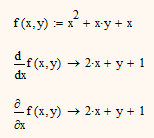
You have to use the detailed derivative operator. While the pic below is from Mathcad 15 (didn't want to wait until Prime3 has started as it takes so long) but its the same in Prime, too. Only difference is that in Prime you can't make it look like a true partial derivative (last line in the pic).

23.04.png

1 reply

Werner_E25-Diamond IAnswer
25-Diamond I
April 23, 2014

You have to use the detailed derivative operator. While the pic below is from Mathcad 15 (didn't want to wait until Prime3 has started as it takes so long) but its the same in Prime, too. Only difference is that in Prime you can't make it look like a true partial derivative (last line in the pic).

23.04.png

10-Marble
April 23, 2014

I see, but this is not how the text books show partial derivatives of a function. It usually looks like f'x(x,y) or as it is shown in Mathcad 15. I think the current MC Prime notation is incorrect and in my view, shows a degree of laziness on the part of the PTC programmers and could cause confusion.

25-Diamond I
April 23, 2014

Mathcad 15 still misses (and ever will be missing) quite some features which where demanded for long times by its users and Prime essentially is missing a lot of features we already are used from Mathcad 15 and below while adding only very few additional benefit (like mixed units in arrays).

Maybe we would need along with the literal and the vector index a third subscript denoting partial derivative to make the confusion as of which subscript to use complete and maybe Prime will offer a better notation for partial derivatives one day.

If you solve a PDE using a solve block with PDESolve, the literal index has to be used to denote partial derivatives anyway and so it follows the usual subscript notation.

For other (documentation) purposes you may define it yourself and hide the definitions in a collapsed area. You can't hide that area completely making it invisible as in MC15 but sufficent enough so its out of the way. So at least you can duplicate the subscript notation from the textbooks.

partDer.png