
Solved
Two Why: Units in Mathcad and Excel
PS
Is there a short name ofthe base US pressure units?

PS
Is there a short name ofthe base US pressure units?
Valery…
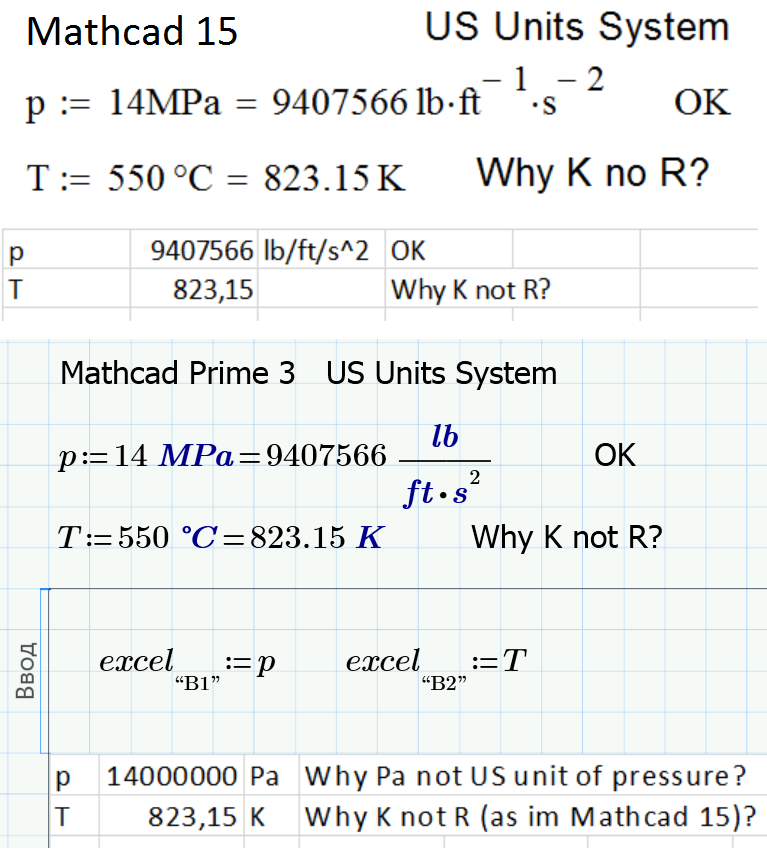
The base temperature unit in the US system *is* Rankine. Mathcad gets it wrong.
However, I and Mathcad are both unit-bilingual, so this Mathcad error is mearly an annoyance. BTW, I was just looking at the definition of the ICAO Standard Atmosphere (for something totally unrelated to this conversation and even my own work) and found that the standard lapse rate used to calculate temperatues in the lower atmosphere is officially defined as "-1.98°C per 1000 feet." Yep, mixed unit systems…at least according to the three semingly knowledgeable websites I checked.
In the US, the federal government requires the use of SI units for its projects…at least, they're supposed to. Most, if not all, state and local agencies still use the US unit system (the California Department of Transporation tried SI for a while, but gave up).
As a civil engineer, I have designed and/or managed the design of site and infrastructure improvements for three federal prisons and three other federal projects. In all six cases, the use of SI units was a problem for some members of the design team and for most members of the construction and construction management teams. I once even had a drafter ask me how to draw a 3:1 slope in metric (that's 3 horizontal to 1 vertical). I did it for him…fortunately he was fired soon after.
The worst situation was a couple of buildings at a local naval air station. I won't go into all the details, but at the project kick-off meeting, the architect complained about having to use SI units. The Navy's project manager said he and his staff didn't like SI units either so he made a command decision to design the project using US units. I piped up and said that the topographic survey the Navy had provided us was in SI units and I was not going to accept the liability of converting the data to SI (it would have been a fairly simple procedure, but it was not my responsibility). The Navy's PM said he didn't have the money for a new survey (maybe $7,000 out of a budget of $20,000,000  ) and the previous surveyor was no longer under contract. So, in the best tradition of King Solomon, the Navy's PM decreed that the site work would be designed using SI units and the buildings using US units.
  I told the Navy's PM and the rest of the design team that this was a VERY bad idea, but that my project engineer and I were fully able to make it work. And we did.
Fred
No account yet? Create an account
Enter your E-mail address. We'll send you an e-mail with instructions to reset your password.