
14-Alexandrite
July 25, 2025
Solved

Uniform snow load from snow drift (triangular load)

  • July 25, 2025
  • 2 replies
  • 823 views

Hello All,


I have attached a Prime 9 sheet. I am trying to calculate  the uniform load on several members resulting from triangular snow load. i have included my instructions as to what needs to be accomplished. 


Thank you for your assistance!

Sam

Best answer by Werner_E

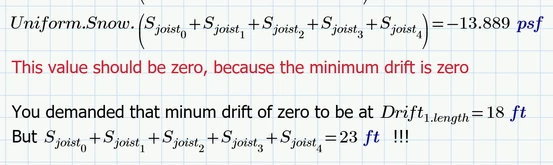
I don't understand why you think that that last value should be zero
Werner_E_0-1753480343905.png

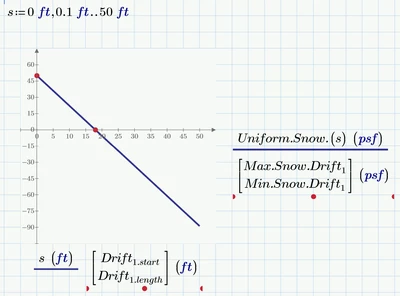
With your function you simply connected two points by a straight line which also extends beyond the points
Werner_E_1-1753480424361.png

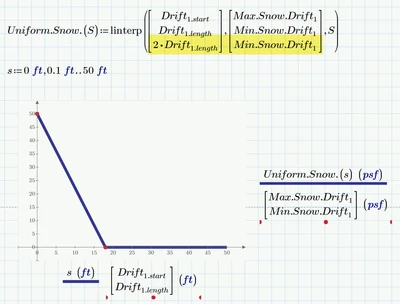
If your intention was that the function value should be zero for all values of s beyond 18 ft, you simply would have to add a third value larger than the last and with the very same function value.
Werner_E_2-1753480687342.png

Now you get

Werner_E_3-1753480719470.png

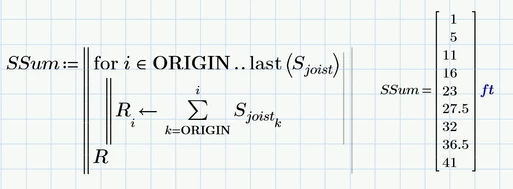
To automate what you did manually step by step you could create a vector containing the sum of all S-values up to
Werner_E_4-1753480812447.png

and use this vector of sums as function argument (vectorization not mandatory here but its good to be on the safe side)
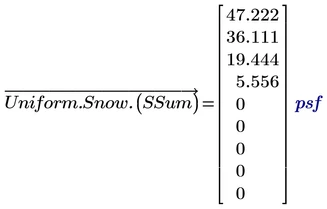
Werner_E_5-1753480901371.png


To automate the 'Trib' values you could use
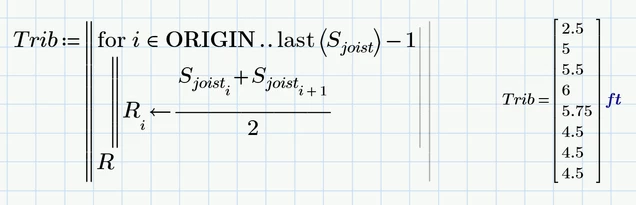
Werner_E_6-1753481191341.png

But for obvious reasons (every element is the arithmetic mean of the corresponding S-value and its successor but the last value in the S vecor has no successor)  this vector has one element less than the rest and so you would not be able to multiply the 9-element vector with the 8-element vector Trib.

But you sure can multiply the first 8 values
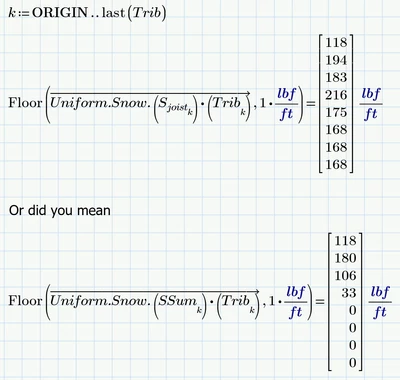
Werner_E_7-1753481634181.png

Not sure if that's what you had in mind

maybe you wanted SSum to be used when calculating the Trib vector and not S.joist? You have to know what you need


Anyway, P9 sheet attached


2 replies

12-Amethyst
July 25, 2025

И так?Screenshot_1.png

SFares14-AlexandriteAuthor
14-Alexandrite
July 25, 2025

Hello Nick,


I’m not sure if what you did is correct. Could you please send me the sheet or a screenshot of your work, and make sure the units are in US units?


Thanks,

Sam

Werner_E25-Diamond IAnswer
25-Diamond I
July 25, 2025

I don't understand why you think that that last value should be zero

Werner_E_0-1753480343905.png

With your function you simply connected two points by a straight line which also extends beyond the points

Werner_E_1-1753480424361.png

If your intention was that the function value should be zero for all values of s beyond 18 ft, you simply would have to add a third value larger than the last and with the very same function value.

Werner_E_2-1753480687342.png

Now you get

Werner_E_3-1753480719470.png

To automate what you did manually step by step you could create a vector containing the sum of all S-values up to

Werner_E_4-1753480812447.png

and use this vector of sums as function argument (vectorization not mandatory here but its good to be on the safe side)

Werner_E_5-1753480901371.png


To automate the 'Trib' values you could use

Werner_E_6-1753481191341.png

But for obvious reasons (every element is the arithmetic mean of the corresponding S-value and its successor but the last value in the S vecor has no successor)  this vector has one element less than the rest and so you would not be able to multiply the 9-element vector with the 8-element vector Trib.

But you sure can multiply the first 8 values

Werner_E_7-1753481634181.png

Not sure if that's what you had in mind

maybe you wanted SSum to be used when calculating the Trib vector and not S.joist? You have to know what you need


Anyway, P9 sheet attached


SFares14-AlexandriteAuthor
14-Alexandrite
July 28, 2025

Thank you so much, Werner!

What  I have is snow drift, which is a triangular load. I was focusing first on Drift #1. As shown below, the snow is maximum at support zero then it decreases to zero. So support 4 and 5 get no snow drift, and that's why i said , the snow drift is zero beyond the snow drift length.


SFares_0-1753537553852.png

you stated "S-value and its successor but the last value in the S vector has no successor)  this vector has one element less than the rest", I agree with your observation.  believe i need to make and adjustment as to what happen ends at a support or somewhere in between. the load calculation will be different. i will have a follow up question later.


Regards,

Sam


23-Emerald I
July 29, 2025

So your drift is triangular in two dimensions?

Fred_Kohlhepp_0-1753788032444.png

And the section of the drift at each joint changes?
