
6-Contributor
October 8, 2025
Solved

Adding splices to a harness in Cabling (Creo Cabling)

  • October 8, 2025
  • 1 reply
  • 457 views

Building a decent sized harness that will have a few places where things get spliced, found this video which give me some information on a way to do it...

https://www.youtube.com/watch?v=n1Ff4-zHkbA


Few things I'd like to know is one is this the best way to add splices to a harness? Would there be a way to do it without adding another physical part to the mix? I have not verified this but doing it in this way would create a new wire number (W-1,W-2 etc) for each new wire that comes out of the splice which would show up as individual wires on a to from table in a drawing. Would there be another method that would call out all those wires as one wire number but still allow multiple gauges?


If this is the only way then I get it Creo being Creo. I just find it hard to believe that there isn't a way to splice wires without adding another solid body to the harness assembly and just doing it right in the harness menu.
Best answer by Lars_F

Hello,


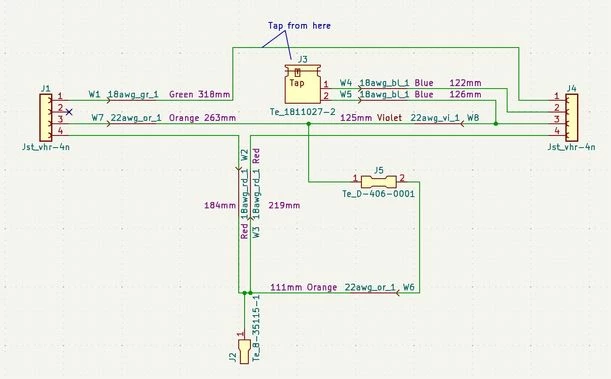
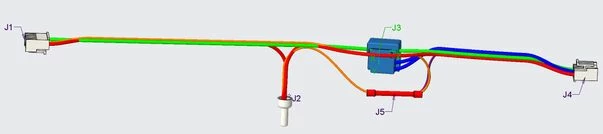
In the video, the author appears to have a well-structured network, but is manually connecting components, which can be both challenging and prone to errors.


Splices function similarly to other types of connectors, with the exception of tap splices, which are designed to connect to an existing wire without interrupting its continuity.


In contrast, butt splices and closed-end splices typically require the wires to be cut to length and terminated at the splice point.


The bill of materials (BOM) should include all relevant components—connectors, splices, and wires—to ensure completeness and traceability. How would you splice a wire without adding something solid to the bom?


Each outgoing wire from a splice should be clearly defined in a wiring table, specifying both the wire type and length. This enables the contractor to accurately cut and prepare the wires for construction of the harness.


When working with schematics, it is relatively straightforward to add wires and splices as needed, allowing for flexible and efficient design modifications.


Lars_F_0-1760025393424.jpeg

Lars_F_1-1760025435948.jpeg


Br, 

Lars


1 reply

Lars_F14-AlexandriteAnswer
14-Alexandrite
October 9, 2025

Hello,


In the video, the author appears to have a well-structured network, but is manually connecting components, which can be both challenging and prone to errors.


Splices function similarly to other types of connectors, with the exception of tap splices, which are designed to connect to an existing wire without interrupting its continuity.


In contrast, butt splices and closed-end splices typically require the wires to be cut to length and terminated at the splice point.


The bill of materials (BOM) should include all relevant components—connectors, splices, and wires—to ensure completeness and traceability. How would you splice a wire without adding something solid to the bom?


Each outgoing wire from a splice should be clearly defined in a wiring table, specifying both the wire type and length. This enables the contractor to accurately cut and prepare the wires for construction of the harness.


When working with schematics, it is relatively straightforward to add wires and splices as needed, allowing for flexible and efficient design modifications.


Lars_F_0-1760025393424.jpeg

Lars_F_1-1760025435948.jpeg


Br, 

Lars


6-Contributor
October 10, 2025

OK I think that makes sense, I guess I thought in my head that that wire would have the same label across all the wires in the splice, but it makes sense for them to be different so it shows up in the to from table nicely.


Thanks