



Techniques for design of parts that are molded flat but are 3D in assembly and use
I am looking for users that have experience designing injection molded parts that are molded in a flat state but adopt a 3D topology in use. I have been challenged by some users to develop a method that allows for the design of the parts in a 3D state that can be flattened for mold design. I am curious to see how this may be handled in other environments.
We are well aware of the mathematical constraints surrounding surfaces that can be developed. This is critical to being able to create a flat pattern from a formed shape. Based on this we currently approach this by designing the flat pattern part and then "morph" it to the assembled form. Both states of the part are needed in the CAD during design for verification and validation prior to tooling the parts.
Some users have argued that they would prefer to model the 3D formed version of the part and flatten it when released for tooling. While this may be a preferred approach, I do not see how to do it without consideration of developable surfaces during the whole design process. Without this the part will not flatten without distortion.
I have used a hybrid approach where the flat (as molded) version is designed simultaneously with the 3D formed version. The downside of this is that it requires a very high level of competence in Creo and use of some arguably convoluted techniques.
I have also tested methods that use material properties to predict deflection when assembled. Conceptually think FEA based on forced displacements although it is a bit more complicated than this. This requires that only the flat version is explicitly modeled. It is currently an iterative process but could be more automated.
This is an example (simple) of a polymer part that is molded flat but adopts a non-planar topology when assembled.
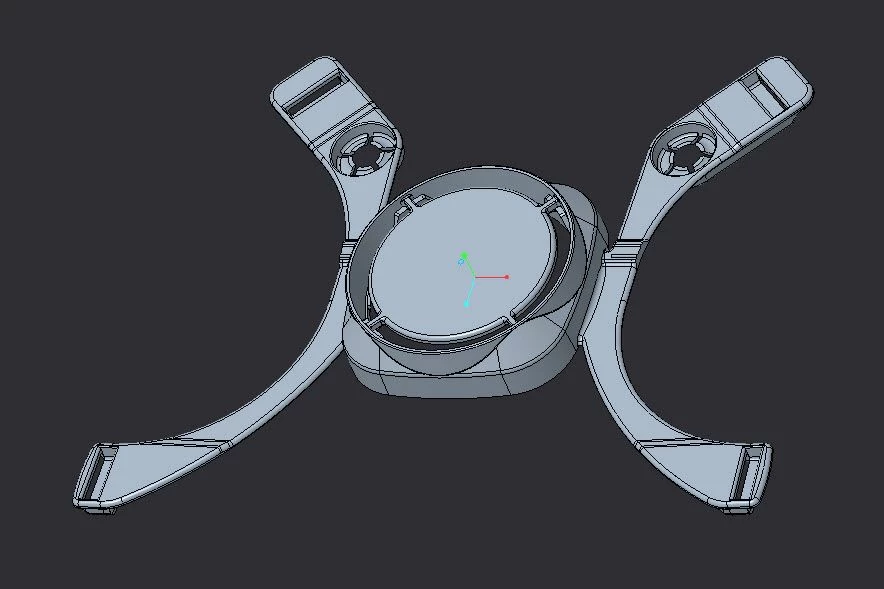 As molded flat state
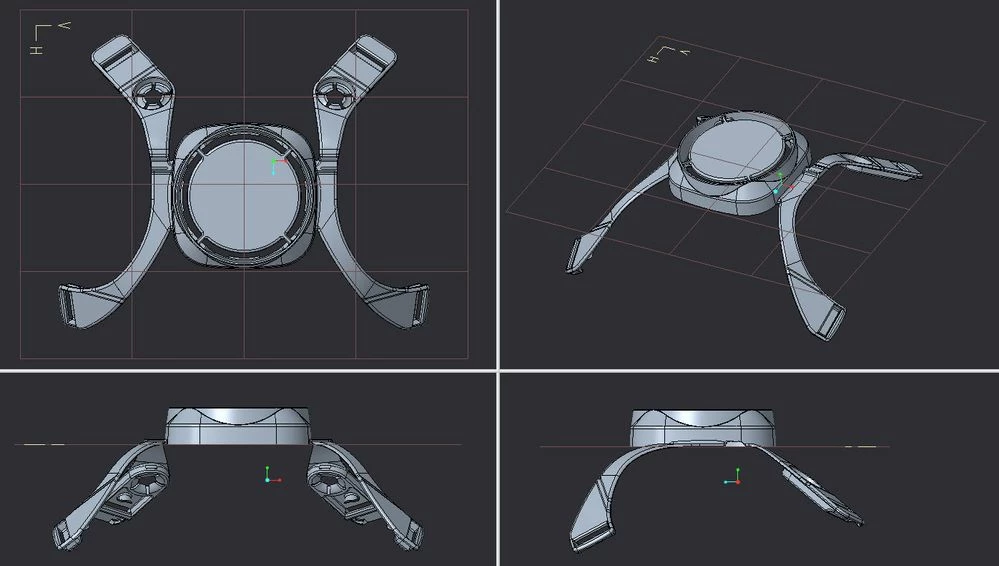 3D topology of assembled state