
16-Pearl
November 1, 2024
Question

Mathcad Community Challenge November 2024 - Frustums and Pyramids

  • November 1, 2024
  • 8 replies
  • 10826 views

This month’s challenge is based around pyramids and frustums (a pyramid that’s had its top removed by a plane parallel to the base). Choose any or all of the following and create a Mathcad worksheet:


Moderate Challenge
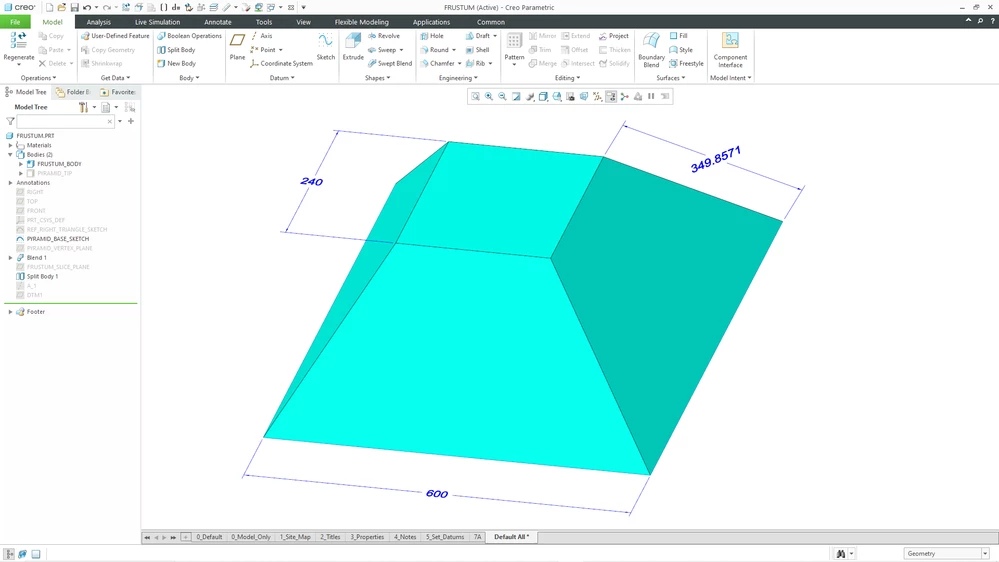
Calculate the volume and surface area of the frustum in the image below. A Creo 7.0 part model is attached to this challenge for verification.
Frustum.png


Note that the original pyramid is a right pentahedron. (A line joining the center of the base and the vertex of the pyramid is at a right angle / perpendicular to the base. See the CAD model and image for additional clarification.) The base and top surface of the frustum are both square.


Optional 1: Create a function that calculates the volume given the 3 dimensions above: edge length of the base, side edge length, and top face edge length.


Optional 2 (for Mathcad Prime 10 users): Use the slider advanced input control to change either the height of the slicing plane or length of the side edge, and recalculate the volume.


Hard Challenge: The Pyramid of Least Volume
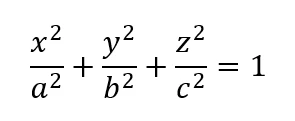
“Of all the planes tangent to the ellipsoid
Ellipsoid Equation.png

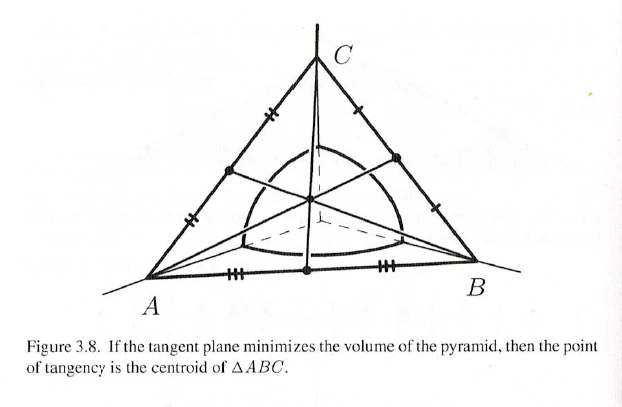
 one of them cuts the pyramid of least possible volume from the first octant x ≥ 0, y ≥ 0, z ≥ 0. Show that the point of tangency of that plane is the centroid of the face ABC.”
Hard Challenge Figure.png


The pyramid in this situation has four sides. One of the corners is at the origin (0,0,0). The centroid is this case means the intersection of its medians.
(Source: “The Mathematical Mechanic” by Mark Levi, section 3.5.)


Documentation Challenge
Create a Mathcad worksheet that uses text and image tools to explain the derivation of the formula for the volume of a pyramid.


Find the Mathcad Community Challenge Guidelines here!

8 replies

23-Emerald IV
November 1, 2024

"Note that this is a right pentahedron":

I count 6 surface faces, I'd call it a hexahedron....


Luc

16-Pearl
November 1, 2024

You are correct. "Right pentahedron" described the original pyramid before the top was cut off to form the frustum. I have edited the original post to reflect that distinction.

23-Emerald V
November 1, 2024

@Werner_E wrote:

However, note that the original pyramid is not a regular polyhedron, as all the faces are not the same size and shape. The base has 4 edges, and the other faces have 3 edges.


Sure, the only pyramid which also is a regular polyhedron is a regular tetrahedron, isn't it?

Given that 'regular polyhedron' means all faces being equal.
As with any pyramid the side faces that are connected to the top of the pyramid are always triangles. For a pyramid to be a regular polyhedron this means that the base must be triangular as well.


I take it we're limiting this discussion to Euclidean space?


Stuart


@DaveMartin I intuitively understood the term "right pentahedron" to mean a pyramid with a square base and four equal-length triangular sides, the frustrum being the hexahedron resulting from lopping off a similar smaller pentahedron from the top of the pyramid.


There are other forms of pentahedron which meet the criterion of a "right" pentahedron being one where "A line joining the center of the base and the vertex of the pyramid is at a right angle / perpendicular to the base", but I did indeed see the CAD model and image for additional clarification.  


Perhaps, a further stipulation is that the right pentahedron under discussion is congruent under right rotations?

19-Tanzanite
November 3, 2024

Ok, here's my entry with Prime 10 Express.


Alan


DJNewman
18-Opal
November 13, 2024
PTC Marketer Creo and Mathcad. I run their YouTube channels, some Creo campaigns, and all Mathcad campaigns and communications.
DJNewman
18-Opal
November 21, 2024

It's come to my attention that November is only 30 days long, so...  as we are over two-thirds through November now, time is running out for entries to this challenge! Don't miss the deadlines...!


We'd love to see as many entries as we can. It's very good seeing different perspectives on how to tackle problems.

PTC Marketer Creo and Mathcad. I run their YouTube channels, some Creo campaigns, and all Mathcad campaigns and communications.
25-Diamond I
November 21, 2024

OK, here are my 2 cents

Only the second part of the challenge, the proof.

Prime 10 was able to handle this almost entirely on its own, only a little help from legacy Mathcad was needed in one place.

Maybe an incentive to improve Primes Symbolics a little further in this direction... 😉

Werner_E_0-1732225455624.png


19-Tanzanite
November 23, 2024

Nice work!


It's also easy enough to get a symbolic solution to:

Proof1.png

by hand, without resorting to another CAS program:

Proof.png

Alan


25-Diamond I
November 23, 2024


It's also easy enough to get a symbolic solution to:


Agreed on - especially because both equations simplify to equations in just one variable each.
It was surprising that Prime could not deal with that situation.


by hand, without resorting to another CAS program:


"by hand", that's the point - my goal was not just using Prime as an equations editor (MathType would do a much better job if that was all it was about) but to let the program do the (not so hard) work on its own (and of course I couldn't resist to show that Mathcad can do it 🙂 ).


BTW, even Prime is able to solve each of the equations on its own if we help it by telling it which variable to solve for.

Forcing the solution in the needed range from 0 to pi/2 seems to confuse Prime - the solution of the second equation is correct but written in a very unusual way:

Werner_E_0-1732354935347.png

adding "simplify" or even "rewrite, asin" did not help.

ttokoro
21-Topaz I
21-Topaz I
November 25, 2024
14-Alexandrite
November 30, 2024

Alright, here is my entry.  Please enjoy (if possible;).


I am a structural engineer so I might tend to skip steps than in a more rigorous, academic proof.  Generally, those that review my engineering work are very familiar with the concepts I present, so I usually go for the simplest consistent formatting—I do not want to miss anything.  And I add plots whenever I can so that I can tell if something is not quite right.


I hid much of the grunt work for the plots, you can reveal them easily enough in the Mathcad sheet.


Here are sample screen shots:

SPauliszyn_0-1732933950576.png

SPauliszyn_1-1732933970611.png


DJNewman
18-Opal
December 12, 2024

Your solution blog is published!
https://www.mathcad.com/en/blogs/community-challenge-frustums-pyramids

(....and badges will be distributed... sometime soon.)

PTC Marketer Creo and Mathcad. I run their YouTube channels, some Creo campaigns, and all Mathcad campaigns and communications.