

Maximum Response of an Elasto-Plastic SDOF to Rectangular Load Pulses
I have been working on a task in which we are to obtain the maximum response of an elasto-perfectly plastic SDOF. The main reference is: Introduction to Structural Dynamics, by John M. Biggs, 1964. In the second chapter, they provide these tables with the maximum response of a SDOF to different types of load pulses (rectangular, triangular, etc Figs 2.23 to 2.26). See the figure for a rectangular load pulse:
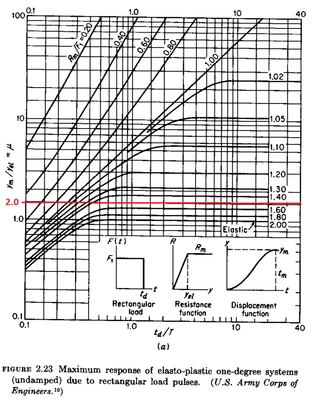
as you can see from the graph, the maximum response is represented by the ductility factor Mu, ratio of the maximum displacement to the elastic displacement of the system. Mu depends only on the ratio between the duration of the pulse (td) and the natural period (T) as well as the maximum spring force (Rm) and the maximum load (F1).
In my case, since we are conducting a sensitivity analysis, it is not very practical for us to be retrieving the results from these graphs for every analysis we do.
Therefore, I proceeded with writing my mathcad file that obtain the complete response of a SDOF system so i could obtain the maximum response analytically.
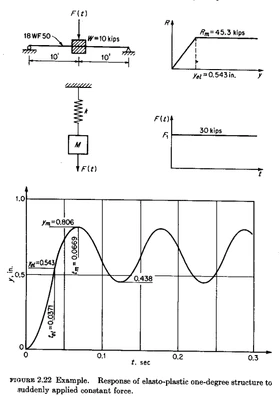
However, my problem is, in trying to compare my results with this graph, I observed that the results dont match. So I took a step back and compared the results of the graph with that of an example in the Book itself:
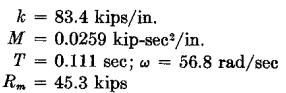
other input parameters are:
This example is a constant force (it doesnt have a td like the graph/figure provided). I assume that for a large td/T, the results would be the same (if not, I would like to understand why).
In this case, I look at the table for the largest value of td/T and for Rm/F1 of 1.51, which should be somewhere close to 2.0 (marked in the first figure in this post).
However, the result in the book gives ym/yel as 0.806/0.543 = 1.48.
From 2 to 1.5 is a big difference, and using different values of td/T in my analytical solution of the complete response of an elasto-plastic SDOF problem under a constant pulse load, the results differ even more
My guess is that I am not using the right values either of displacement or something else when using these tables. Anyone have familiarity with this approach can explain why this difference in the results?