2 replies

24-Ruby IV
December 18, 2020

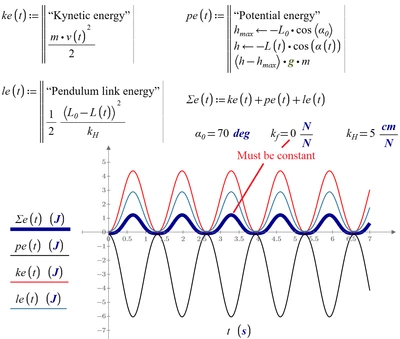
Sorry, a potential eneggy can be negativ - see please the picture (a hard link!).

May be the problem in the function for le.

Must-be-const-0.png

23-Emerald I
December 19, 2020

We have a physical point (mass without size) and a weightless non-bendable spoke that compresses or stretches according to Hooke's law.
There are three energies:
- kinetic energy of a physical point
- potential energy of a physical point
- energy of compression or stretching of the spoke
The sum of these three energies must be constant if we do not take into account friction (k_f = 0), or it must decrease (k_f > 0).


a weightless non-bendable spoke that compresses or stretches according to Hooke's law.  This is a spring!  And the "physical point" is moving radially as the non-bendable spoke compresses or stretches.  So there is a fourth energy, the kinetic energy of that radial motion.

Fred_Kohlhepp_0-1608400944413.png


23-Emerald I
December 21, 2020

Courtesy of Wikipedia:

Fred_Kohlhepp_0-1608562872790.png

Had to drop the friction damping (at least first pass)

24-Ruby IV
December 21, 2020

OK!

And what about the spring energy?

23-Emerald I
December 21, 2020

And what about the spring energy?


You could define (as I had before) defined pendulum and spring energy separately; but you'd need to take the vector magnitude "sqrt(Vp^2 + Vv^2) to add them together.  Please also note that the solver is different from the previous version.  Velocities, lengths, and angles report different trajectories.  (Haven't figured out why just yet.)