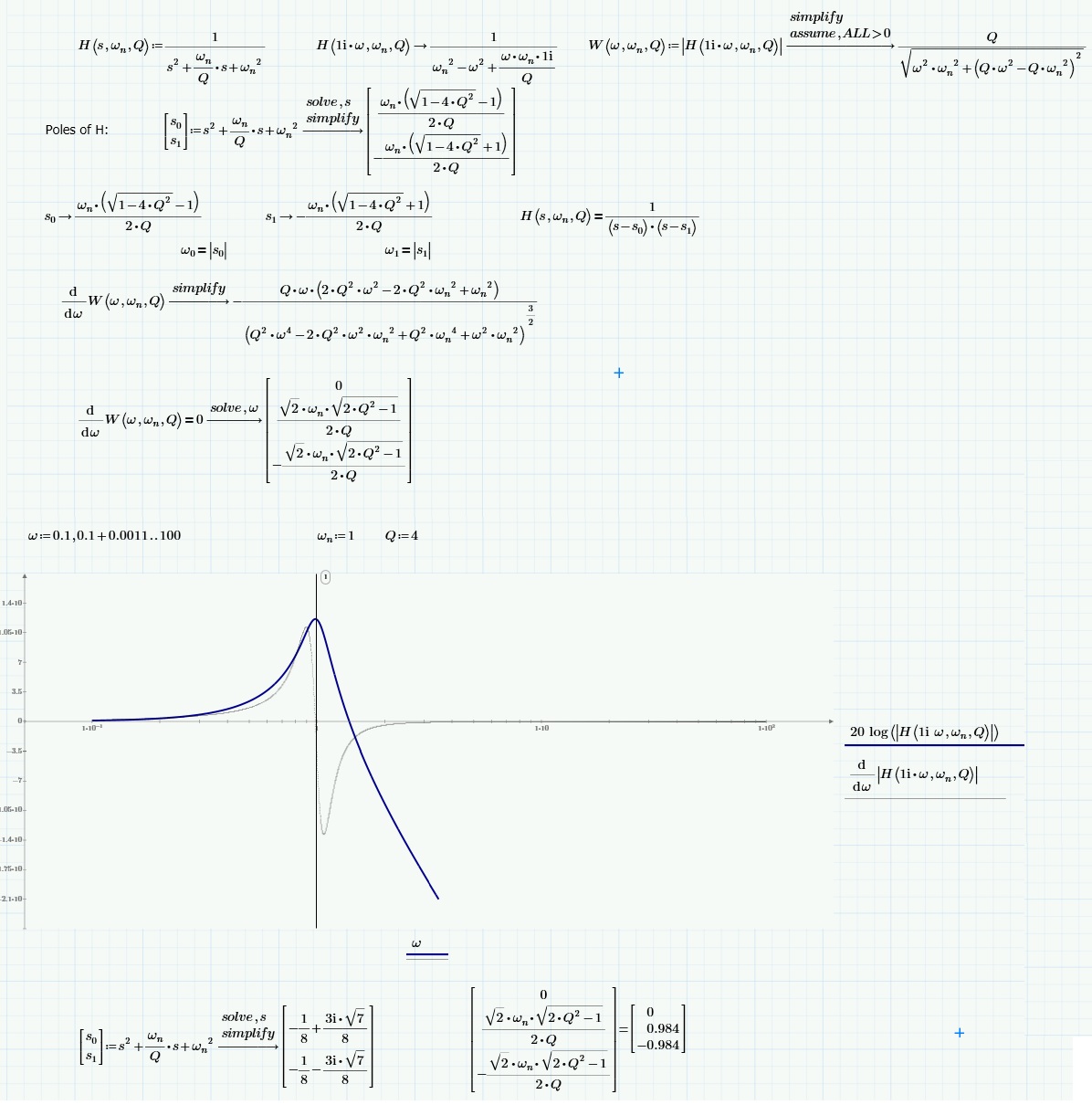
Symbolic solution to filter magnitude frequency response
- November 9, 2016
- 1 reply
- 4161 views
Hi all,
please see attached.
I am attempting to derive what I thought would be a simple enough equation to describe the maxima and/or minima of a "filter" function magnitude response. The example is a simplified version of my original problem and although in this case the answer is very obvious (w = 1), my original problem did not have so obvious an answer, And also, although I can easily plot the response, I would like to establish the design equations to allow me to work backwards from a requirement to a solution in equation form.
In the worksheet, the symbolic solution seems to fail. I specify the function H(s) and then substitute s = 1i.w to obtain continuous frequency response. I suspect the problem is complicated by the use of the |magnitude| function which might make symbolic solution difficult - that's my guess at why this doesn't seem to work. If there is a better way then please let me know! I have been staring at this on and off for a few days so might be missing the obvious.
Thanks in advance,
D