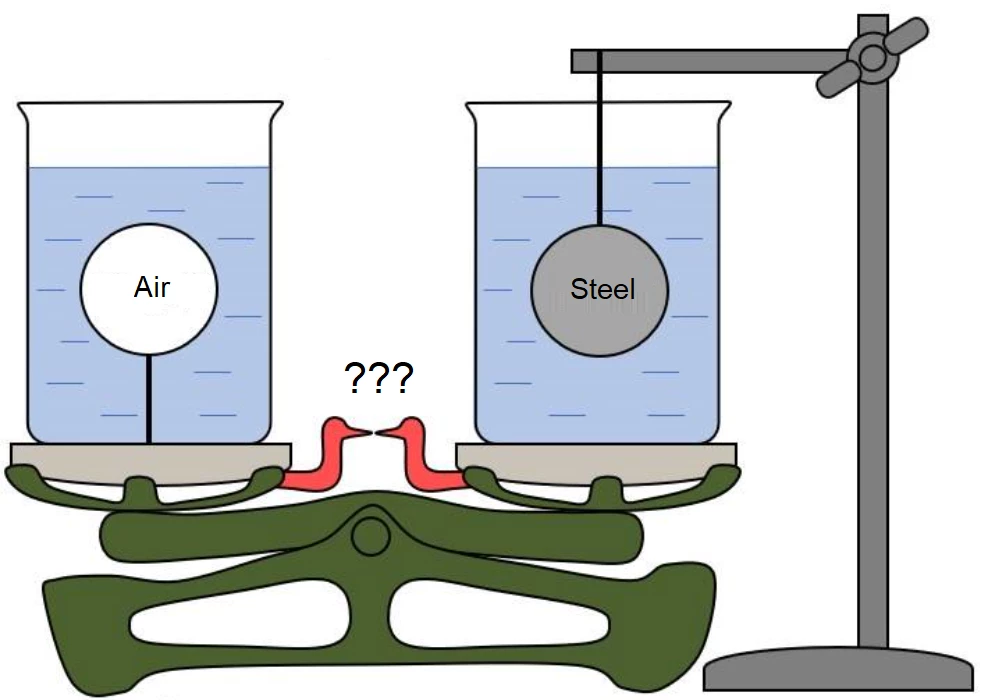
I don't think I agree with your numerical evaluation Val (though I agree the left side is heavier).
The amount of water is identical on both sides, the weights of the beakers are the same (presumably), the steel ball is externally supported, so the only extra weight on the left side is that of the air in the balloon. The net difference in weight is therefore (4/3)*pi*(d/2)^3*rho*g, which is much smaller than that which you've calculated.
We are not talking about the masses of what lies on the scales, but about the forces that act on the scales. Which way the scales will swing - clockwise or counterclockwise.
Then I started doing "free body" analysis. The mass calculations you've done are correct. But the buoyancy force on the balloon creates a tension in its string--otherwise it would float to the top, and that tension needs to be reflected in the scales. I think the left rises, the right drops.
That tension in the rope pulls the bottom of the beaker up. I can understand that reasoning. On the other side of the rope is the balloon, filled with air, it puls at the rope with the same force. But why can it pull, because it sets itself off against the water, which is also in the beaker, and presses the bottom of the beaker down: by its own weight and the same extra force due to the mass of the air in the balloon.
Suppose the water (instantly) freezes; that action should not change the mass of whatever is in the beaker, so the total mass of water and the air inside it remains the same. And if that mass remains the same, so does its weight at that same position with respect to Earth(s gravity).
{One might argue that the beaker breaks due to expansion (Ice has a lower mass by volume than water). My counter argument would be that we'd use a fluid in both beakers that does not change its specific mass going from fluid to solid.}
Since the rope is assumed to have no mass, its length doesn't matter. Now I try to imagine what happens if the rope between balloon and bottom gets longer. While the balloon is 'piercing' through the water level, the force on/in the rope lowers, but so does the counter force on the water. And finally the balloon hangs just above the water level. No more buoyance, just the mass of the (contents of) the balloon, on top of (mass of) the water is all that makes up the weight on the left side of the balance. But since the balloon itself and the rope have no mass, it's just air on top of the water. There's no distinction with the air that was already there. That would be different from when the balloon wwould be filled with, say Helium. Helium floats (up) in air. In that case the balloon filled with helium would still be pulling at the bottom of the beaker, bringing the weight down. Thus I come to the conclusion that my calculation is wrong. The air in the balloon does not count (as does the steel ball on the other side), because air does not float up in air. So the balance in the given example, under the given assumptions, is perfect. Simple.