
16-Pearl
September 19, 2017
Solved

Solve block for N inputs

  • September 19, 2017
  • 3 replies
  • 2512 views

I'm wondering if there is a simple way to perform this, as I can't figure it out.  

Let's saying we're using a solve block to develop a solution - in this case the flow through multiple orifices in series.  Easy enough to enter the equations and solve as follows:ori1.jpg
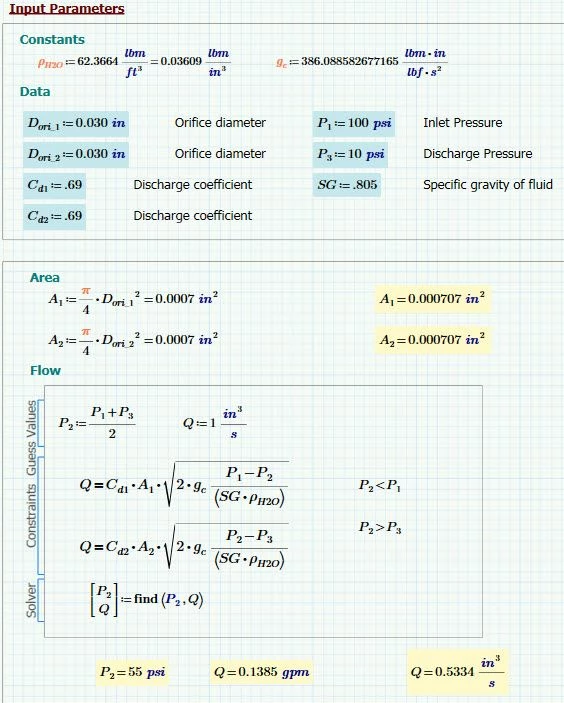
 

But if we have 10 orifices, that's a lot of typing.  Is there a way to use indices or otherwise simplify this?  I was thinking of something along these lines, but can't get it to work.  Judging by the error maybe it's impossible.  
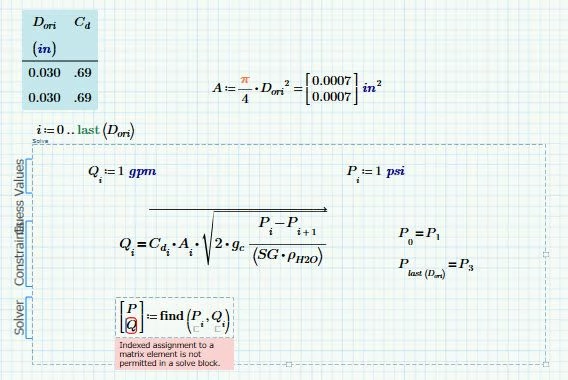
ori4.jpg


This still shows N=2 orifii as a starting point, but the table could have 2, 3, .. N rows.  

Any thoughts or solutions would be appreciated.

4.0 attached.

Thanks!

Best answer by MJG

See attached (PDF and Prime 3.1).


P_in is the pressure before the first orifice.  P_out is the pressure after the last orifice.

Pin and Pout are vectors with the pressure before and after each orifice.

The guess values for Pin and Pout are multiplied by C just to make them vectors of the same size.

3 replies

23-Emerald I
September 19, 2017

Can you treat it ike a finite difference problem--define a vector of N=1 pressures, develop a cost function that computes the error in each step and use a solve block to find the correct values in the vector?

24-Ruby IV
September 19, 2017

I have used a programing tools in same case

16-10[1].png

MJG1-VisitorAnswer
1-Visitor
September 19, 2017

See attached (PDF and Prime 3.1).


P_in is the pressure before the first orifice.  P_out is the pressure after the last orifice.

Pin and Pout are vectors with the pressure before and after each orifice.

The guess values for Pin and Pout are multiplied by C just to make them vectors of the same size.

DJF16-PearlAuthor
16-Pearl
September 19, 2017

Thank MJG, exactly what I was after.  Very clever with the stack = stack constraint.  I also think I could get there using Minerr, which is where Fred was headed, I think.  But this solution is very compact.  Will come in handy for this and other problems.