

15-Moonstone
June 4, 2019
Solved

Need to build repetitive curve in a sketch

  • June 4, 2019
  • 3 replies
  • 4807 views

I am needing to build a sketch that the curve needs to follow an exact pattern.  I have attached a sketch that shows the basic curvature. (As it is freehand the shape is not exact however)
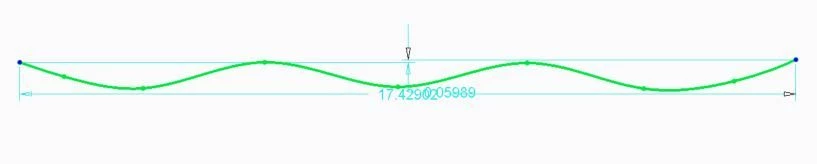
pattern.JPG

The pattern of curvature needs to follow a point placement like this.  The initial point is at X=0 and Y=+.06.  The second point on the curve would be X=+.5 and Y=-.06.  The 3rd point on the curve would be X=1 and Y=.06.  Etc...


I want to build a curve where I don't have to manually enter the dimensions as the size will extend for close to 50 inches.


My initial thought would be that Relations might be the way to go, but I have no experience with this and don't know if it would be capable of what I am looking to do.

Best answer by Roy_Crerar
I'll try again tomorrow. Trying to remember the formula just now.

X= 40*(t*720)
Y= 4*sin*(t*360)
Z=0

In this case 40 is the wavelength.
720 is 2 cycles
I think 4 is amplitude for y
Z is zero because it's in a single plane.

Difficult when not in front of a car screen to check.

3 replies

pimm15-MoonstoneAuthor
15-Moonstone
June 4, 2019

Still looking this over online.  I haven't pieced this together but I am now wondering whether this can be done as a relation at all within a sketch.


I am seeing examples how using a variable section sweep can influence different shapes but haven't seen a simple straight line oscillating curve that would result in the basic sweep shape of the curve on my initial post.

1-Visitor
June 4, 2019

HI, Use curve from equation.


Datum\Curve\curve from equation. Example can be tailored from below.


pimm15-MoonstoneAuthor
15-Moonstone
June 4, 2019

Rcrerar-2:  The images you attached aren't showing.  I will see if I can find the location you are suggesting but if there is an easy way to see these images it would be great.

1-Visitor
June 4, 2019
I'll try again tomorrow. Trying to remember the formula just now.

X= 40*(t*720)
Y= 4*sin*(t*360)
Z=0

In this case 40 is the wavelength.
720 is 2 cycles
I think 4 is amplitude for y
Z is zero because it's in a single plane.

Difficult when not in front of a car screen to check.
1-Visitor
June 5, 2019

Just Checked the formula I used.


x=50*t

y= 4*sin(t*720)

z=0


curve would be 50 units long and total height is 8 units crest to crest. This produces 2 cycles if you want more then each cycle is multiple of 360.


If it is not a sin curve then the maths needs working out.


Have fun.

1-Visitor
June 6, 2019

Subsitute 'sin' for 'cos' in the formula & you get another variation of the curve.

Worth a mention.