
10-Marble
July 25, 2024
Solved

Defining Inlet and Outlet Parameters in CFD Simulations: 0 Pa or 101325 Pa/with or without Particles

  • July 25, 2024
  • 1 reply
  • 3184 views

Greetings,

I am currently focused on designing and optimizing a pipe connector that transitions from a diameter of 100mm to 125mm. This project involves utilizing Computational Fluid Dynamics (CFD) and BMX studies to refine the design parameters. I am using Creo 11.

I have noticed that most tutorials define an inlet and an outlet, with the inlet specifying parameters such as pressure, volumetric flux, or pressure inlet, and particles being released that move through the part, which is logical. 
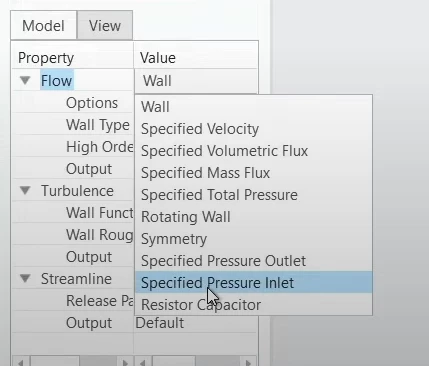

InletInlet

At the outlet, it is often defined as a specified pressure outlet, and no particles are released there. My question is: how do I determine when to release particles or not? Additionally, sometimes the outlet pressure is set to 0 Pa, while other times it is set to the normal atmospheric pressure of 101325 Pa. How do I know which pressure to use? 
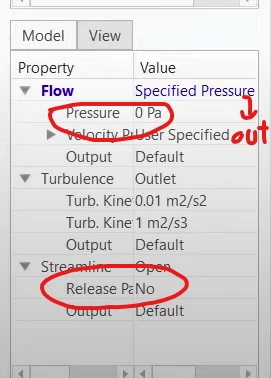
 

OutledOutled

Best regards,
Spy

Best answer by MikeBennett

Hi @The_Spy 


 The Wall boundary condition is a solid boundary.  Yes, like a bottle lid in your analogy or a wall.

As you mention, we are on Earth and the air escapes to the environment.  The Specified Pressure Outlet boundary condition sets the static pressure at an opening where flow is expected to exit the domain.  Your outlet is the environment, which has a known pressure.

Also, note that the streamline is a massless particle that does not interfere with the flow as it helps to visualize.

1 reply

16-Pearl
July 25, 2024

Hello @The_Spy,


Using an output of 0 should not differ from using 1 atm or 101325 Pa but you can always check for a difference by comparing the results of two simulations.  If specific pressures are required for the analysis, they should be entered.


Releasing particles depends on how you want to view the streamlines in your analysis.  You could use forward directed streamlines at the inlets or backward directed streamlines at the outlet.  You can review the streamlines of the fluid entering from the input or trace back the streamlines from the output.


Hope this helps,

Michael

The_Spy10-MarbleAuthor
10-Marble
July 26, 2024

Hi @MikeBennett ,

would it be possible to use the “Wall” boundary condition instead of the “specified pressure outled,” since the Wall is the default option?


Wall optionWall option

I experimented with this before and it seemed like it acted as a sort of barrier, where nothing could pass through. Is that correct? (Like the lid of a bottle).


As mentioned, I am currently constructing a connecting piece and allowing air to enter from the left side with a specific flow rate at 9.7 m^3/s. Since I do not know the exit velocity at the outed, I was concerned about specifying the volumetric flux as 0 m^3/s. I feared that this would cause the particles to decelerate to 0 or collide with stationary particles, potentially leading to turbulence. Since we are on Earth and the air simply escapes into the environment, I thought that using the normal pressure (101325 Pa) at the outled might be a good alternative. But what do you think of my suggestions?


In summary, the question is what I should specify if I only know the entry conditions but not the exit conditions. 


Best regards,
Spy

16-Pearl
July 26, 2024

Hi @The_Spy 


 The Wall boundary condition is a solid boundary.  Yes, like a bottle lid in your analogy or a wall.

As you mention, we are on Earth and the air escapes to the environment.  The Specified Pressure Outlet boundary condition sets the static pressure at an opening where flow is expected to exit the domain.  Your outlet is the environment, which has a known pressure.

Also, note that the streamline is a massless particle that does not interfere with the flow as it helps to visualize.