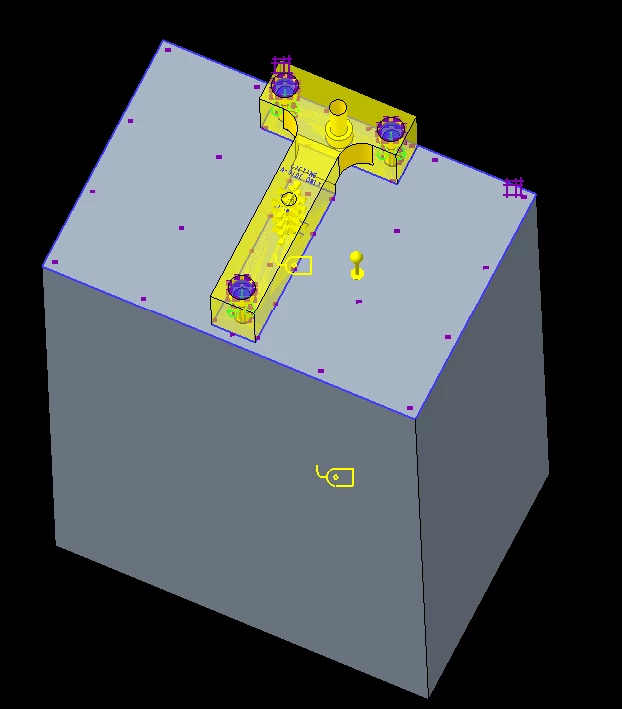
Trouble with stress results surrounding fasteners
I'm currently working on trying to evaluate the safety of the screws used for a lift bar of a block but seem to not be able to get reasonable values for the stresses inside the bolts. I believe that the model is over constrained but don't know how to fix it. I'm currently using Creo 11 simulate not the live one.
The assembly consists of a large steel block (approx. 4,400 lbs), with a T-shaped lift bar bolted to it. The lift bar is mounted using three screws: two on either end of the top of the T and one at the base. The lifting point is centered on the crossbar of the T (via an eyebolt), and in the simulation this point is fixed. Gravity is applied in the -Y direction using -386.1 in/sec².
The fasteners are 1-inch diameter UNRC coarse-thread screws modeled using Creo Simulate's screw fastener feature. They are threaded directly into the block (no nuts), with preload disabled. The materials are high-carbon alloy steels.
Analysis Type: Structural, nonlinear with large deformation enabled
Constraints: Fixed at the lifting eye (midpoint of T-bar)
Loads: Gravity only
Contact Interface: “Contact” selected between bar and block (surface-to-surface)
Mesh: Reasonable for the geometry, but refinement hasn’t improved stability
Issues Encountered
Unrealistic Fastener Forces
In some cases, Creo reports axial forces in excess of 8 million lbf on a single screw, which is clearly unphysical.
In others, all shear forces on screws are reported as zero.
Contact Interface Not Allowing Separation
Despite selecting "contact" (not bonded), the lift bar and block behave as if fully bonded.
Creo does not present an “allow separation” checkbox — only penetration is available.
This seems to artificially restrict behavior and drive up fastener forces.
Warnings About Large Rotations
I frequently see this message:
“Running large deformation analysis with advanced rigid links or fasteners may lead to inaccurate results near large rotations.”
Unsure if this is related to the instability or a secondary concern.
What I’ve Tried
Disabling preload in fasteners
Switching between contact types
Testing mesh refinements and load step reductions
Reviewing fastener dimensions and thread definitions
Is the screw fastener tool suitable for nonlinear large deformation analyses with contact?
Should I instead model the screws as solid geometry if they’re threading into the block? i tried this but cant seem to correctly simulate the screws.
How can I properly enable separation between contact surfaces i
Any help would be greatly appreciated. I’m trying to determine whether the issue lies in the fastener definitions, contact interface limitations, or some deeper constraint/load interaction