1-Visitor
June 10, 2013
Solved

Modelling a 'Canted' spring in Wildfire 4.0 ?

  • June 10, 2013
  • 7 replies
  • 19510 views

Hi all,

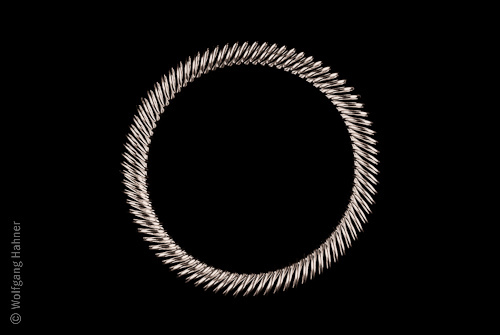
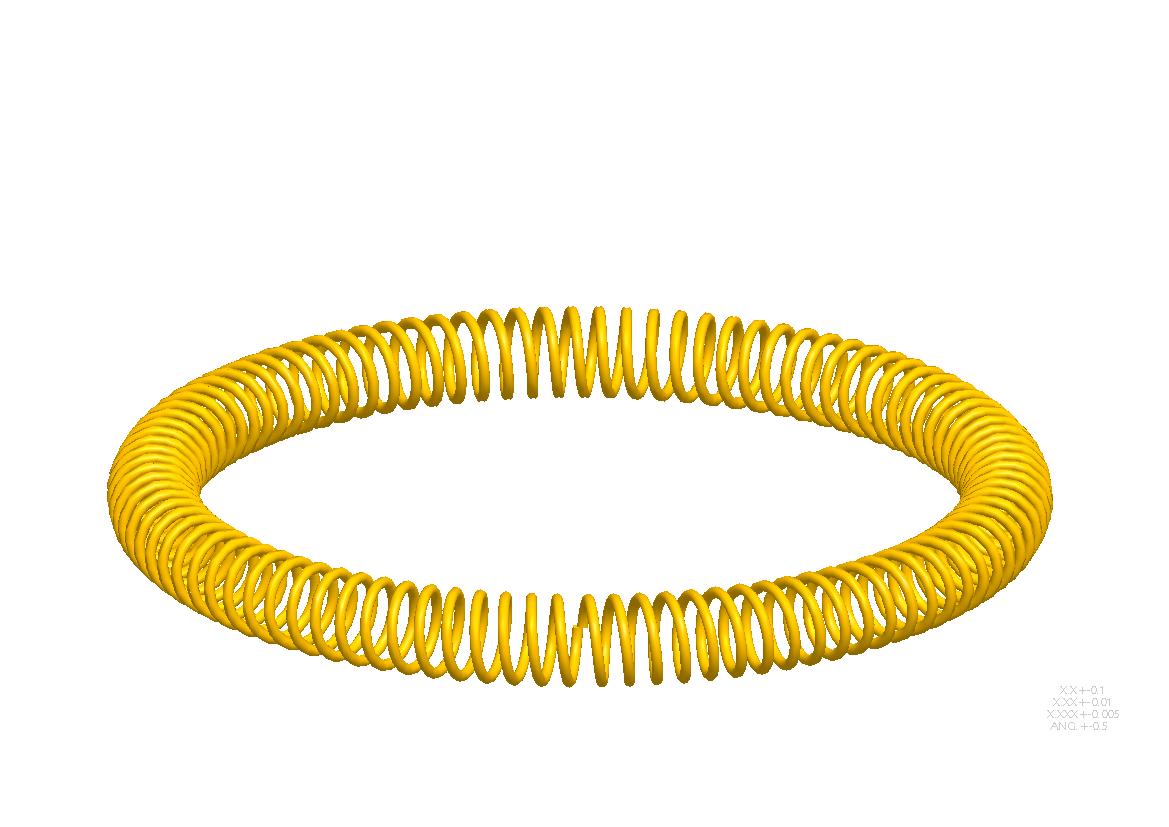
I'm attempting to model a canted coil spring in WF4.0 but have only managed to model what is in effect a 'garter spring'. The difference being the coils of the canted spring are not perpendicular to the trajectory but are 'canted' over at an angle.

These are sometimes referred to as 'Balseal' springs.


Can anyone offer any help on this please?

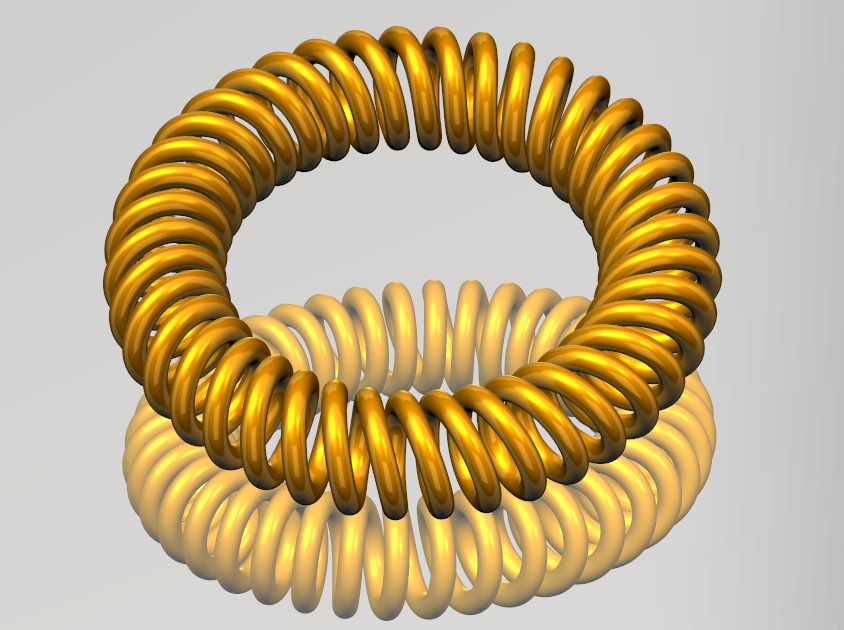
I've attached an image of the spring I've modelled as well as a photo of a true canted coil spring.

Any help appreciated.

Thanks.
test_spring.jpg

canted_spring.jpg

    Best answer by TomD.inPDX

    Forgot the glamor shot...

    canted_spring_glamor.PNG

    Creo 2.0 file attached

    7 replies

    17-Peridot
    June 10, 2013

    Warp would help but you don't have that in WF 4, right?

    What if you created 1 coil and patterned them from an "offset" center?

    1-Visitor
    June 10, 2013

    Correct, no warp here !

    Are you saying just model 1 'ring' and pattern it so I'd have a pattern of canted rings rather than a continuous spring?

    Thanks

    17-Peridot
    June 10, 2013

    Correct. I recommend using the geometry pattern. In the longrun, it has the same efficiency on the GPU and probably faster on the regens. Long sweeps of circles are really high overhead on the system.

    13-Aquamarine
    June 10, 2013

    Try page 19 of this thesis...

    I was able to get some of the equation to work using an equation by curve.

    http://tam.northwestern.edu/joswald/data/thesis-jjo.pdf

    I am going to go out on a limb and say you can absolutely do this once you find the right equation. I tried both a cylindrical coordinate system and a cartesian one (the kind used in the thesis). I could get ONE canted coil but I was having trouble making a string of them. I'd bet that you can either create the coil using an equation and then just sweep to make the physical coil geometry... OR that you could take a simple loop and use the trajpar variable with some type of equation to generate the geometry.

    Seriously... this is a job for Vladimir Palffy. He'd have this thing modeled in under an hour... and then he'd render it so it looked like a real spring. Maybe he'll chime in if he's not busy.

    Let us know if you make any progress.

    Thanks!

    -Brian

    13-Aquamarine
    June 10, 2013

    Actually... Frank might have some tricks for this, too. I forgot he's also a whiz with springs. I always thought I was really good with them until Frank showed me some of the stuff I had missed.

    We have some really excellent members who would probably love a challenge such as this. I'm one of them... I'm just preoccupied at the moment!

    Good luck!

    17-Peridot
    June 10, 2013

    Nope... Spinal bend! (Frank would be proud!)

    Wrap a sketch around a cylinder using a curve. Something like this: ~

    Pattern the sketch and use it for a sweep of a line (to get a surface for the spinal bend)

    Spinal Bend the surface

    Use the surface edge for a sweep

    Remember the limitations of Spinal Bend doesn't allow geometry beyond the two datum planes. You need to be very specific about the end conditions.

    I'll post up the process I used in a bit.

    Brian; that paper is excellent. It is mostly concerned with load bearing coils. As you are probably well aware, these are often used on shipping pallets to minimize transport shock and vibration. Typically, they are very heavy steel cable coils fixed to mounting plates tangent to the coils.

    1-Visitor
    June 11, 2013

    Thanks for all the replies guys - some very interesting solutions

    Looks like I'll be busy this morning trying this.

    Thanks enormously to everyone. !!!

    22-Sapphire II
    June 11, 2013

    Ok, so here's my take. Anyone wanna try it in less than 6 features?

    BALSEAL_CANTED_SPRING-01.jpg

    17-Peridot
    June 11, 2013

    Very nice!

    22-Sapphire II
    June 11, 2013

    Thanks! Check your personal (not here) e-mail, I sent you and Brian a file.

    1-Visitor
    June 11, 2013

    please check this.if this is what you require.

    spring.png

    17-Peridot
    June 11, 2013

    Maybe we can stick a fork in it now

    canted_spring_square_glamor.PNG

    22-Sapphire II
    June 11, 2013

    Hah! Check, and MATE!

    1-Visitor
    June 12, 2013

    Well I never thought a 'Spring' would generate so much interest and alternate techniques !

    Cheers guys

    17-Peridot
    June 12, 2013

    So did you end up with what you needed?

    22-Sapphire II
    June 12, 2013

    Without actually seeing one, the question is: If you section the spring thru the toroidial axis, is the cross-section of the spring circular, or elliptical (as shown). If the manufacturing method is take a cylindrical, helical spring, "smear it" as if the side view was now a trapezoid instead of a rectangle, then you end up with an elliptical section. If the spring has a perfectly round cross-section, then a slightly different method is used, and/or the spring starts out NOT cylindrical.

    Interesting either way and it's also do-able either way, now with 4 features (from 6). I'd sure like to get my hands on a large one to look at it.

    BALSEAL_CANTED_SPRING-02.jpg

    17-Peridot
    June 12, 2013

    Frank, these are often used in axle seals for your car. You should be able to find one in any wrecking yard.

    This is a patent page that shows them oval in section:

    https://data.epo.org/publication-server/rest/v1.0/publication-dates/19920624/patents/EP0491258NWA1/document.html

    Go to the end of the document.

    edit: the Bal Seal catalog pretty much confirms this too

    http://www.balseal.com/sites/default/files/rotarycatalog_092506044932.pdf

    This just means you need to intersect an appropriate elliptical surface with the spun surface. ...or the equation curve with the driving sketch to manage the height to the width.

    22-Sapphire II
    June 12, 2013

    I saw that, and agree that the cross-section should be elliptical. I also did a "-02" version where, unlike the green coil above, the cross-section IS perfectly circular. It was actually pretty easy to modify the -01 file (when I was removing a couple unneccessary curve features).

    I think they probably manufacture the coils like we thought, by "squishing" or "smearing" them, so they end up elliptical.

    I think also that if I remember these types of seals are used in motorcycle fork seals.

    Thanks for the links!

    This was actually a fun diversion and learning experience so thanks to Paul for starting this!