1-Visitor
March 27, 2017
Solved

2nd Moments of Area

  • March 27, 2017
  • 3 replies
  • 13861 views

Hello to all!

Tonight I am working on what should be a simple problem as below:
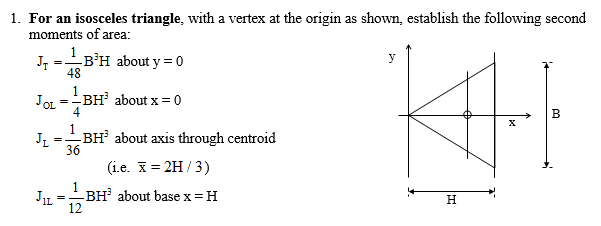
2ndMA.PNG

I know that from my reading material I have been given that:
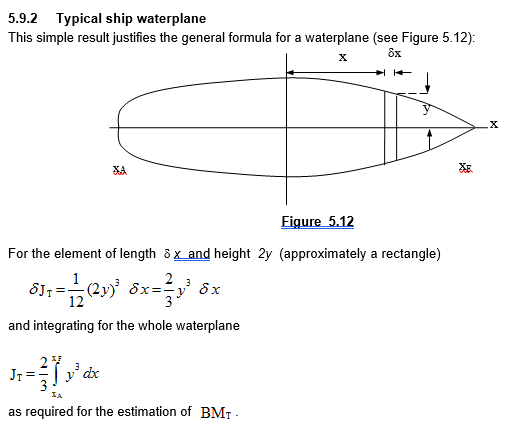
2MA2.PNG

So for my simple triangle problem I have started by defining y (assuming that y is symmetric about x as:

yequal.PNG

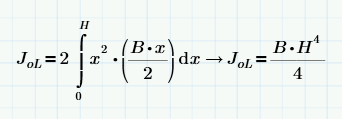
I have then integrated using the given forumula for JT but I am not coming up with the model answer of 1/48*B^3*H I am instead getting H to the power of 4? Which is a reoccurring problem...
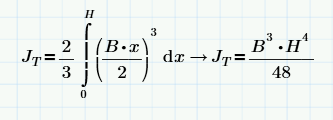
2MA.PNG

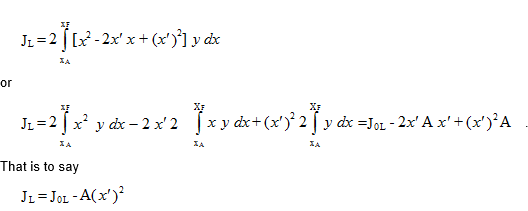
Following the question I have used the same approach for JoL and JL given that these are defined as:

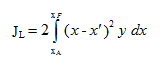
2MA1.PNG

2MA3.PNG

2MA4.PNG

2MA5.PNG

2MA6.PNG

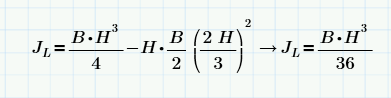
NB JL is the only answer I get spot on but only by using the given answer for JoL not the one I have calculated.

Further if anyone can elaborate as to how J1L would be derived for a base of x=H? The given answer seems to be the answer for JoL for a rectangular shape?

As always your help is greatly appreciated.

Andy
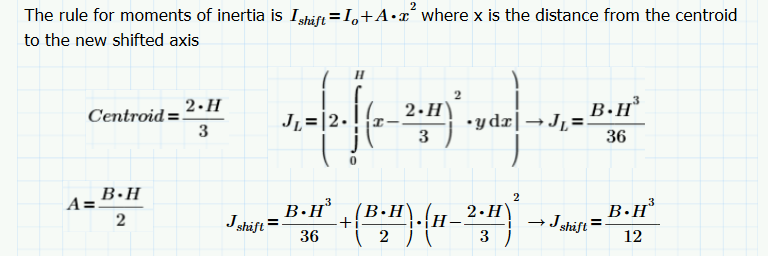
Best answer by Fred_Kohlhepp

The moment of inertia about the centroid is always the smallest!  You can translate between any two if you do the math right.

3 replies

1-Visitor
March 27, 2017

Andy Wibroe wrote:

2ndMA.PNG

I have started by defining y (assuming that y is symmetric about x as:

yequal.PNG

Take another look at your definition of y

Give some values to H & B and check a few values of x & y.

For example, if we assume H=10 and B=8, let's check what you get for y when x=5

y = B * x / 2 = (8) * (5) / 2 = 20

Is this a reasonable value for y?

I'll give you a clue: the equation for y needs to include the variable H.

awibroe1-VisitorAuthor
1-Visitor
March 28, 2017

Eureka!

I had omitted the H

So this should be:

yequal.PNG

This gives the correct answer for the first three 2nd moments.

Any idea on the derivation of the last? i.e. J1L?

Andy

23-Emerald I
March 28, 2017

Set up your integrations right and:

awibroe1-VisitorAuthor
1-Visitor
March 28, 2017

Fred,

That is amazing! Thanks so much!

Is it however, possible to set up in the way I was doing originally i.e. integrating over one half of the triangle and multiplying by 2 noting the triangle is symmetric about x?

Thanks,

Andy.

23-Emerald I
March 28, 2017

The calculation of centroid locations will not work with your technique (in the y direction) because the figure is symmetrical in y.

In general, the answer is "No".

I use this technique on airfoils shapes, defining the y(x) for the top and bottom surfaces, so it works in general as a computed numeric solver.  The expressions from the symbolic solver are specific to the triangle figure.

awibroe1-VisitorAuthor
1-Visitor
March 28, 2017

Fred,

Thanks again, I understand what you are saying. I have tried to stick with the method I was using as best I can as I believe this is the method that is expected of me. But I do understand fully the logic of not relying on symmetry about x and integrating between -y to +y.

I have however managed to rearrange as follow:

Jl1.PNG

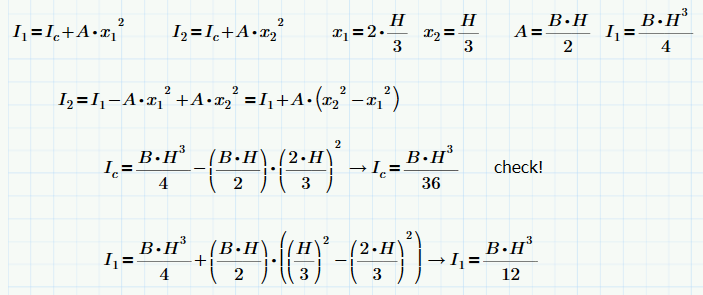
What I find perplexing is that taking what is essentially a second moment about the distance x from x=0 from the second moment of the total area  gives the second moment about the new point x. This I have proven above with the calculations of JL which work either by integration and with the subtraction method. However, this does not seem to work for JL1. i.e. JL1 can be derived by integration but not by the subtraction method. Why is this?

Andy.

1-Visitor
June 8, 2017

Hi Andy!

Your problem is a good exercise and example for multiple integration of functions, i'm teaching my students.

The interrestig there is the relationship between the Steiner-moment and the directly integration.

You can see an example in the attachement.

Best Regards, Volker