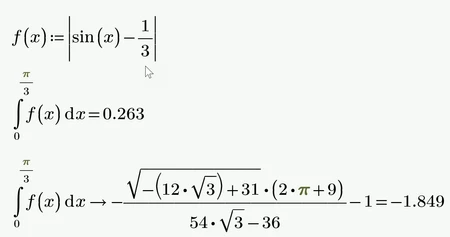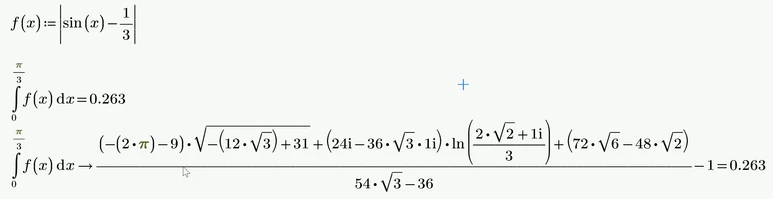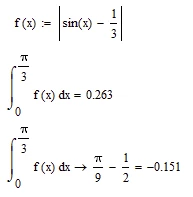
I am sorry to see that Maple in MC11 is coming up with an incorrect result as well when the absolute value is used.
Reason seems to be that, while the symbolic evaluation of the indefinite integral is correct in all versions, all versions (including Prime 6, which so far is the only version which returns a correct result for the definite integral) return a function which is only piecewise continuous.
Therefore this integral function must not be used to calculated the definite integral the 'usual', simple way (which is was all versions except Prime 6 seem to do),
but instead has to consider the jumps at the discontinuities.
To get the correct result we could use
EDIT: SORRY!! The above was awfully wrong! The zero of f(x) is NOT at pi/9 but rather arcsin(1/3) of course! F(x) is not defined at this position (division by zero, actually a form of 0/0) so we have to use the limes
Somehow Prime 6 is the only version where the symbolic version is able to return a correct result, even though its ugly looking
And of course once we know where the problem seems to be we an also split the integral accordingly o get the correct symbolic result
We get the same results in Prime if we rewrite the function using the square root of the square. Reason seems to be that an internal simplification ends up at the absolute value again
Out of idle curiosity, why did you choose that particular integral to evaluate? Have you a worksheet with multiple calculus equations that you test?
I tried it on Wolfram Mathematica and that gave the correct result.
Stiuart
I've shuffled things around on my small workspace and I've freed up just room to use my Apple Magic Mouse with my Dell laptop. Works well, if not perfectly, and makes life so much easier than using the trackpad. Annoyingly, the tiny mouse I bought specifically for the Dell won't connect ...
Out of idle curiosity, why did you choose that particular integral to evaluate? Have you a worksheet with multiple calculus equations that you test?
I tried it on Wolfram Mathematica and that gave the correct result.
I was just about trying to generate an example showing that numeric integration often is way off the exact result because of inaccuracies adding adding up and then wanted to show the effect of TOL setting. As an exact reference I would use a symbolic evaluation - at least thats what I thought 😉
However, the result of this integral was too far away from the numerical one and I didn't really believe that the definite integral from 0 to pi/3 could be negative for this function 😉
Not surprised that Wolfram can do it
I just still can't get my head around the misnomers that Wolfram uses
sin^-1 instead of arcsin and sec^-1(3) instead of arccos(1/3).
But Wolfram deliberately does not adhere to existing standards because he wants to set his own standards 😞
The sin-1 and sec-1/3 were the standard when I learned mathematics in the UK, and young Mr Wolfram learned maths in the UK.
At the time, I thought the Russian(*) use of arcsin and arcsec was archaic, although I preferred that notation.
Stuart
(*) At university, some of the physics papers I was interested in were in Russian. So I sat down with a dictionary and sort-of-crudely translated the bits that seemed relevant from the formulae.
Typical. We have a nice storm raging outside and I wanted to measure the wind speed. I have one of those handheld anemometers, and I saw it a week or so ago. But can I find it, even though I ransacked the house (I've got Viking ancestry, apparently)?? No, of course not. Good day to take a longboat for a sail.