Best answer by LucMeekes

With the diode voltage Vanode versus Vcathode (and diode current Id running from anode to cathode) the diode model could be:
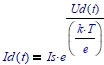
LucMeekes_0-1754820349347.png

(Where Is is the leakage current, generally below 1 pA, k is Boltzmann's constant, e is the electron charge and T is absolute temperature, around 300 K at room.)

The capacitor current Ic depends on the voltage across it Ud, as follows:

LucMeekes_1-1754820371880.png

now the diode voltage depends on the input voltage Ui as:

Ud=Uc-Ui

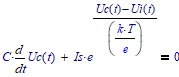
And finally Ic+Id=0, which leads to the differential equation:
LucMeekes_4-1754820816845.png

The solution is:

LucMeekes_5-1754820839234.png

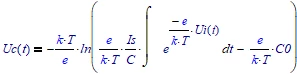
Which brings in a(n integration) constant C0 (which is a voltage).

This expression can be worked to an expression for Uc:
LucMeekes_4-1754857902693.png

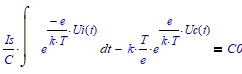
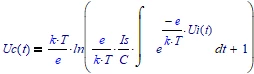
To find C0 we use the initial condition set: at t=0, Uc=0, but also the integral is 0. So we get:

LucMeekes_0-1754847315667.png

So the expression for Uc simplifies to:
LucMeekes_5-1754857925392.png

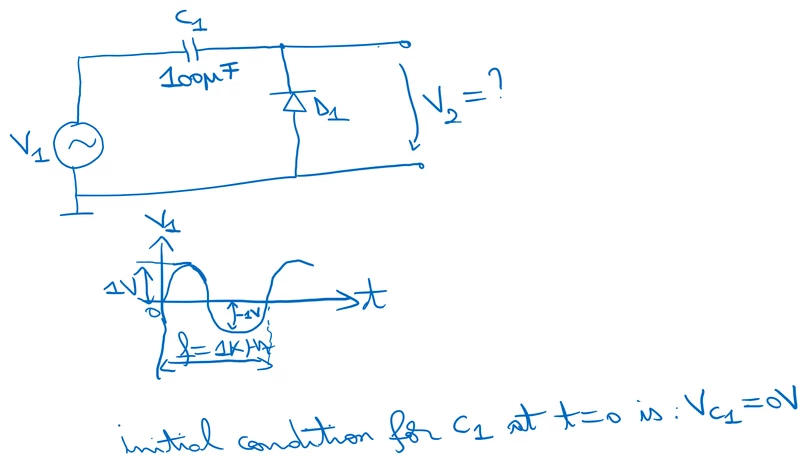
With Ui known,

LucMeekes_7-1754821398990.png

(where A=1 V and f=1*kHz)

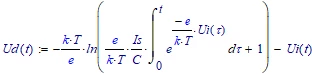
the integral can be solved, but not symbolically, and then Ui  can be subtracted from it to get Ud.
LucMeekes_6-1754857958955.png

Remember that Ud was defined upside-down. In fact V2 = -Ud, so we can write:
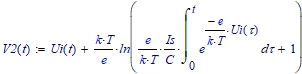
LucMeekes_7-1754857985570.png

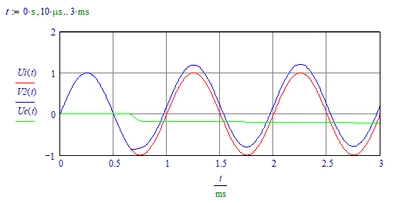
Lets take some values and plot:

LucMeekes_6-1754847670632.png

LucMeekes_8-1754858013788.png

We see the voltage across the capacitor Uc slowly growing more negative as time progresses. This moves V2 further above Ui.


Success!
Luc


3 replies

12-Amethyst
August 8, 2025

Ssomething like that.something like that.omething like that.

Cornel19-TanzaniteAuthor
19-Tanzanite
August 8, 2025

Hi,

I can also do simulation, but that's not what I'm interested in now about simulation, but how to solve the circuit analytically using mathcad.
Anyway, your simulation set-up and result is not yet right (see below - here assuming forward voltage drop of the diode = 0V):

Cornel_2-1754660754738.png

ttokoro
21-Topaz I
21-Topaz I
August 11, 2025

Prime 11 VDi=on=0

image.png

Prime 11 VDi=on=0.7

image.png

Using Luc's method, IS=10-15

image.png


Using Luc's method, IS=10-12

image.png

t.t.
LucMeekes23-Emerald IVAnswer
23-Emerald IV
August 10, 2025

With the diode voltage Vanode versus Vcathode (and diode current Id running from anode to cathode) the diode model could be:

LucMeekes_0-1754820349347.png

(Where Is is the leakage current, generally below 1 pA, k is Boltzmann's constant, e is the electron charge and T is absolute temperature, around 300 K at room.)

The capacitor current Ic depends on the voltage across it Ud, as follows:

LucMeekes_1-1754820371880.png

now the diode voltage depends on the input voltage Ui as:

Ud=Uc-Ui

And finally Ic+Id=0, which leads to the differential equation:

LucMeekes_4-1754820816845.png

The solution is:

LucMeekes_5-1754820839234.png

Which brings in a(n integration) constant C0 (which is a voltage).

This expression can be worked to an expression for Uc:

LucMeekes_4-1754857902693.png

To find C0 we use the initial condition set: at t=0, Uc=0, but also the integral is 0. So we get:

LucMeekes_0-1754847315667.png

So the expression for Uc simplifies to:

LucMeekes_5-1754857925392.png

With Ui known,

LucMeekes_7-1754821398990.png

(where A=1 V and f=1*kHz)

the integral can be solved, but not symbolically, and then Ui  can be subtracted from it to get Ud.

LucMeekes_6-1754857958955.png

Remember that Ud was defined upside-down. In fact V2 = -Ud, so we can write:

LucMeekes_7-1754857985570.png

Lets take some values and plot:

LucMeekes_6-1754847670632.png

LucMeekes_8-1754858013788.png

We see the voltage across the capacitor Uc slowly growing more negative as time progresses. This moves V2 further above Ui.


Success!
Luc


23-Emerald I
August 11, 2025

I really like Luc's solution.


But I've been hacking away using my meager knowledge and Prime Express.  Attached.

23-Emerald I
August 12, 2025

No calculation, simply a reference and a verbal description.  

This is one half of a "Greinacher multiplier."