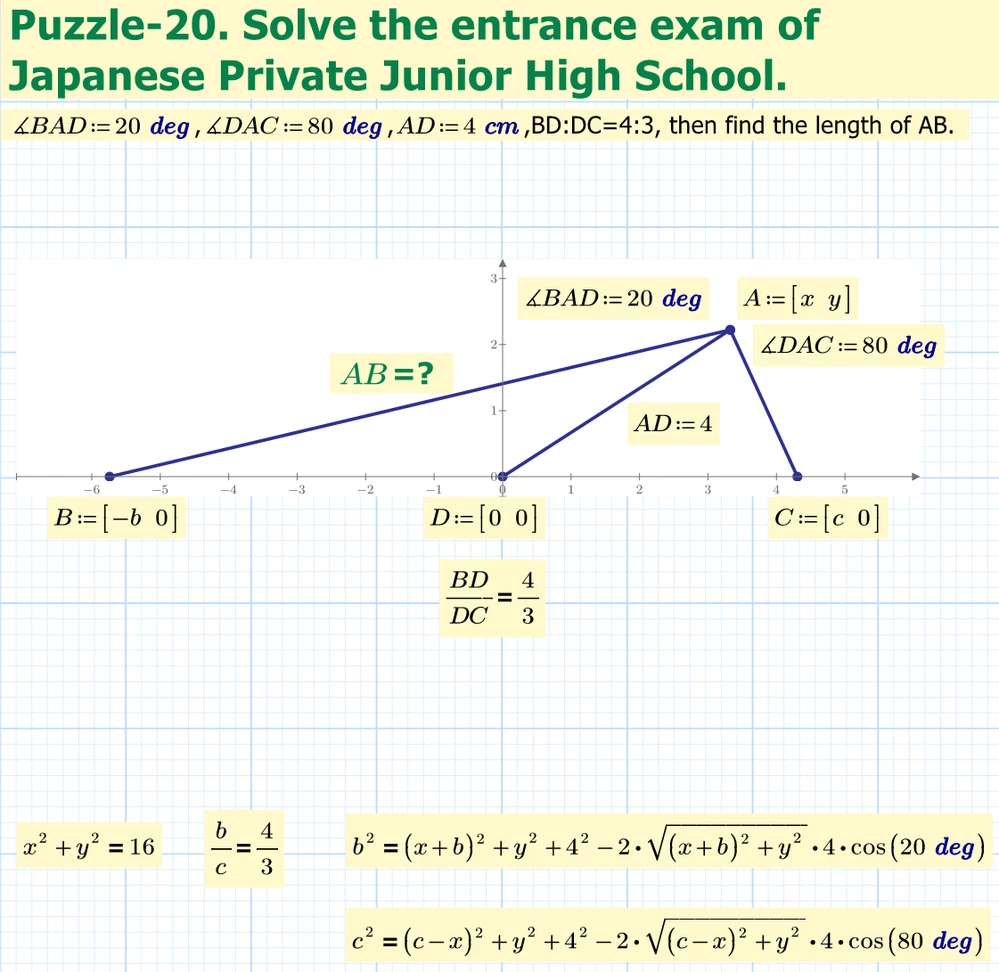
You have already set up four equations with four unknowns. So you could use a numeric solve block (add constraints like x>0, y>0, b>0, c>0) or the symbolic solve. Maybe you did in the sheet but I can't open it with P6 using the usual trick of exchanging the app.xml - maybe you used some new features not available in P6.
Here is a different approach (of course done in real Mathcad 🙂 )
So I see he did not attempt a solution but just provided the four equation. In his collapsed area he used the solution 28/3 to calculate the points for the plot.
Prime cannot solve his system symbolically. Both engines throw a "no solution found".
I haven't tried but a numeric solve block should do the job but we won't be able to arrive at the exact solution 28/3 that way.
My approach simply followed the idea "how would I draw that figure with pencil, ruler and compass".
But being an entrance exam for Junior High I suppose there must be a much easier approach to solve the task. Looks like this private school is going for the bests ...
Yeah, as I suspected a numeric solve block does the job. I was too lazy to try as it was clear that unfortunately this would not give us the exact solution 28/3.
Either write AD instead of AB or exchange sin(alpha) for sin(beta).
One additional constraint you are looking for could be a second way to calculate AB
BTW, the value for AB is not 9.333 but exactly 28/3 which of course can't be proofed by using numerical algorithms like "root".
But symbolic calculations fails, too, to proof the result is 28/3.
The new symbolic switches to float mode and so the result is unusable for a proof:
The old symbolic succeeds in an exact solution for phi but fails to simplify AB down to be 28/3:
I really like the solution sketched by ttokoro using just some ratios and avoiding trigonometry completely, but I still wonder which 12 year old would be able to come up with that kind of solution to pass the entrance test. I guess I myself would have failed ...
Here another suggestion for an additional constraint to get the value of phi. We calculate the length of AD using BD, beta and BAD and check, if its equal to predefined value AD=4
Here the choice of the range for phi is less critical so we get a good result even by using the large range from 0.1 to pi
The "solution" where AB=10.6 isn't a solution to the original problem because here the angle DAC is 100 degree and not 80 degree as demanded.
The last equation in your set of four isn't fulfilled with that "solution".
Looks like Maple squared the last two equation when it solved the system and "forgot" to discard the invalid "solutions" we may get when we square an equation.
I wonder if Maple in MC11 would be capable enough to come up with the exact solution 28/3 - either with ttkoros initial setup or the way Fred approached the problem.
OK, I thought of a second way to draw the figure using pencil and ruler and now the calculation is much simpler.
I use a different coordinate system with D(0/0) and A(4/0).
The parallel g1 to AB through D and the line AB intersect in P and because of BP:PA=PD:DA=4:3 we have AB=7/3*PA.
So the whole calculation simplifies to
I haven't tried but I guess that even Primes new symbolic engine should now be able to arrive at the exact solution.
Remark: Of course in the picture we see at a glance that in the triangle DAP the angle at P is 80° as well (all three angles must add up to 180°) and so we have an isosceles triangle with PA=DA=4. So we can tell without further calculation that BA=7/3*PA=7/3*4=28/3. This is similar to what @ttokoro already had shown as the solution for (or from) the 12 year olds 😉
I haven't tried but I guess that even Primes new symbolic engine should now be able to arrive at the exact solution.
OK, now I gave it a try and it seems that I was wrong. The new symbolic engine can not even simplify this expression - at least not in Prime 6 (the legacy engine of course succeeds).
The new engine is now calculating for quite some minutes and I don't have the patience to wait for this calculation to perhaps end at some point. Possibly again without result and with the "out of memory" error message ...
I attach the Prime sheet if anybody likes to give it a try himself.
EDIT: Of course I was curious and let Prime work in the background. Here's the result: 😞
Without the modifier "max" we get the very same result, but much faster.
EDIT 2
Incredible! A second symbolic evaluation does the job! Why, oh why, doesn't the engine get it right on the first run???